
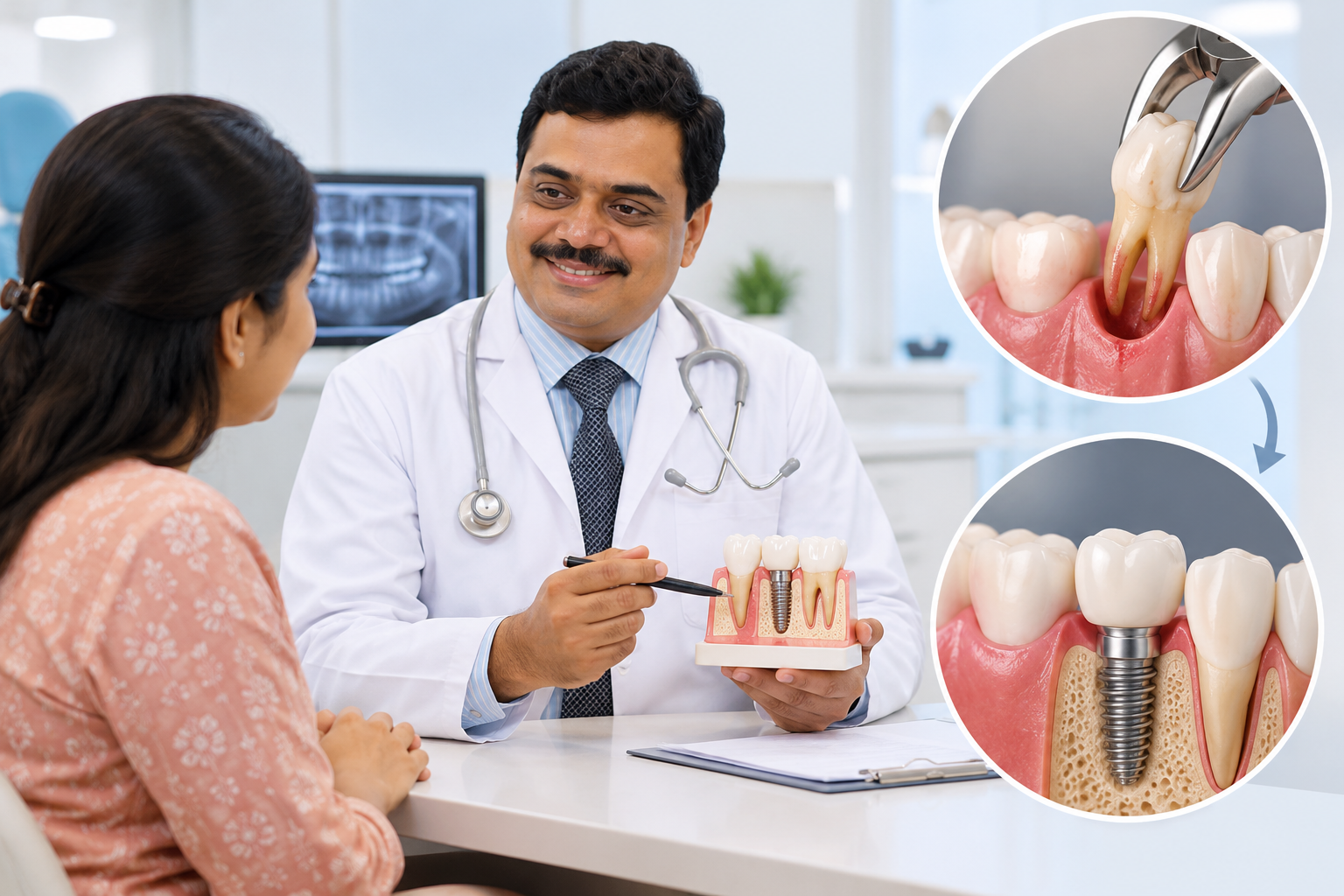
Dental Implant Right After Extraction Or Wait Three Months? Choosing The Timing At Our Adajan Clinic
<style type="text/css"> </style> An implant can be placed on the same day as the extraction when the socket walls are intact, there is no active infection and the implant can be fixed firmly. When bone is thin, the tooth was infected or it is a large molar, dentists usually wait 8 to 12 weeks, sometimes with a bone graft.
Losing a tooth can affect chewing, speech and confidence. Dental implants offer a fixed tooth-replacement option, but one common question is whether the implant should be placed immediately after extraction or after the area has healed.
Some patients can have an implant placed during the same appointment as tooth removal. Others may need to wait several weeks or months.
Neither approach is automatically better.
The important factors are bone availability, infection control, gum health, implant stability and the position of the missing tooth.
What Is the Difference Between Immediate, Early and Delayed Dental Implants?
Dental implant timing is commonly classified according to how much healing has occurred after extraction.
The International Team for Implantology (ITI) describes different placement timings, including immediate placement into a fresh extraction socket, early placement after soft-tissue or partial bone healing, and late placement after more complete socket healing.
1. Immediate Dental Implant Placement
An immediate implant is inserted during the same surgical appointment as tooth extraction.
After carefully removing the damaged tooth, the dentist evaluates the socket and prepares the bone for implant placement.
This option may be considered when:
-
The socket anatomy is suitable.
-
Sufficient bone is available for implant stability.
-
The implant can be positioned correctly.
-
Infection can be adequately managed.
-
The surrounding tissues are suitable.
-
The patient has no uncontrolled medical risks.
Immediate placement can reduce the number of separate surgical stages, but it does not guarantee faster delivery of the final crown.
Important: Immediate implant placement and receiving a fixed tooth on the same day are two different things.
2. Early Dental Implant Placement
Early placement allows some healing before the implant is inserted.
Two commonly recognised early-placement windows are:
-
Approximately 4–8 weeks: After soft-tissue healing.
-
Approximately 12–16 weeks: After partial bone healing.
An early approach may be preferred when soft-tissue healing, infection resolution or improved site conditions are desirable before implant placement.
3. Delayed Dental Implant Placement
Delayed placement generally takes place after more complete healing, often around six months or later under the ITI classification.
In everyday clinical practice, the term delayed is also sometimes used more broadly for implants placed several months after extraction.
A longer waiting period may be necessary when substantial bone reconstruction, infection management or other treatment is required.
Immediate vs Early vs Delayed Dental Implants: Comparison Table
| Implant timing | Ideal situation | When it may not be suitable | Typical appointments* | Estimated time to final tooth* |
|---|---|---|---|---|
| Immediate: extraction day | Suitable socket, adequate bone and strong primary stability | Unfavourable socket anatomy, inadequate stability or uncontrolled infection | Approximately 4–6 | Often 3–6 months |
| Early: 4–8 weeks | Soft-tissue healing is beneficial before implant placement | Significant unresolved infection or bone deficiency | Approximately 5–7 | Often 4–7 months |
| Early: 12–16 weeks | Partial bone healing is preferred | Site still requires additional reconstruction | Approximately 5–7 | Often 5–8 months |
| Later placement: around 6 months or more | Extensive healing or reconstruction is required | Remaining bone may still be inadequate without grafting | Approximately 5–8 or more | Often 8–12 months or longer |
Appointment counts and timelines are illustrative estimates, not fixed clinical schedules. They depend on investigations, extraction complexity, grafting, implant stability, healing and the final restoration.
The appropriate option is determined by the condition of the extraction site, not simply by how quickly a patient wants the replacement tooth.
Which Factors Decide If an Implant Can Be Placed on Extraction Day?
Before recommending an immediate dental implant after tooth extraction, the dentist assesses several important factors.
1. Condition of the Extraction Socket
The extraction socket is the space left behind after tooth removal.
Its surrounding bone walls help determine whether an implant can be positioned appropriately.
If the socket walls are intact, immediate placement may be technically more favourable.
If there is extensive bone damage, additional treatment may be necessary.
2. Available Bone
Dental implants require adequate bone for support.
The dentist evaluates:
-
Bone height
-
Bone width
-
Bone quality
-
Distance from important anatomical structures
-
The planned implant position
A dental CBCT scan may be recommended when three-dimensional assessment is necessary.
3. Primary Implant Stability
Primary stability means the implant is mechanically stable when first inserted.
This is one of the most important requirements for immediate placement.
If adequate stability cannot be achieved, the dentist may postpone placement or change the treatment plan.
4. Infection Around the Tooth
An infected tooth does not automatically rule out immediate implant placement.
However, the infection must be assessed carefully.
The dentist considers:
-
Whether infection is acute or chronic
-
The amount of bone destruction
-
Whether infected tissue can be thoroughly removed
-
Whether the implant can be stabilised in suitable bone
-
The patient's overall health
Uncontrolled or spreading infection may require treatment before implant placement.
5. Gum and Soft-Tissue Health
Healthy surrounding tissues help support wound healing and long-term implant maintenance.
Active periodontal disease, poor oral hygiene or significant tissue defects may need treatment first.
6. Smoking and Medical Conditions
Smoking increases the risk of impaired healing and implant complications.
Poorly controlled diabetes and certain other medical conditions can also increase treatment risks.
These factors do not always prevent implant treatment, but they can influence the timing and overall plan.
Is an Immediate Implant Riskier for Molars and Infected Teeth?
A dental implant after molar extraction often requires more complex planning than replacing a single-rooted front tooth.
Molars usually have multiple roots and larger extraction sockets.
After removal, the remaining socket may not match the shape or dimensions of the implant.
Why Are Molar Implants More Challenging?
The dentist must assess:
-
The size of the extraction socket
-
Bone between the original roots
-
Bone around the outer socket walls
-
Available bone beyond the socket
-
Distance from the sinus or mandibular nerve
-
The ability to achieve implant stability
Some molar sites are suitable for immediate implants.
Others require healing or bone grafting before implant placement.
Can an Implant Be Placed After Removing an Infected Tooth?
Sometimes, yes.
Selected sites with a history of infection may be suitable for immediate placement after careful extraction, debridement and assessment.
However, infection can damage the surrounding bone and compromise implant stability.
An active spreading infection or an inability to clean the site adequately may make immediate placement inappropriate.
The safest timing depends on the condition of the socket and surrounding tissues, not merely on whether the tooth previously had an infection.
How Many Visits Does Each Implant Timing Need?
Patients often assume that a same-day implant means the entire treatment is completed in one appointment.
In most cases, that is not correct.
Immediate Implant: Example Visit Plan
Visit 1: Consultation and Imaging
The dentist examines the tooth, gums and bone.
X-rays or CBCT imaging may be recommended.
Visit 2: Extraction and Implant Placement
The damaged tooth is removed, the socket is evaluated and the implant is placed if conditions are suitable.
A temporary tooth may be provided in selected cases.
Visit 3: Healing Review
The dentist checks healing and implant stability.
Visit 4: Impression or Digital Scan
Once the implant is ready for restoration, measurements are taken for the final crown.
Visit 5: Final Crown Placement
The permanent crown is fitted and adjusted.
Additional appointments may be required.
Early or Delayed Implant: Example Visit Plan
The treatment may involve:
-
Initial consultation and imaging
-
Tooth extraction
-
Healing assessment
-
Implant placement
-
Postoperative review
-
Impression or digital scan
-
Final crown placement
The number of visits may increase if bone grafting, gum treatment or other procedures are required.
Patients considering dental implant treatment should ask for a personalised appointment schedule before starting.
What Happens If Bone Grafting Is Required?
A bone graft before implant placement may be recommended when the extraction site does not have sufficient bone to support an implant in the desired position.
Bone grafting aims to preserve or rebuild bone volume.
When Might a Bone Graft Be Needed?
Common situations include:
-
Thin bone around the extraction socket
-
Damaged socket walls
-
Bone loss caused by periodontal disease
-
Bone destruction associated with infection
-
Long-standing missing teeth
-
Insufficient bone for correct implant positioning
Can Bone Grafting Be Done With Immediate Implant Placement?
Yes, in selected cases.
A dentist may place an implant and graft a gap or localised bone defect during the same appointment.
However, when the bone deficiency is extensive, staged reconstruction may be more appropriate.
Does Bone Grafting Increase Treatment Time?
It can.
Some grafting procedures are performed at the same time as implant placement, while others require several months of healing before the implant can be inserted.
The healing period depends on the type and extent of grafting.
Is Bone Grafting Always Necessary?
No.
Many patients have adequate natural bone for implant placement.
Grafting is recommended according to anatomical requirements rather than as a routine part of every implant procedure.
Dental Implant in Adajan Surat: How Is the Right Timing Decided?
Patients considering a dental implant in adajan surat should undergo a clinical assessment before choosing immediate or delayed placement.
The dentist needs to evaluate the tooth, extraction socket, gum health and available bone.
At Elegance Clinic, patients can enquire about dental consultations and the assessment needed for tooth replacement. Dr. Ashutosh Shah is associated with the clinic's plastic and cosmetic surgery services; implant suitability and treatment planning should be confirmed with the appropriately qualified treating dental surgeon.
Dental Implant Timing Checklist
| Assessment | Favourable for immediate placement | May require waiting or additional treatment |
|---|---|---|
| Socket walls | Adequate supporting bone | Significant socket damage |
| Bone availability | Sufficient bone for correct implant positioning | Thin or deficient bone |
| Primary stability | Strong initial implant stability achievable | Implant cannot be stabilised |
| Infection | Infection controlled and site suitable after debridement | Uncontrolled or spreading infection |
| Gum health | Healthy or manageable surrounding tissues | Active periodontal disease |
| Smoking | Non-smoker or risks appropriately managed | Ongoing smoking with elevated healing risk |
| Diabetes | Adequate glycaemic control | Poorly controlled blood glucose |
| Patient expectations | Understands staged healing and restoration | Expects guaranteed same-day permanent teeth |
A consultation should explain the available options, treatment stages, estimated visits, potential complications and expected recovery.
Patients can check the Adajan clinic location before arranging an appointment.
Can You Get a Temporary Tooth on the Same Day?
Some patients can receive a temporary restoration when an implant is placed.
This is called immediate provisionalisation.
However, it is not suitable for every implant.
The dentist must consider:
-
Initial implant stability
-
Implant position
-
Bite forces
-
Bone quality
-
Whether the temporary restoration can be protected from excessive loading
A temporary crown may be designed mainly for appearance and kept out of heavy biting contact.
Is the Temporary Tooth the Final Crown?
Usually not.
The final crown is generally fitted after the implant has integrated sufficiently with the surrounding bone.
This biological process is called osseointegration.
Immediate placement does not eliminate the need for healing.
What Happens If You Wait Too Long After Tooth Extraction?
After tooth extraction, the surrounding jawbone gradually changes.
The ridge may become narrower or shorter because it no longer supports a natural tooth root.
This process is called alveolar ridge resorption.
Waiting does not necessarily mean an implant becomes impossible.
However, prolonged tooth loss can sometimes increase the need for:
-
Bone grafting
-
Additional imaging
-
More complex implant planning
-
Alternative restorative procedures
The amount of bone loss varies between patients.
If implant placement is planned for a later date, the dentist may discuss socket preservation at the time of extraction.
What If an Implant Is Not Suitable?
Dental implants are not the only tooth-replacement option.
Depending on the condition of adjacent teeth and the patient's preferences, a dental bridge or removable denture may be considered.
The guide to implant, bridge or denture compared explains these alternatives.
What Are the Risks of Immediate Dental Implant Placement?
Immediate implant placement can be successful in appropriately selected patients, but complications remain possible.
Potential risks include:
-
Infection
-
Implant failure
-
Inadequate osseointegration
-
Gum recession
-
Bone loss
-
Implant malposition
-
Damage to nearby structures
-
Aesthetic complications
-
Need for additional grafting or surgery
Placing an implant immediately does not guarantee a better outcome than waiting.
Similarly, delayed placement is not automatically safer in every case.
The treatment should be selected according to the clinical findings and the experience of the treating dental surgeon.
For additional patient information, visit the clinic's dental implant FAQs.
Key Takeaways
-
An immediate dental implant after tooth extraction is placed during the same appointment as tooth removal.
-
Immediate placement requires suitable bone, appropriate implant positioning and adequate primary stability.
-
Early implant placement may occur after approximately 4–8 weeks or 12–16 weeks of healing.
-
Later placement may be necessary when more extensive healing or reconstruction is required.
-
Infected teeth do not automatically rule out immediate placement, but infection must be carefully managed.
-
Molar implants often require additional planning because of their complex root anatomy.
-
Bone grafting is not necessary for every patient.
-
Same-day implant placement does not always mean receiving a same-day tooth.
-
Smoking, gum disease and poorly controlled diabetes can affect healing and implant outcomes.
-
The correct timing should be determined through clinical examination and appropriate imaging.
Conclusion: Should You Get an Immediate Implant or Wait?
An immediate dental implant after tooth extraction can be a suitable option when the extraction site has adequate bone and the implant can be placed with strong initial stability.
However, patients with damaged socket walls, significant bone deficiency or unfavourable healing conditions may benefit from early or delayed placement.
The goal is not simply to finish treatment quickly. It is to achieve a stable implant, healthy surrounding tissues and a functional replacement tooth.
A consultation with a qualified dental surgeon can help determine the appropriate timing, expected number of visits and whether additional procedures are necessary.