Eye Bags That Sleep Does Not Fix: When Lower Eyelid Surgery Is The Answer And When It Is Not
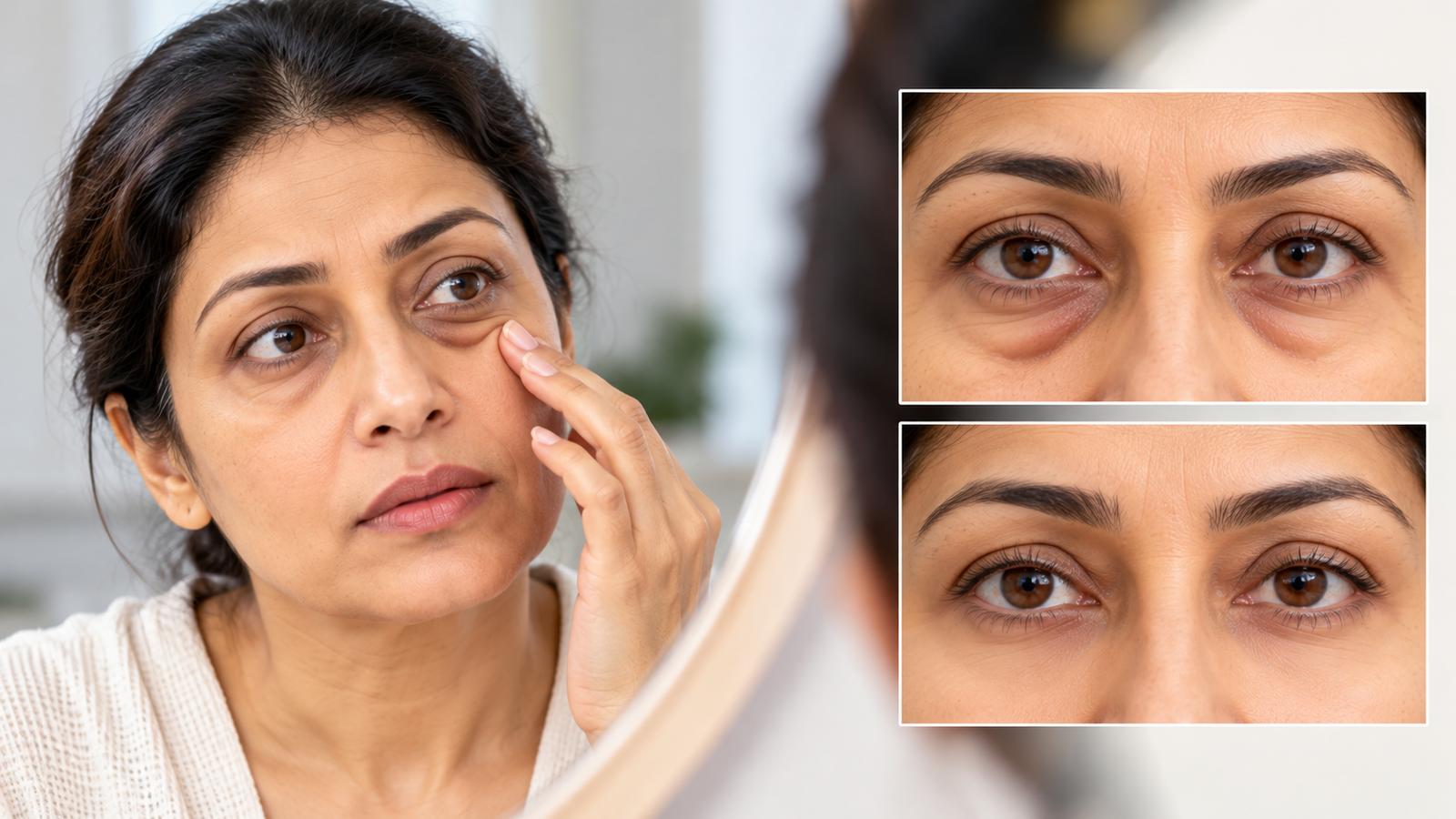
Under-eye bags that remain visible despite adequate sleep, reduced salt intake and skincare may result from fat pads protruding beneath the eyes rather than temporary fluid retention. Eye bags removal surgery, also called lower blepharoplasty, can correct selected fat-related bags. However, allergies, thyroid eye disease, hollow tear troughs and loose skin require different assessments and treatments.
Many people notice that their eyes look tired even when they feel rested. They try eye creams, cold compresses, facial massage and additional sleep, but the swelling beneath their eyes never completely disappears.
The reason is simple: not every under-eye bag has the same cause.
Some people have excess fluid, while others have prominent orbital fat, volume loss or ageing-related skin changes.
Understanding the cause helps determine whether surgery, non-surgical treatment or medical evaluation is appropriate.
Are Your Eye Bags Fat, Fluid, Hollowness or Loose Skin?
Before considering eye bags removal surgery, it is important to identify what is creating the under-eye appearance.
Four common causes can produce similar-looking concerns.
1. Protruding Fat Pads
The lower eyelids naturally contain fat compartments that help protect the eyes.
As supporting tissues weaken with age, these fat pads may become more prominent.
This can create a rounded bulge beneath the lower eyelid.
Common signs include:
-
Under-eye bags remain visible throughout the day.
-
The bulge persists even after adequate sleep.
-
Eye creams produce little improvement.
-
The lower eyelid appears rounded or swollen.
-
Similar changes may be present in family members.
Selected patients with prominent fat pads may benefit from lower blepharoplasty.
2. Fluid Retention and Temporary Puffiness
Fluid-related puffiness often changes throughout the day.
It may appear worse after waking and improve gradually.
Possible contributing factors include:
-
High salt intake
-
Inadequate sleep
-
Seasonal allergies
-
Nasal congestion
-
Certain medications
-
Medical conditions affecting fluid balance
Lower eyelid surgery is generally not the first treatment for fluid-related puffiness.
Persistent or unexplained swelling may require medical evaluation.
3. Hollow Tear Troughs
Some people have a deep groove between the lower eyelid and upper cheek.
This area is called the tear trough.
The hollow creates shadows that can make the eyes appear tired or make nearby fat pads look more prominent.
In these cases, removing fat may worsen the hollow appearance.
Carefully selected patients may benefit from volume restoration, fat repositioning or other approaches.
4. Loose or Crepey Lower-Eyelid Skin
Ageing, sun exposure and reduced skin elasticity can cause fine wrinkles and loose skin.
These changes may occur without prominent fat bags.
Treatment depends on the amount of skin laxity, lower-eyelid support and associated facial changes.
Under-Eye Bags Self-Check Table
| Under-eye sign | Possible cause | Who should assess it? | Is surgery helpful? |
|---|---|---|---|
| Puffiness worse in the morning | Fluid retention or allergies | Physician or appropriate specialist | Usually not the first option |
| Bulge remains the same all day | Prominent orbital fat | Qualified eyelid or plastic surgeon | Often helpful in suitable candidates |
| Deep hollow groove | Tear trough volume loss | Qualified facial aesthetic specialist | Fat repositioning or volume correction may help |
| Fine wrinkles and crepey skin | Skin laxity | Dermatologist or plastic surgeon | Depends on severity |
| Swelling on one side only | Several possible medical or anatomical causes | Physician or ophthalmologist | Only after diagnosis |
| Redness, pain or sudden swelling | Infection, inflammation or another urgent condition | Urgent medical or eye assessment | Cosmetic surgery is not appropriate initially |
Important: This table is a screening guide, not a diagnosis. Eye bags can involve several causes simultaneously.
Why Do Creams and Massage Not Shift Fat Bags?
A common question is whether eye bags removal cream vs surgery produces better results.
The answer depends on what is causing the bags.
What Eye Creams Can Improve
Eye creams may temporarily improve:
-
Skin hydration
-
Fine lines caused by dryness
-
The appearance of mild puffiness
-
Certain pigmentation concerns
-
Skin texture
Products containing caffeine may temporarily reduce the appearance of some fluid-related swelling.
Retinoids and other skincare ingredients may improve selected skin-quality concerns when used appropriately.
However, creams cannot remove or permanently reposition protruding orbital fat.
Can Cold Compresses Help?
Cold compresses may temporarily reduce mild swelling.
They can be useful for occasional puffiness, but they do not correct the anatomical position of fat pads.
Avoid applying ice directly to the eyelid skin.
Does Under-Eye Massage Remove Bags?
Gentle massage may temporarily affect fluid movement, but it cannot remove orbital fat.
Aggressive rubbing or massage can irritate delicate eyelid tissues.
When Is Surgery More Appropriate?
When persistent bags result primarily from prominent fat pads, lower blepharoplasty may offer a more meaningful correction than creams.
However, patients should undergo an examination before assuming that every under-eye bulge requires fat removal.
How Is Lower Eyelid Surgery Done and Where Is the Scar?
Lower blepharoplasty is a surgical procedure designed to improve selected concerns involving lower-eyelid fat, skin or both.
The surgeon may remove, reposition or redistribute fat depending on the patient's anatomy.
Two common approaches are used.
1. Transconjunctival Lower Blepharoplasty
A transconjunctival approach places the incision on the inner surface of the lower eyelid.
This allows the surgeon to access the fat compartments without creating an external skin incision.
Potential advantages include:
-
No external skin incision
-
Access to prominent fat pads
-
Preservation of the outer eyelid skin
-
Suitability for selected patients with good skin elasticity
However, the technique does not directly remove significant excess lower-eyelid skin.
It also carries surgical risks, including bleeding, swelling, asymmetry and injury to surrounding structures.
Does Transconjunctival Blepharoplasty Leave a Scar?
A transconjunctival blepharoplasty scar is located inside the lower eyelid.
There is no external skin-incision scar from this approach.
However, internal tissue healing still occurs, and the absence of an external incision does not eliminate surgical risks.
2. Transcutaneous Lower Blepharoplasty
A transcutaneous approach uses an incision just beneath the lower eyelashes.
It allows the surgeon to address selected combinations of:
-
Prominent fat pads
-
Excess lower-eyelid skin
-
Skin laxity
-
Certain eyelid contour concerns
The resulting scar is usually positioned close to the lash line.
Its visibility depends on healing, skin characteristics and surgical technique.
This approach requires careful evaluation of lower-eyelid support because excessive skin removal or scarring can contribute to eyelid malposition.
Patients considering eyelid lift surgery should discuss which incision is appropriate for their anatomy.
Is Fat Always Removed?
No.
Modern lower-eyelid surgery may involve fat repositioning rather than simply removing fat.
This can be particularly important when a patient has both protruding fat and a hollow tear trough.
Removing too much fat can produce a sunken appearance.
The surgical plan should aim to improve the transition between the lower eyelid and cheek while preserving natural facial proportions.
What Should You Know Before Lower Eyelid Surgery?
Before choosing lower blepharoplasty, patients should understand the available surgical techniques, incision placement, anaesthesia options, recovery time and possible complications.
The appropriate procedure depends on whether the concern involves protruding fat, loose skin, tear trough hollowness or a combination of these changes.
For more information about surgical preparation, recovery and common patient concerns, read our eyelid surgery FAQs.
Discuss any remaining questions with your surgeon before deciding on treatment.
Who Is a Suitable Candidate for Eye Bags Removal Surgery?
A suitable lower blepharoplasty candidate generally has a clearly identified anatomical concern that surgery can reasonably improve.
Possible candidates include people who:
-
Have persistent protruding lower-eyelid fat
-
Have realistic expectations
-
Are in suitable general health
-
Have adequate lower-eyelid support
-
Understand the potential complications
-
Can follow postoperative care instructions
Age alone does not determine eligibility.
Some younger adults develop prominent fat pads because of inherited anatomy, while others experience changes later in life.
What Does the Surgeon Check Before Surgery?
A proper assessment should include more than looking at photographs.
Important checks may include:
1. Medical and thyroid history
Thyroid eye disease can cause swelling, eye prominence and eyelid changes. Suspected thyroid eye disease requires appropriate medical or ophthalmic evaluation.
2. Dry-eye screening
Dry eyes, incomplete eyelid closure or previous eye surgery may influence the safety and choice of procedure.
3. Lower-eyelid snap test
The clinician gently assesses how quickly the lower eyelid returns to its normal position after being pulled away from the eye.
This helps assess eyelid laxity, although it is only one part of the examination.
4. Eyelid position and support
The surgeon checks lower-eyelid tone, position, facial symmetry and the relationship between the eyelid and cheek.
5. Fat prominence and tear troughs
The examination determines whether fat removal, fat repositioning, skin treatment or another approach is more appropriate.
Who Should Not Have Lower Blepharoplasty?
Eye bags removal surgery may be unsuitable or require additional precautions for certain patients.
Patients With Untreated Medical Causes of Swelling
Allergies, thyroid eye disease, inflammation and systemic causes of fluid retention should be assessed before cosmetic treatment.
Surgery will not correct these underlying problems.
Patients With Significant Dry Eyes
Lower-eyelid surgery can worsen eye dryness in some patients.
A detailed eye assessment may be necessary before treatment.
Patients With Poor Lower-Eyelid Support
Weak eyelid support increases the risk of postoperative eyelid malposition.
The surgeon may recommend additional support procedures or a different treatment plan.
Patients With Unrealistic Expectations
Lower blepharoplasty cannot guarantee perfect symmetry, eliminate every wrinkle or stop facial ageing.
It also cannot correct every form of under-eye darkness.
Patients With Uncontrolled Medical Conditions
Certain medical conditions, active infections and medications may increase the risks of bleeding or poor healing.
Surgical planning should account for these factors.
What Are the Risks of Lower Eyelid Surgery?
Like every surgical procedure, lower blepharoplasty carries possible complications.
These may include:
-
Swelling and bruising
-
Bleeding or infection
-
Temporary blurred vision or eye irritation
-
Dryness and difficulty closing the eyes
-
Asymmetry or contour irregularities
-
Overcorrection or undercorrection
-
Visible scarring with external incisions
-
Lower-eyelid retraction or ectropion
-
Persistent swelling
-
Need for revision surgery
Rare but serious complications include bleeding behind the eye, which can threaten vision.
Seek emergency medical care immediately if you develop sudden vision loss, severe eye pain, rapidly increasing swelling or significant visual changes after surgery.
A surgeon should discuss these risks and the steps taken to reduce them before obtaining consent.
What Does Recovery Look Like Week by Week?
Recovery varies according to the technique, the amount of correction and individual healing.
The following timeline provides general expectations rather than a guaranteed schedule.
Lower Blepharoplasty Recovery Timeline
| Recovery period | What you may notice | Recommended precautions |
|---|---|---|
| Days 1–3 | Swelling, bruising, tightness and mild discomfort | Rest, follow prescribed eye care, keep head elevated as advised |
| Days 4–7 | Bruising and swelling may begin improving | Avoid rubbing eyes and follow wound-care instructions |
| Week 2 | Many patients feel comfortable resuming routine social activities | Attend follow-up and confirm activity restrictions |
| Weeks 3–4 | Residual swelling continues to settle | Resume exercise only with surgeon approval |
| Weeks 4–6 | Eyelid contour becomes clearer | Continue protecting healing tissues |
| Months 2–3 and beyond | Subtle swelling and scar maturation continue | Review results and any persistent symptoms |
When Can You Return to Work?
Many patients return to desk-based work within approximately 7–14 days.
Some may return earlier, while others need additional time.
Jobs involving physical exertion, dust or eye strain may require different advice.
When Can You Wear Makeup?
Eye makeup should be avoided until the surgeon confirms that healing is adequate.
Applying products too early may irritate healing tissues or introduce infection.
How Long Does Bruising Last?
Bruising commonly improves over one to two weeks, although some patients experience a longer recovery.
Swelling may take several weeks or months to settle fully.
When Are Final Results Visible?
Early improvement may become apparent as bruising and swelling decrease.
The final contour can take several months to become clear.
Under Eye Bags Treatment Near Nana Varachha: When Should You Consult?
People searching for under eye bags treatment near nana varachha should first determine whether their concern comes from protruding fat, temporary puffiness, hollowness or loose skin.
A consultation is useful when:
-
Under-eye bags remain visible despite adequate rest.
-
The lower eyelid has a persistent bulge.
-
Creams provide little improvement.
-
A hollow groove makes the bags appear more noticeable.
-
Loose skin affects the lower-eyelid contour.
-
You want to understand whether surgery is necessary.
At Elegance Clinic, Dr. Ashutosh Shah, Plastic and Cosmetic Surgeon, can assess lower-eyelid anatomy, fat prominence, skin quality and facial proportions to discuss whether surgery or another treatment may be appropriate.
Patients should also discuss their medical history, dry-eye symptoms, expected recovery and possible complications.
For selected patients with volume-related concerns rather than true fat bags, under-eye filler options may be discussed.
You can also explore injectable treatments at our filler clinic for information about non-surgical facial rejuvenation.
Important: Under-eye filler is not suitable for every patient. It can cause persistent swelling, irregularities and rare but serious vascular complications, including vision loss.
Eye Bags Removal Cream vs Surgery: Which Actually Works?
The most effective treatment depends on the cause.
| Treatment | May help with | Main limitation |
|---|---|---|
| Eye cream | Dryness, fine lines, mild temporary puffiness | Cannot remove orbital fat |
| Cold compress | Temporary swelling | Does not correct persistent fat bags |
| Allergy management | Allergy-related puffiness | Does not correct anatomical fat prominence |
| Under-eye filler | Selected hollow tear troughs | Can worsen puffiness; serious injection risks |
| Skin treatments | Selected pigmentation and skin-texture concerns | Limited effect on protruding fat |
| Lower blepharoplasty | Selected persistent fat bags and associated contour concerns | Requires surgery and recovery; carries complications |
For patients seeking a permanent solution for eye bags, surgery may offer long-lasting improvement when prominent fat pads are the primary cause.
However, no treatment can guarantee that the lower-eyelid area will remain unchanged throughout life.
Key Takeaways
-
Persistent under-eye bags are not always caused by poor sleep.
-
Protruding orbital fat, fluid retention, hollowness and loose skin require different treatments.
-
Eye creams may improve skin quality or temporary puffiness but cannot remove orbital fat.
-
Eye bags removal surgery can improve selected persistent fat-related bags.
-
Transconjunctival lower blepharoplasty uses an internal eyelid incision.
-
Patients with significant excess skin may require a different surgical approach.
-
Thyroid history, dry-eye screening and lower-eyelid support assessment are important before surgery.
-
Recovery commonly involves one to two weeks of visible bruising, with swelling improving over a longer period.
-
Results can be long-lasting, but surgery does not stop ageing.
-
The correct treatment depends on identifying the cause rather than choosing surgery automatically.
Conclusion: When Is Lower Eyelid Surgery the Right Answer?
Lower eyelid surgery may be appropriate when persistent under-eye bags result primarily from prominent orbital fat and the patient has suitable eyelid anatomy and overall health.
However, surgery is not the correct answer for every tired-looking eye.
Fluid retention, allergies, thyroid-related changes, hollow tear troughs and loose skin may require different treatments.
The most important step before considering eye bags removal surgery is identifying the underlying cause.
A detailed assessment can help patients understand whether lower blepharoplasty, non-surgical treatment or further medical evaluation offers the most appropriate path.