
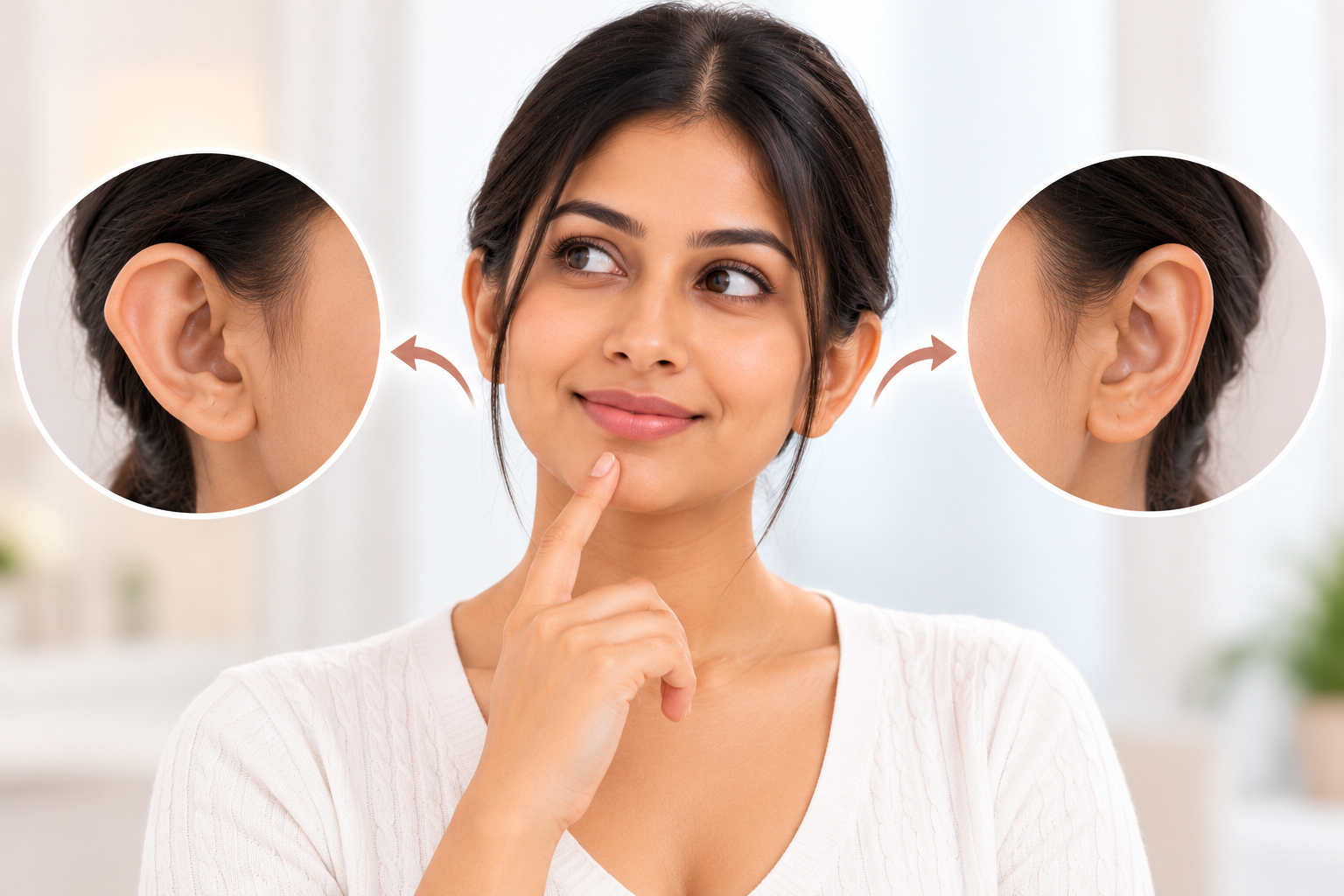
Uneven Ears: Can Size, Shape and Symmetry Be Fixed?
Ear asymmetry correction can improve differences in ear size, shape, projection or position through carefully planned otoplasty or reconstructive ear surgery. Minor differences between ears are normal, but noticeable asymmetry may be improved by reshaping cartilage, adjusting ear position or correcting specific structural differences. The goal is better balance, not perfectly identical ears.
Some people have one ear that sticks out more than the other. Others notice differences in ear folds, earlobe shape or overall ear size.
Understanding the cause of these differences helps determine whether surgery is appropriate.
What Causes Uneven or Asymmetrical Ears?
Ear asymmetry can develop naturally or result from injury, previous surgery or differences in cartilage development.
Common causes include:
-
Congenital differences: One ear may develop with a different shape or size.
-
Uneven cartilage folds: Differences in the antihelical fold can affect ear projection.
-
Prominent ears: One ear may extend farther from the head.
-
Trauma: Injury may change the cartilage structure or ear position.
-
Previous surgery: Earlier ear procedures may leave residual asymmetry.
-
Earlobe differences: One earlobe may be larger, longer or differently shaped.
Small differences are common and do not necessarily require treatment.
However, patients who are concerned about visible asymmetry may consider an assessment for facial cosmetic surgery.
Can Ear Asymmetry Be Corrected With Otoplasty?
Yes. Otoplasty can improve many types of external ear asymmetry, particularly differences involving ear projection, cartilage folds and position.
During ear asymmetry correction, the surgeon examines both ears to identify which structures contribute to the difference.
Treatment may involve:
-
Repositioning one or both ears closer to the head.
-
Creating or adjusting cartilage folds.
-
Reshaping selected areas of ear cartilage.
-
Correcting differences in ear projection.
-
Addressing certain earlobe irregularities.
Not every difference can be corrected with standard otoplasty. Major size differences or missing ear structures may require reconstructive procedures.
What Types of Uneven Ears Can Surgery Improve?
1. One Ear Sticks Out More Than the Other
This is a common reason patients consider ear correction.
One ear may have a deeper conchal bowl or a less developed antihelical fold, causing it to project outward.
Otoplasty can reposition the more prominent ear and improve overall balance.
2. Different Ear Shapes
Some people have ears with noticeably different upper curves, folds or cartilage contours.
Ear reshaping techniques may improve these differences by adjusting cartilage structure.
3. Unequal Ear Sizes
When one ear is significantly larger than the other, treatment may involve selected cartilage or skin reduction techniques.
However, substantial size differences cannot always be corrected with conventional otoplasty alone.
4. Uneven Earlobes
Earlobe asymmetry may result from natural development, ageing, stretched piercings or previous injury.
Depending on the concern, earlobe repair or reshaping may be considered.
5. Asymmetry After Ear Injury
Trauma can cause cartilage irregularities, scar tissue or changes in ear contour.
Reconstructive treatment may be necessary when the normal ear structure has been damaged.
Can Both Ears Be Made Exactly the Same Size and Shape?
No surgical procedure can guarantee perfectly identical ears.
Natural ears are rarely completely symmetrical, even in people who have never undergone surgery.
The goal of ear asymmetry correction is to reduce noticeable differences while maintaining natural ear contours.
|
Ear Concern |
Possible Surgical Improvement |
Important Limitation |
|---|---|---|
|
One ear protrudes more |
Ear repositioning |
Minor projection differences may remain |
|
Unequal cartilage folds |
Cartilage reshaping |
Exact fold matching is not guaranteed |
|
Different ear sizes |
Selected reduction or reconstruction |
Major differences may need complex surgery |
|
Uneven earlobes |
Earlobe reshaping |
Small contour differences may remain |
|
Previous surgical asymmetry |
Revision otoplasty |
Scar tissue may limit correction |
Patients should discuss realistic expectations before undergoing surgery.
How Is Ear Asymmetry Correction Surgery Performed?
The surgical approach depends on the type and severity of asymmetry.
Step 1: Ear Examination
The surgeon assesses ear height, width, projection, cartilage folds and the relationship between the ears and head.
Measurements and clinical photographs may help with planning.
Step 2: Surgical Planning
The surgeon determines whether one ear or both ears require treatment.
In some cases, correcting only the more prominent ear may improve balance.
Step 3: Anaesthesia
Otoplasty may be performed under local anaesthesia with or without sedation, or general anaesthesia, depending on patient age and procedure complexity.
Step 4: Cartilage Adjustment
The surgeon may reshape cartilage, create folds, reposition the ear or remove selected excess tissue.
Step 5: Incision Closure
Incisions are commonly placed behind the ears where practical, although some reconstructive techniques require other incision locations.
Step 6: Protective Dressing
A dressing may be applied to protect the ears during early healing.
The procedure may take approximately one to three hours for standard otoplasty, while complex reconstruction can take longer.
Is Ear Reshaping Surgery Suitable for Adults and Children?
Ear reshaping can be considered for both children and adults, but the timing and indications differ.
Ear Correction in Children
Otoplasty is often considered from around five or six years of age, when the ears have reached much of their adult size.
However, the appropriate timing depends on ear development, the child's wishes and the specific concern.
Ear Correction in Adults
Adults may undergo ear reshaping at many ages if they are medically suitable.
Cartilage may become firmer with age, but this does not automatically prevent correction.
There is no fixed upper age limit for otoplasty.
Can Ear Asymmetry Be Corrected Without Surgery?
Nonsurgical options are limited, especially after ear cartilage has matured.
For newborns with selected ear deformities, ear moulding may help reshape soft cartilage when started early.
However, ear moulding is generally not effective for reshaping mature adult cartilage.
Hairstyling or accessories may make mild asymmetry less noticeable, but they do not change the ear's structure.
For persistent structural differences in older children or adults, surgery may be the main corrective option.
How Long Does Recovery Take After Uneven Ears Surgery?
Recovery varies according to the surgical technique and whether one or both ears are treated.
|
Recovery Period |
Expected Changes |
|---|---|
|
First 2–3 days |
Swelling, tenderness and protective dressing |
|
First week |
Early swelling and discomfort begin improving |
|
1–2 weeks |
Many patients resume desk-based work or school |
|
3–4 weeks |
Ear swelling and sensitivity continue decreasing |
|
4–6 weeks |
Gradual return to additional physical activities with approval |
|
Following months |
Ear contours and scars continue settling |
Patients may be advised to wear a protective headband at night for several weeks.
Avoid sleeping directly on the operated ear or participating in contact sports until cleared by the surgeon.
Will Ear Asymmetry Correction Leave Scars?
Otoplasty usually involves surgical incisions, so some scarring is unavoidable.
For common ear pinning techniques, incisions are often placed behind the ears to reduce their visibility.
Scar appearance depends on:
-
Incision location
-
Skin characteristics
-
Individual healing
-
Surgical technique
-
Infection or wound complications
-
Postoperative care
Some scars may remain noticeable, particularly after complex reconstructive procedures.
What Are the Risks of Ear Asymmetry Correction?
Like other surgical procedures, ear asymmetry correction has potential risks.
These include:
-
Bleeding or haematoma
-
Infection
-
Persistent swelling
-
Visible scarring
-
Cartilage irregularities
-
Overcorrection or undercorrection
-
Persistent ear asymmetry
-
Temporary or lasting numbness
-
Suture-related complications
-
Recurrence of ear prominence
-
Need for revision surgery
Patients should discuss these risks with a qualified surgeon before making a treatment decision.
Can Otoplasty Be Combined With Other Facial Cosmetic Procedures?
Some patients considering ear correction may also have concerns about facial balance or other facial features.
In selected cases, otoplasty may be discussed alongside other procedures, such as:
-
Eyelid surgery
-
Facial fat grafting
-
Facial contouring procedures
-
Other reconstructive or cosmetic facial surgery
However, ear asymmetry does not automatically mean that other facial procedures are necessary.
Treatment should be based on individual anatomy and patient goals.
How Much Does Ear Asymmetry Correction Cost?
The cost of ear reshaping surgery varies according to:
-
Type of ear asymmetry
-
Whether one or both ears require correction
-
Surgical complexity
-
Anaesthesia requirements
-
Facility charges
-
Surgeon fees
-
Follow-up requirements
-
Whether revision surgery is needed
Simple ear pinning and complex reconstructive ear surgery can have different costs.
An accurate estimate requires an examination and personalised treatment plan.
Who Is a Good Candidate for Ear Asymmetry Correction?
Suitable candidates may include individuals who:
-
Have noticeable differences in ear projection, shape or size
-
Are concerned about their ear appearance
-
Have realistic expectations about symmetry
-
Are medically suitable for surgery
-
Understand the potential risks
-
Can follow postoperative care instructions
Not everyone with uneven ears needs treatment.
Minor differences are normal and may not require any medical intervention.
Ear Asymmetry Correction Consultation With Dr. Ashutosh Shah
At Elegance Clinic, Dr. Ashutosh Shah evaluates patients concerned about uneven ear size, shape or position. The consultation includes assessment of ear cartilage, projection, symmetry and individual treatment goals. Patients considering ear asymmetry correction can discuss whether otoplasty, ear reshaping or reconstructive treatment may be appropriate, along with expected improvements, surgical risks and recovery requirements.
Conclusion
Ear asymmetry correction can improve noticeable differences in ear size, shape, projection and position.
Otoplasty and reconstructive ear surgery may help create better balance, although perfectly identical ears are not a realistic surgical guarantee.
The appropriate treatment depends on ear anatomy, the degree of asymmetry, medical suitability and personal expectations.
For more information about ear reshaping and facial cosmetic procedures, visit Elegance Face Makeover.