
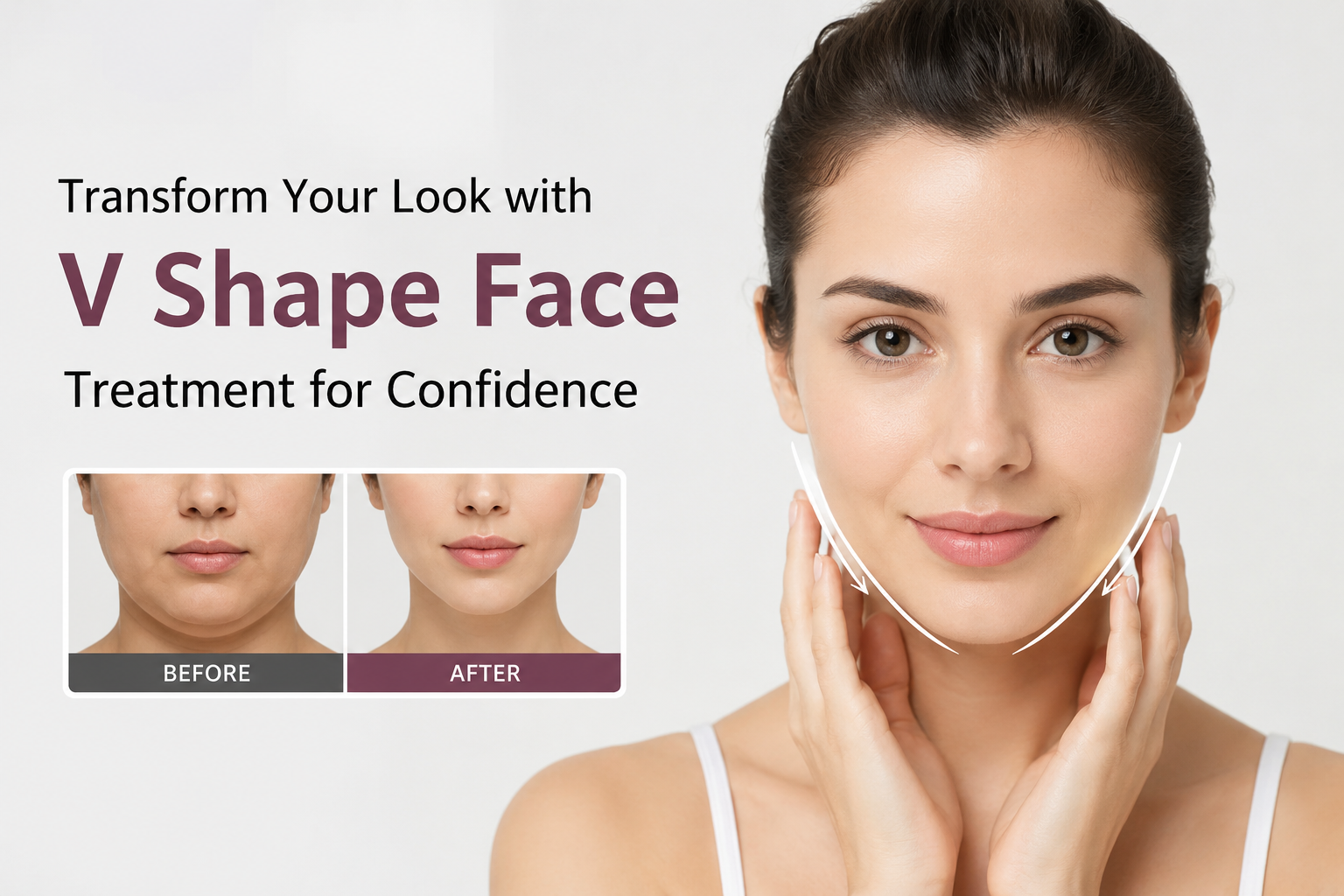
V-Shape Face: Is It Your Jaw Muscle, Fat Or Bone, And Which Treatment Matches Each
A V-shape face treatment only works when it targets the actual cause of a wide lower face. Enlarged masseter muscles respond to Botox, excess fat to injection lipolysis or facial liposuction, a weak chin to chin augmentation, and wide jaw or cheekbones to bone surgery. Clenching tests and pinch tests during the consultation tell these apart.
A V-shaped face generally has a narrower lower facial contour with a balanced chin and jawline. However, not everyone has the same facial structure.
Some people have a round face because of excess facial fat. Others have prominent jaw muscles, a broad jawbone or a small chin that makes the lower face appear wider.
Choosing the wrong treatment can produce disappointing results or unwanted changes in facial proportions.
Understanding the cause of facial width is therefore the first step toward selecting a suitable treatment.
What Makes a Lower Face Look Wide or Round?
A wide or rounded lower face can result from several anatomical factors.
1. Enlarged Masseter Muscles
The masseter muscles are located on both sides of the jaw and help with chewing.
Some people naturally have larger masseter muscles. Others may develop increased muscle prominence associated with frequent clenching or teeth grinding.
Common signs include:
-
A square appearance near the jaw angles
-
Prominent muscles when clenching the teeth
-
A wider lower face despite relatively low facial fat
-
Firm tissue along the sides of the jaw
When muscle enlargement is the main cause, reducing masseter activity may help create a slimmer lower-face appearance.
2. Excess Facial Fat
Fat deposits around the cheeks, lower face and beneath the chin can make the face appear rounder.
Common signs include:
-
Soft, pinchable fullness around the lower cheeks
-
A less defined jawline
-
Fullness that may change with body weight
-
Fat beneath the chin
However, not all facial fat should be removed.
Excessive fat reduction can create hollow cheeks or make age-related volume loss more noticeable.
3. Wide Jawbone
The shape of the mandible contributes significantly to facial width.
Some people naturally have prominent jaw angles or a broad lower jaw.
Signs may include:
-
A wide lower face even when the masseter muscles are relaxed
-
Firm bony prominence along the jaw angles
-
Limited changes in width after weight loss
-
Skeletal width confirmed through examination or imaging
Botox and fat-reduction procedures cannot physically narrow the jawbone.
4. Small or Recessed Chin
A weak chin may make the face appear round or less defined even when the jaw itself is not excessively wide.
In selected patients, improving chin projection can create a more balanced facial outline without reducing facial width.
This is why facial proportions must be evaluated together rather than treating the jawline in isolation.
How Does a Doctor Tell Muscle From Fat From Bone?
Before recommending a v shape face treatment, the doctor should identify the anatomical source of facial width.
A structured consultation may include three simple clinical assessments.
Test 1: Clench and Palpation Test for Masseter Muscle
The patient is asked to gently clench their teeth while the doctor examines the muscles near the jaw angles.
If the masseter muscles become noticeably prominent during clenching, muscle enlargement may contribute to facial width.
The doctor may also assess:
-
Muscle size on both sides
-
Facial symmetry
-
Jaw movement
-
Teeth grinding or clenching history
-
Temporomandibular joint symptoms
This examination helps determine whether masseter-targeted treatment may be appropriate.
However, clenching alone does not establish that muscle enlargement is the only cause.
Test 2: Soft-Tissue Examination for Facial Fat
The doctor gently examines the fullness around the lower cheeks and jawline.
A pinch test can help assess superficial soft tissue, but it cannot reliably measure every deep facial fat compartment.
The assessment considers:
-
Skin thickness
-
Fat distribution
-
Skin elasticity
-
Existing facial hollowness
-
Changes associated with weight
-
Whether the fullness is superficial or deeper
This helps determine whether a fat-reduction procedure is likely to improve facial contour.
Test 3: Profile and Skeletal Assessment
The doctor examines facial proportions from the front, side and three-quarter views.
Important features include:
-
Chin projection
-
Jaw angle prominence
-
Lower facial width
-
Cheekbone projection
-
Facial symmetry
-
Dental and jaw relationships
Imaging may be recommended if skeletal surgery is being considered.
A wide jawbone should not be treated as if it were simply excess fat or muscle.
Why Are All Three Tests Important?
A patient may have more than one cause of facial width.
For example, someone may have enlarged masseter muscles, mild lower-cheek fullness and a relatively small chin.
Treating only one feature may provide limited improvement.
The purpose of the consultation is to identify which anatomical changes are responsible and whether treatment is necessary.
Which V-Shape Face Treatment Matches Each Cause?
There is no single treatment that creates the same result for every face.
The following comparison explains the main options and their limitations.
Cause-to-Treatment Comparison Table
| Cause | How it is assessed | Possible treatment | Sessions | Expected longevity | Main limitation |
|---|---|---|---|---|---|
| Enlarged masseter muscle | Clench and palpation | Masseter Botox | Usually one treatment session, reassessed later | Often around 3–6 months | Does not narrow bone |
| Localised facial fat | Soft-tissue assessment | Selected injectable fat reduction or liposuction | Variable; surgery generally one procedure | Fat reduction may be lasting, but weight and ageing affect contour | Does not correct muscle or bone |
| Double-chin fat | Submental examination | Selected fat-reduction procedures | Varies by technique | Depends on treatment | Skin laxity may remain |
| Small or recessed chin | Facial profile assessment | Chin filler or implant | Filler often one session; implant one operation | Filler temporary; implant long-lasting | Does not reduce jaw width |
| Wide jawbone | Skeletal examination and imaging when indicated | Jaw contouring surgery | Usually one operation | Long-lasting skeletal change | Surgical risks and recovery |
| Mixed causes | Combined facial assessment | Carefully selected combination | Depends on procedures | Varies | Higher complexity and cumulative risks |
The table provides general expectations. The exact number of sessions and duration depend on the product, technique, anatomy and individual response.
Masseter Botox for Jaw Slimming
Masseter Botox is a non-surgical treatment that uses botulinum toxin to reduce the activity of enlarged jaw muscles.
Over time, reduced muscle activity may decrease masseter bulk.
This can make the lower face appear less square in suitable patients.
Who May Benefit?
Masseter treatment may be considered for patients who:
-
Have prominent jaw muscles
-
Notice increased jaw width when clenching
-
Have a relatively broad lower face due mainly to muscle
-
Prefer a non-surgical option
-
Understand that results are temporary
Patients considering Botox for jaw slimming should have their muscle anatomy and bite-related symptoms assessed first.
When Will Results Appear?
Muscle activity begins changing before visible facial slimming develops.
A noticeable reduction in muscle bulk may take several weeks, with contour changes often becoming clearer over approximately two to three months.
How Long Do Results Last?
Results are temporary.
Some patients notice effects lasting approximately three to six months, although muscle-size changes and the need for repeat treatment vary.
Can Masseter Botox Cause Side Effects?
Possible side effects include:
-
Temporary chewing weakness
-
Smile asymmetry
-
Uneven muscle reduction
-
Bruising or discomfort
-
Excessive narrowing
-
Increased visibility of pre-existing skin laxity
Inappropriate dosing or placement can affect nearby muscles.
Masseter injections for cosmetic slimming may also be an off-label use, depending on the product and jurisdiction.
Fat Reduction for a Round or Full Face
A face slimming treatment for round face concerns may focus on localised fat deposits when fat is the main contributor.
However, facial fat plays an important role in maintaining youthful proportions.
Reducing too much fat can create an excessively hollow appearance.
Can Fat-Dissolving Injections Slim the Face?
Injectable fat-reduction treatments may be considered for certain localised fat deposits.
However, product approvals and evidence vary by treatment area.
For example, deoxycholic acid products approved for submental fat in some countries are not automatically approved or established as safe for cheek or jawline injections.
Potential complications include:
-
Swelling
-
Bruising
-
Pain
-
Uneven fat reduction
-
Skin injury
-
Nerve injury
-
Contour irregularities
Patients should not assume that every injectable product marketed for facial slimming has established safety for all areas of the face.
What About Facial Liposuction?
Liposuction may be considered for selected, accessible fat deposits.
It can remove fat but cannot reduce enlarged muscles or reshape bone.
The amount of fat removed must be carefully planned to avoid irregularities and excessive volume loss.
For more information about available approaches, patients can review the clinic's non-surgical facial liposuction page. The exact technique, whether it is genuinely non-surgical, and its suitability should be clarified during consultation.
Does Losing Weight Create a V-Shaped Face?
Weight loss may reduce facial fullness when excess body fat contributes to a round face.
However, it cannot change the underlying width of the jawbone.
It may also have little effect on naturally enlarged masseter muscles.
Rapid or excessive weight loss can reduce facial volume and make skin laxity more noticeable.
Chin Filler or Chin Implant for Facial Balance
Sometimes a patient does not need a narrower jaw.
Instead, the chin may be relatively short or recessed.
Improving chin projection can change the visual balance between the cheeks, jawline and lower face.
Chin Filler
Dermal filler may provide temporary improvement in selected patients.
Potential benefits include:
-
Adjustable volume
-
No bone surgery
-
Relatively short initial recovery
-
Temporary contour enhancement
However, filler can cause swelling, asymmetry, nodules, infection and rare but serious vascular complications.
Chin Implant
A chin implant is a surgical option for patients who need more durable structural projection.
It may improve chin proportions, but it carries surgical risks, including infection, displacement, altered sensation and the possible need for revision.
Patients can compare chin implant or filler before deciding which option may suit their anatomy.
Important: Chin augmentation can improve the appearance of facial balance, but it does not physically reduce jaw width.
When Is Jawbone or Cheekbone Surgery Considered?
Skeletal contouring surgery may be considered when facial width is caused mainly by prominent bone.
Procedures may involve:
-
Mandibular angle reduction
-
Selected jaw contouring operations
-
Cheekbone reduction in suitable patients
-
Other skeletal procedures when clinically indicated
These operations are substantially different from injectable facial slimming treatments.
They may require general anaesthesia, imaging, bone cutting, fixation and a longer recovery period.
Potential risks include:
-
Bleeding and infection
-
Nerve injury
-
Facial asymmetry
-
Unfavourable contour changes
-
Bone-healing problems
-
Soft-tissue sagging
-
Need for revision surgery
Patients with prominent cheekbones can review the separate guide to cheekbone reduction, including candidacy and postoperative sagging concerns.
Skeletal surgery should be considered only after a detailed assessment by a qualified surgeon experienced in the relevant procedure.
How Long Do Non-Surgical V-Shape Results Last?
The longevity of a non surgical v shape face approach depends on the treatment and the underlying anatomy.
Masseter Botox
Results are temporary, with repeat treatment sometimes required.
Muscle bulk may gradually return as treatment effects diminish.
Chin Filler
Hyaluronic acid filler results may last several months to more than a year, depending on the product and individual factors.
Some filler may persist longer than expected.
Injectable Fat Reduction
When a suitable treatment permanently damages fat cells, the reduction may be lasting.
However, outcomes vary, and the remaining fat cells can change with weight gain.
Multiple sessions may be necessary.
Energy-Based Skin Tightening
Some treatments produce gradual changes in skin firmness.
Results are variable and do not replace bone or muscle reduction.
Can Results Be Maintained Without Repeat Treatment?
Some changes may be long-lasting, but no treatment stops ageing.
Maintaining a stable weight, following medical advice and avoiding unnecessary procedures may help preserve a balanced appearance.
When Is a Combined V-Shape Treatment Plan Needed?
A combined plan may be appropriate when several anatomical features contribute to facial width.
For example:
-
Enlarged masseter muscles with localised fat
-
A weak chin with a broad lower face
-
Mild skin laxity after fat reduction
-
Skeletal width with associated soft-tissue concerns
However, combining procedures does not automatically produce better results.
Each treatment adds its own risks, cost and recovery considerations.
Why Should Treatments Sometimes Be Staged?
Staging allows the clinician to evaluate the result of one treatment before recommending another.
For example, after masseter Botox, the face may already appear sufficiently narrow.
Adding fat reduction immediately could create excessive hollowing.
Similarly, improving chin projection may change facial balance enough that jaw reduction is unnecessary.
The aim should be the smallest appropriate intervention that addresses the patient's actual concern.
V Line Face Treatment Near Katargam: Which Option Suits You?
Patients considering facial slimming should first identify whether the concern comes from muscle, fat, bone or chin proportions.
At Elegance Clinic, Dr. Ashutosh Shah, Plastic and Cosmetic Surgeon, can assess facial anatomy, skin quality and treatment goals to discuss appropriate facial contouring options, expected outcomes and potential complications.
People searching for v line face treatment near katargam should ask the following questions during consultation:
-
Is my lower face wide because of masseter muscle, fat or jawbone?
-
Would a clenching examination help identify muscle enlargement?
-
Is my chin contributing to the appearance of facial width?
-
Can a non-surgical procedure address my concern?
-
How many treatment sessions might be needed?
-
What side effects should I consider?
-
How long are the expected results likely to last?
-
Could treatment cause hollow cheeks or loose skin?
-
Would a combined or staged plan be more appropriate?
The final recommendation should be based on individual anatomy rather than a standard treatment package.
Key Takeaways
-
A wide lower face may result from enlarged masseter muscles, excess fat, jawbone structure or a small chin.
-
V shape face treatment should target the underlying anatomical cause.
-
The clench-palpation test helps assess masseter prominence.
-
Soft-tissue examination helps identify fat-related fullness.
-
Profile and skeletal assessment help evaluate chin and jawbone proportions.
-
Masseter Botox can reduce selected muscle-related width but does not change bone.
-
Fat reduction is not suitable for every round face and may cause hollowing.
-
Chin augmentation changes facial balance rather than narrowing the jaw.
-
Bone surgery may provide lasting skeletal changes but carries significant risks.
-
A staged treatment plan may be preferable when several causes contribute to facial width.
Conclusion: Which V-Shape Face Treatment Is Right for You?
The appropriate v shape face treatment depends on what makes the lower face appear wide.
For some patients, enlarged masseter muscles are the main concern. Others may have excess fat, a relatively small chin or naturally broad jawbones.
These anatomical differences require different treatments.
Choosing a procedure without identifying the cause may produce limited improvement or unwanted facial changes.
A personalised assessment can help determine whether non-surgical treatment, chin augmentation, fat reduction, skeletal contouring or no intervention is the most appropriate option.