Prominent Ear Correction: How Otoplasty Works
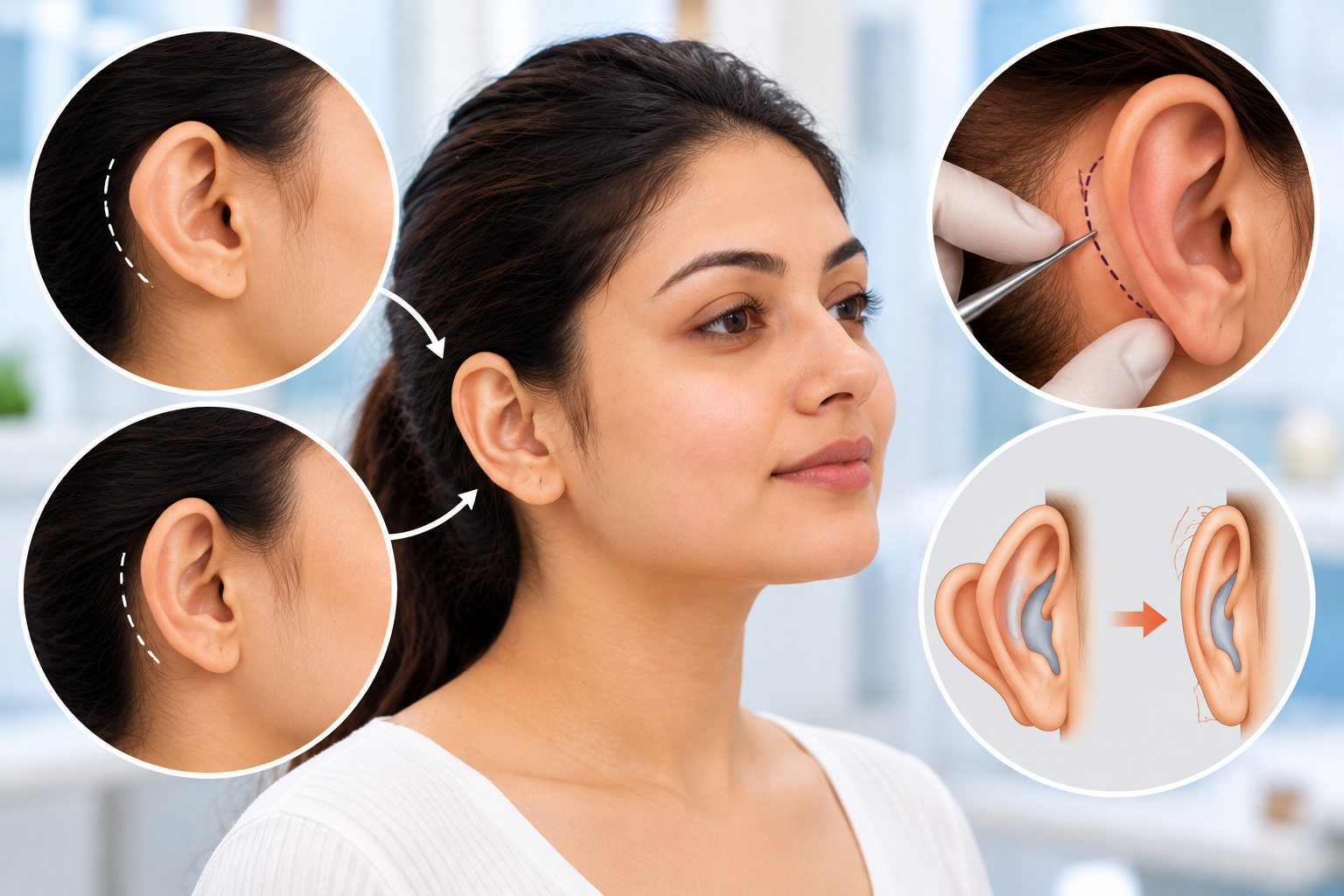
Otoplasty is a cosmetic ear surgery that can correct prominent or protruding ears by reshaping or repositioning the ear cartilage. The procedure brings the ears into better proportion with the head while maintaining their natural appearance. Both children and adults may be suitable candidates, depending on ear development, overall health, and individual treatment goals.
Prominent ears are a common anatomical variation. Some people have ears that project farther from the head because of inherited differences in cartilage shape or ear structure.
Although protruding ears generally do not affect hearing, their appearance can cause self-consciousness or unwanted attention, particularly during childhood.
Prominent ear correction offers a surgical option for individuals who wish to change the position or shape of their ears.
Understanding how the procedure works, its recovery requirements, and possible risks can help patients make informed decisions.
Key Takeaways
-
Otoplasty can improve the appearance of prominent or protruding ears.
-
Surgery typically involves reshaping or repositioning ear cartilage.
-
Children and adults can undergo ear correction after an appropriate assessment.
-
The procedure generally does not change hearing ability.
-
Initial recovery usually takes around one to two weeks, although complete healing takes longer.
-
Results are generally long-lasting, but perfect symmetry cannot be guaranteed.
-
A consultation helps determine the appropriate technique for each patient.
What Is Otoplasty?
Otoplasty, commonly called ear pinning or ear reshaping surgery, is a procedure used to improve the position, shape, or proportions of the external ears.
It is often performed when the ears project noticeably away from the sides of the head.
The procedure may involve:
-
Reshaping ear cartilage
-
Creating or improving natural ear folds
-
Adjusting the angle between the ear and head
-
Reducing excessive prominence of the outer ear
-
Improving differences between the two ears
Unlike surgery performed to treat hearing problems, cosmetic otoplasty primarily addresses the external appearance of the ears.
The goal is to create a balanced result without making the ears appear unnaturally flat against the head.
What Causes Prominent or Protruding Ears?
Prominent ears are usually related to variations in ear cartilage development.
Several anatomical factors can contribute to this appearance.
1. Underdeveloped antihelical fold
The antihelical fold is a natural curved ridge within the outer ear.
When this fold is poorly developed, the ear may appear flatter and project farther from the head.
2. Enlarged conchal cartilage
The concha is the bowl-shaped area of the outer ear.
If this region is unusually deep or prominent, it can increase the distance between the ear and the head.
3. Combination of cartilage differences
Some patients have both an underdeveloped antihelical fold and a prominent concha.
In these cases, the surgeon may need to address more than one anatomical feature.
4. Genetic factors
Prominent ears often run in families.
The condition may be visible from birth and become more noticeable as a child grows.
Prominent ears are not usually caused by incorrect sleeping positions or everyday habits.
Can Prominent or Protruding Ears Be Corrected?
Yes. Otoplasty can often correct prominent or protruding ears by reshaping the cartilage and changing the ear's position relative to the head.
The surgeon selects the technique according to the patient's ear anatomy.
For example, an underdeveloped antihelical fold may require cartilage-folding sutures, while a prominent concha may need additional repositioning.
Some patients require correction of both features.
The aim is not necessarily to make both ears identical. Instead, the procedure focuses on achieving natural proportions and improving overall symmetry.
How Does Otoplasty Surgery Work?
Otoplasty is planned according to the specific cartilage structures responsible for ear prominence.
Although techniques vary, the procedure generally follows several steps.
Step 1: Ear examination and surgical planning
The surgeon examines:
-
Ear size and shape
-
Degree of ear prominence
-
Cartilage flexibility
-
Natural ear folds
-
Differences between the ears
-
Skin condition and previous ear injuries
Photographs and measurements may be used to help plan the correction.
Step 2: Anaesthesia
Otoplasty may be performed under local anaesthesia with or without sedation, or under general anaesthesia.
The choice depends on the patient's age, medical condition, surgical complexity, and ability to remain comfortable during the procedure.
General anaesthesia is commonly considered for younger children.
Step 3: Making the incision
In many traditional otoplasty techniques, the surgeon makes an incision behind the ear.
This location helps keep the resulting scar relatively inconspicuous.
Other techniques may use different incision placements depending on the correction required.
Step 4: Reshaping the cartilage
The surgeon may use permanent internal sutures to create or reinforce the antihelical fold.
When necessary, cartilage may also be repositioned, weakened, or modified to improve the ear's contour.
The exact technique depends on the anatomy and desired correction.
Step 5: Closing the incision
After achieving the planned ear position, the surgeon closes the incision and applies a protective dressing.
Dressings help support the ears and protect them during the early healing period.
Step 6: Recovery and follow-up
The patient receives instructions regarding dressing care, sleeping position, activity restrictions, and follow-up appointments.
Many otoplasty procedures are performed as day-care surgery, although this depends on the patient's condition and the surgical plan.
Who Is a Suitable Candidate for Otoplasty?
Both children and adults may be candidates for ear correction surgery.
Suitability depends on ear development, general health, and personal expectations.
Otoplasty for children
Ear correction is commonly considered from around five or six years of age, when the external ears have reached much of their mature size.
However, there is no universal age that is appropriate for every child.
Important considerations include:
-
Ear development
-
General health
-
The child's own wishes
-
Emotional readiness
-
Ability to cooperate with recovery instructions
-
Parent or guardian understanding of the procedure
Children should not be pressured into cosmetic surgery solely because of comments from others.
Otoplasty for adults
Adults can also undergo prominent ear correction.
There is no fixed upper age limit, although health conditions and cartilage characteristics can affect surgical planning.
Adults may consider surgery if they have been concerned about their ear appearance for many years or wish to improve visible asymmetry.
What Is the Difference Between Otoplasty and Earlobe Repair?
Although both procedures involve the external ear, they address different concerns.
|
Feature |
Otoplasty |
Earlobe repair |
|---|---|---|
|
Main purpose |
Correct ear prominence or shape |
Repair torn, stretched, or damaged earlobes |
|
Treatment area |
Mainly ear cartilage |
Mainly earlobe soft tissue |
|
Common concern |
Protruding ears |
Split or elongated piercing holes |
|
Technique |
Cartilage reshaping or repositioning |
Soft-tissue repair |
|
Recovery |
Usually several weeks of precautions |
Often shorter, depending on repair |
Some patients may require treatment for both ear prominence and earlobe concerns.
These procedures are planned separately or together depending on the patient's needs.
How Long Does Otoplasty Recovery Take?
Recovery varies according to the technique used, patient age, and individual healing.
Most patients experience some swelling, tenderness, and bruising during the first several days.
|
Recovery stage |
What to expect |
|---|---|
|
First 1–3 days |
Swelling, discomfort, and protective dressing |
|
Days 4–7 |
Gradual improvement in discomfort; dressing review as directed |
|
Weeks 1–2 |
Many patients resume routine school or desk activities |
|
Weeks 3–6 |
Continued healing and gradual return to activities with surgeon approval |
|
Following months |
Residual swelling settles and scars continue to mature |
These timelines are general estimates rather than guarantees.
Important aftercare instructions
Patients are usually advised to:
-
Avoid pressure or injury to the ears.
-
Follow the surgeon's instructions for wearing a protective headband, if prescribed.
-
Avoid contact sports until cleared.
-
Keep dressings clean and dry as instructed.
-
Attend scheduled follow-up appointments.
-
Avoid sleeping directly on the ears during early recovery.
Patients should contact their surgical team if they develop severe or increasing pain, rapidly worsening swelling, fever, discharge, or significant bleeding.
Does Otoplasty Leave Visible Scars?
Otoplasty usually involves an incision behind the ear, where the scar is less noticeable.
However, all surgical incisions create scars.
Scar appearance depends on factors such as skin type, healing response, incision placement, and postoperative care.
Most scars gradually become less prominent, although some patients may develop thickened or raised scars.
Patients with a history of hypertrophic scars or keloids should discuss this with their surgeon before surgery.
Is Otoplasty Painful?
Otoplasty is performed with anaesthesia to manage pain during the procedure.
After surgery, patients may experience:
-
Mild to moderate discomfort
-
Ear tenderness
-
Tightness around the dressing
-
Temporary swelling
-
Sensitivity when touching the ears
Postoperative discomfort is often manageable with prescribed medication.
Severe, persistent, or increasing pain should not be ignored because it may indicate a complication requiring assessment.
What Are the Risks of Otoplasty?
Like any surgical procedure, protruding ears surgery carries potential risks.
Possible complications include:
-
Bleeding or haematoma
-
Infection
-
Scarring
-
Temporary or persistent changes in skin sensation
-
Ear asymmetry
-
Overcorrection or undercorrection
-
Recurrence of ear prominence
-
Suture-related problems
-
Skin or cartilage complications
-
Need for revision surgery
Rarely, complications involving cartilage infection or blood supply can affect ear shape.
A qualified surgeon should explain the procedure-specific risks, expected benefits, and alternatives before obtaining informed consent.
Are Otoplasty Results Permanent?
Otoplasty generally provides long-lasting changes because the procedure reshapes or repositions ear cartilage.
However, the final result depends on cartilage characteristics, surgical technique, and healing.
In some cases, cartilage may partially return toward its original position, causing recurrent prominence.
Minor differences between the ears can remain after surgery because natural ears are rarely perfectly symmetrical.
Patients should understand that the goal is improvement rather than guaranteed perfection.
How Much Does Otoplasty Cost?
The cost of otoplasty varies depending on several factors.
These include:
-
Whether one or both ears require correction
-
Complexity of the cartilage changes
-
Surgical technique
-
Anaesthesia requirements
-
Hospital or surgical facility charges
-
Follow-up care
-
Whether additional procedures are required
An accurate cost estimate generally requires a physical examination and a discussion of the proposed surgical plan.
Cosmetic otoplasty may not be covered by standard health insurance policies. Coverage depends on the policy and medical indication.
Otoplasty Consultation With Dr. Ashutosh Shah at Elegance Clinic
Dr. Ashutosh Shah at Elegance Clinic offers consultations for individuals considering otoplasty and other cosmetic ear procedures.
During the consultation, the patient's ear shape, cartilage structure, degree of prominence, medical history, and expectations can be assessed.
The consultation may include a discussion of available correction techniques, anaesthesia, recovery requirements, expected results, and potential complications.
The objective is to recommend an individualized treatment approach that improves ear proportions while maintaining a natural appearance.
Conclusion
Otoplasty is an established surgical option for correcting prominent or protruding ears and improving external ear proportions.
The procedure works by reshaping or repositioning cartilage, with the aim of creating a natural-looking ear position.
Both children and adults may benefit from prominent ear correction when they are suitable candidates.
A consultation with Dr. Ashutosh Shah at Elegance Clinic can help patients understand their treatment options, surgical risks, recovery requirements, and realistic expectations.
For more information, explore the clinic's Otoplasty & Earlobe Repair treatment page.