Rolling, Boxcar Or Icepick Acne Scars: When Subcision, Filler Or Both Actually Work
Subcision works best for rolling acne scars, which are tethered down by fibrous bands, and for some soft boxcar scars. Filler can lift broad depressed scars once they are released. Icepick scars are too narrow and deep for either and need TCA CROSS or punch techniques. Most need 2 to 3 subcision sessions, 4 to 6 weeks apart.
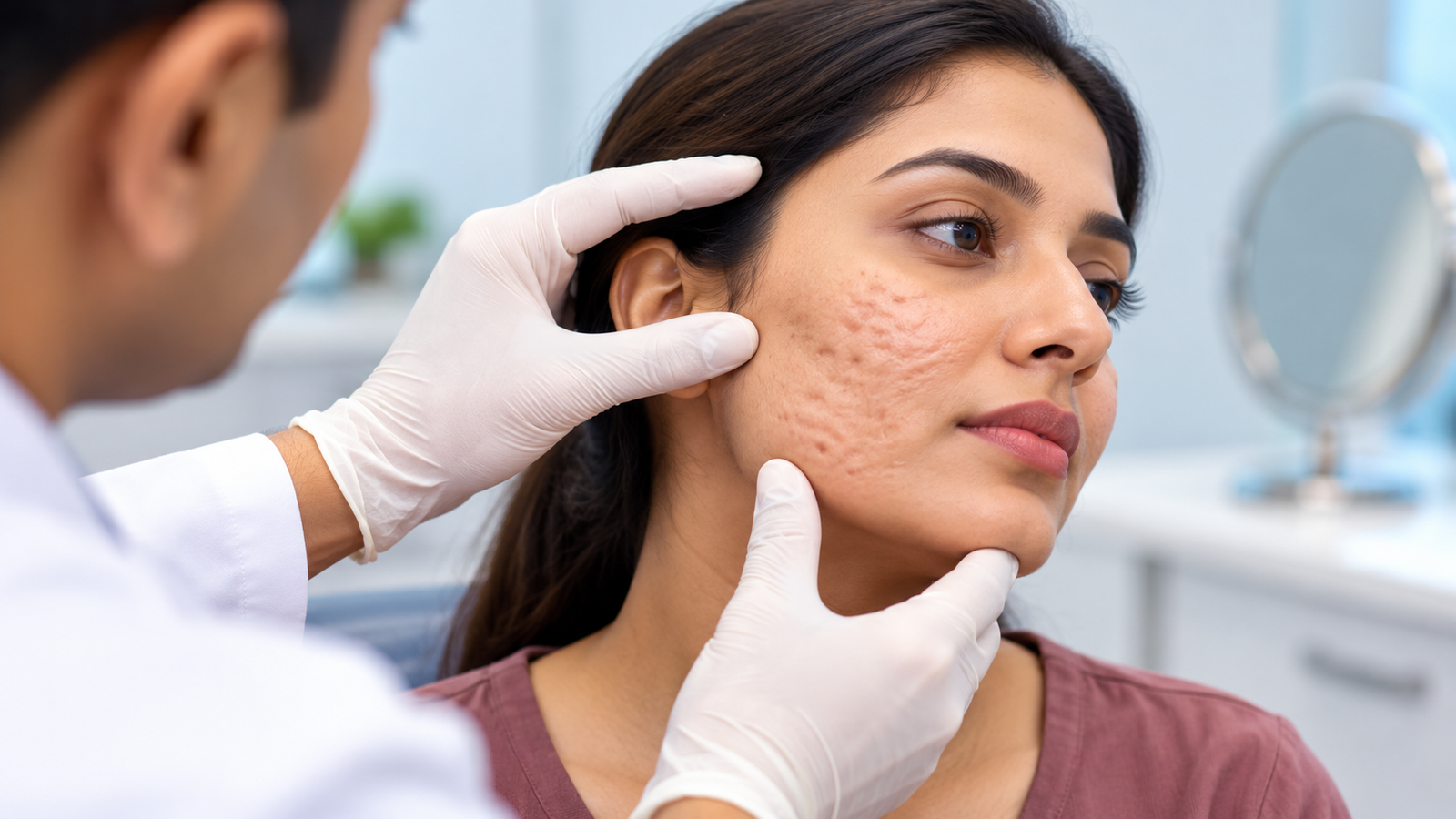
Acne scars do not all have the same shape or structure. Some form broad depressions, others have sharply defined edges, and some extend deeply into the skin.
This difference matters because a treatment that improves one type of scar may do very little for another.
Subcision releases scar tissue beneath the skin. Fillers provide support or volume. Laser treatments target surface texture, while TCA CROSS and punch procedures address selected deeper scars.
Choosing the correct treatment begins with identifying the scar type rather than treating every depression in the same way.
Which Type of Acne Scar Do You Have?
Dermatologists commonly classify depressed acne scars into three main types: rolling, boxcar and icepick.
This classification, described by Jacob and colleagues, helps clinicians select suitable treatments.
1. Rolling Acne Scars
Rolling scars are broad depressions with sloping edges.
They create a wave-like appearance across the skin, especially under angled lighting.
These scars often develop when fibrous bands connect the skin surface to deeper tissues and pull it downward.
Rolling acne scars treatment may involve subcision when tethering is present.
Some patients also benefit from filler or skin resurfacing.
2. Boxcar Acne Scars
Boxcar scars are round or oval depressions with more clearly defined edges.
They may be shallow or deep.
Shallow boxcar scars can sometimes improve with resurfacing treatments.
Selected boxcar scars that are tethered may respond to subcision, while broad residual depressions may benefit from filler.
Deep, sharply edged scars may require punch elevation or another procedure.
3. Icepick Acne Scars
Icepick scars are narrow, deep openings that extend into the skin.
They often look like tiny punctures.
Because they are narrow and deep, they generally do not respond well to subcision or dermal fillers.
Icepick scars treatment commonly involves targeted techniques such as TCA CROSS or punch excision.
4. Mixed Acne Scars
Many patients have more than one scar type.
For example, someone may have rolling scars across the cheeks, boxcar scars near the temples and several icepick scars.
A combination treatment plan may be necessary.
The aim is to match each procedure to the scar's structure rather than applying one technique to the entire face.
Acne Scar Type and Treatment Comparison
| Scar type | How it looks | Subcision | Dermal filler | Other treatment options | Typical treatment course |
|---|---|---|---|---|---|
| Rolling | Broad, wave-like depressions | Often useful when tethered | May support residual depressions | Microneedling, fractional laser | Often 2–3 subcision sessions when needed |
| Shallow boxcar | Broad depression with defined edges | Sometimes, if tethered | May help selected broad depressions | Fractional laser, microneedling | Multiple sessions depending on technique |
| Deep boxcar | Deep depression with sharp edges | Limited unless tethering contributes | Usually not sufficient alone | Punch elevation, resurfacing | Individualised |
| Icepick | Narrow, deep opening | Generally unsuitable | Generally unsuitable | TCA CROSS, punch excision | Often multiple targeted sessions |
| Mixed scars | Combination of scar shapes | For suitable tethered scars | For selected residual depressions | Combination treatment | Staged over several months |
Important: These are general treatment patterns, not guaranteed outcomes. The number of sessions depends on scar depth, severity, skin characteristics and the chosen procedure.
How Does Subcision Release Rolling Scars?
Subcision for acne scars is a minimally invasive procedure designed to release fibrous attachments beneath depressed scars.
These attachments can pull the skin downward, preventing the surface from sitting at the same level as the surrounding tissue.
How the Procedure Works
After examining the scars, the clinician marks the areas suitable for treatment.
Local anaesthesia is administered to reduce discomfort.
A specialised needle or cannula is then introduced beneath the scar.
The instrument is moved in a controlled manner to release the fibrous bands tethering the skin.
Once these attachments are released, the depressed skin may rise.
The healing response can also contribute to tissue remodelling over time.
Why Subcision Works Better for Rolling Scars
Rolling scars commonly have broad depressions caused by tethering.
Releasing these bands directly addresses an important part of the scar's structure.
However, not every rolling scar is equally tethered, and not every depression responds completely.
Some patients retain a shallow depression even after successful release.
Can Subcision Treat Boxcar Scars?
Yes, but only selected boxcar scars.
If fibrous attachments contribute to a boxcar depression, subcision may help.
However, scars with sharply defined vertical edges may respond better to resurfacing or punch techniques.
The clinician must examine each scar before choosing treatment.
Is Subcision Permanent?
The released fibrous bands do not necessarily reform in the same way, but improvement is not guaranteed to remain unchanged.
Some scars may become tethered again, and residual depressions may persist.
Subcision also cannot prevent new acne scars from developing.
For patients with different scar types, a comprehensive acne scar management plan may provide a more appropriate approach.
When Is Filler Added After Subcision?
The decision between subcision vs filler for acne scars depends on whether the main problem is tethering, volume loss or both.
Subcision releases the scar.
Filler supports a depression by adding material beneath the skin.
These treatments perform different functions.
When Subcision Alone May Be Enough
Subcision alone may provide satisfactory improvement when the scar is mainly caused by fibrous tethering.
Once the bands are released, the skin may rise sufficiently without additional volume.
When Filler May Help
Filler may be considered when a broad depression remains after the tethering has been released.
For example, a rolling scar may become less tightly attached but still sit below the surrounding skin.
In selected cases, a dermal filler can provide additional support.
Why Filler Should Not Automatically Be Added
Not every scar needs filler.
Adding unnecessary filler can increase cost and introduce risks without providing a meaningful benefit.
Potential complications include:
-
Swelling
-
Bruising
-
Lumps or irregularities
-
Inflammation
-
Infection
-
Unwanted contour changes
Rare but serious vascular complications can also occur with facial filler injections, including tissue injury and vision loss.
For this reason, facial fillers should be administered only by appropriately trained medical professionals.
Subcision First, Then Reassessment
A practical staged approach is:
-
Identify scars with fibrous tethering.
-
Perform subcision on suitable scars.
-
Allow initial healing and reassess after approximately six weeks.
-
Identify any residual broad depressions.
-
Consider filler only when additional volume support is likely to help.
This approach can reduce unnecessary treatment.
In some clinical situations, subcision and filler may be performed together, but that decision should be individualised.
Why Do Icepick Scars Need a Different Treatment?
Icepick scars have a different structure from rolling scars.
They are narrow at the surface and extend deeply into the skin.
Subcision does not effectively address this narrow, deep scar architecture.
Similarly, filler cannot reliably correct the small opening and deep tract.
TCA CROSS
TCA CROSS stands for chemical reconstruction of skin scars.
A clinician carefully applies a high-concentration trichloroacetic acid solution inside selected scars.
This produces a controlled chemical injury intended to stimulate remodelling.
Several sessions may be needed.
Potential risks include irritation, pigmentation changes, widening of scars and unintended injury to surrounding skin.
Punch Excision
Punch excision involves removing a selected deep scar using a small surgical instrument.
The resulting wound is then closed or otherwise managed according to the technique.
This may be considered for selected deep icepick scars.
Punch Elevation
Punch elevation is more commonly considered for certain deep boxcar scars.
The depressed scar base is elevated to better match the surrounding skin.
Laser Resurfacing
Fractional laser treatments may improve skin texture and selected acne scars.
However, laser resurfacing alone may not adequately correct deep tethered rolling scars or narrow icepick scars.
Patients can review laser skin resurfacing as one component of a broader scar treatment plan.
How Many Subcision Sessions Are Needed and What Results Are Realistic?
Patients frequently ask how many subcision sessions they will need.
Some people improve after one treatment, while others require two or three sessions or a combination of procedures.
The number depends on the severity and distribution of tethered scars.
Typical Treatment Timeline
| Stage | Approximate timing | Purpose |
|---|---|---|
| Initial assessment | Before treatment | Identify scar types and assess tethering |
| First subcision session | Week 0 | Release selected fibrous attachments |
| Early recovery | First 1–2 weeks | Allow bruising and swelling to settle |
| Reassessment | Around week 6 | Evaluate healing and residual depression |
| Additional session | Often after 4–6 weeks or longer | Treat remaining tethered scars if needed |
| Filler consideration | After reassessment | Support suitable residual broad depressions |
| Longer-term review | Several months | Assess overall improvement and additional options |
These intervals are approximate and should not be treated as a fixed protocol.
What Results Can You Expect?
The goal is usually to make scars less noticeable, not to erase them completely.
Some scars improve substantially, while others show modest changes.
Results depend on:
-
Scar type and depth
-
Degree of tethering
-
Duration of scarring
-
Skin thickness
-
Individual healing response
-
Treatment technique
-
Presence of active acne
-
Use of complementary treatments
Improvement may continue over several months as tissue remodelling occurs.
Can PRP Microneedling Be Combined With Subcision?
In selected patients, microneedling or PRP-based treatments may be considered to address surface texture after tethered scars have been treated.
However, evidence for the added benefit of PRP varies.
The guide to PRP microneedling for scars explains how these treatments differ from targeted scar release.
What Is Recovery Like After Subcision?
Subcision involves controlled disruption of tissue beneath the skin.
Temporary swelling, bruising and tenderness are common.
First 24–48 Hours
Patients may experience:
-
Swelling
-
Bruising
-
Mild discomfort
-
Tenderness
-
Small entry-point marks
The clinician may recommend specific aftercare instructions.
Days 3–7
Swelling and bruising usually begin improving.
Some patients notice temporary firmness or small lumps beneath the treated area.
Weeks 1–2
Visible bruising often settles substantially.
However, recovery can take longer after extensive treatment.
Weeks 4–6
The clinician can reassess the scars after early healing.
Final improvement may continue developing beyond this period.
When Should You Contact the Clinic?
Seek medical assessment if you experience:
-
Increasing pain
-
Spreading redness
-
Fever
-
Pus or unusual discharge
-
Rapidly increasing swelling
-
Significant skin discolouration
-
Persistent or worsening lumps
These symptoms may indicate a complication rather than routine healing.
Can Subcision Make Acne Scars Worse?
Although subcision can improve selected scars, complications are possible.
These may include bruising, haematoma, infection, temporary pigmentation changes, persistent lumps or contour irregularities.
Additional scarring is uncommon but possible.
Treatment performed at the wrong depth or in unsuitable scars may produce limited improvement or unwanted tissue changes.
This is why scar classification and careful technique are important.
Is Subcision Safe for Darker Skin?
Subcision can be considered for patients with darker skin tones.
However, darker skin may be more prone to post-inflammatory hyperpigmentation following skin injury.
The clinician should assess pigmentation risk, scar type and treatment intensity.
Patients may need a carefully planned approach when combining subcision with lasers or chemical procedures.
Sun protection and appropriate aftercare are also important.
Acne Scar Treatment Near Limbayat: Which Procedure Matches Your Scar?
Patients considering acne scar treatment near limbayat should have their scars classified before choosing subcision, filler or resurfacing.
At Elegance Clinic, Dr. Ashutosh Shah, MBBS, MS, MCh, DNB, Plastic and Reconstructive Surgeon with clinical practice since 2004, can assess scar morphology, tissue tethering, skin characteristics and treatment expectations.
A consultation may include:
-
Identifying rolling, boxcar and icepick scars.
-
Checking whether depressed scars are tethered.
-
Assessing scar depth and distribution.
-
Reviewing active acne and previous treatments.
-
Evaluating pigmentation and skin-healing risks.
-
Discussing subcision, filler and resurfacing options.
-
Planning treatment stages and review appointments.
-
Explaining expected improvement and possible complications.
Questions to Ask Before Treatment
-
Which scars are suitable for subcision?
-
Are any scars too deep or narrow for subcision?
-
Would filler provide additional benefit?
-
How many sessions might be necessary?
-
What degree of improvement is realistic?
-
How long will bruising last?
-
What are the risks for my skin type?
-
When should I return for reassessment?
A scar-specific treatment plan is more useful than choosing a single procedure for every acne scar.
Key Takeaways
-
Subcision for acne scars is mainly used for rolling scars caused by fibrous tethering.
-
Selected tethered boxcar scars may also benefit.
-
Icepick scars generally require different treatments, such as TCA CROSS or punch excision.
-
Dermal fillers can support residual broad depressions after scar release.
-
Not every scar requires filler.
-
Some patients need two or three subcision sessions, but treatment schedules vary.
-
Bruising and swelling commonly improve within one to two weeks.
-
Laser resurfacing and microneedling may help selected surface irregularities.
-
Patients with darker skin should discuss pigmentation risks.
-
Complete scar removal cannot be guaranteed.
-
Scar-specific treatment planning is essential for realistic results.
Conclusion: Match the Treatment to the Acne Scar Type
The effectiveness of subcision for acne scars depends on the structure of the scar.
Rolling scars with fibrous attachments are often suitable candidates, while selected boxcar scars may also benefit.
Broad depressions that remain after scar release may be treated with filler when appropriate.
Icepick scars usually need a different approach because their narrow, deep structure does not respond reliably to subcision or filler.
A carefully planned treatment programme should identify each scar type, address the underlying cause of depression and use additional procedures only when they offer a clear benefit.
The goal is meaningful improvement in skin texture and scar appearance, with realistic expectations about recovery, repeat sessions and possible limitations.