Brow Lift Risks By Technique: Endoscopic, Hairline, Direct And Thread Lifts Compared
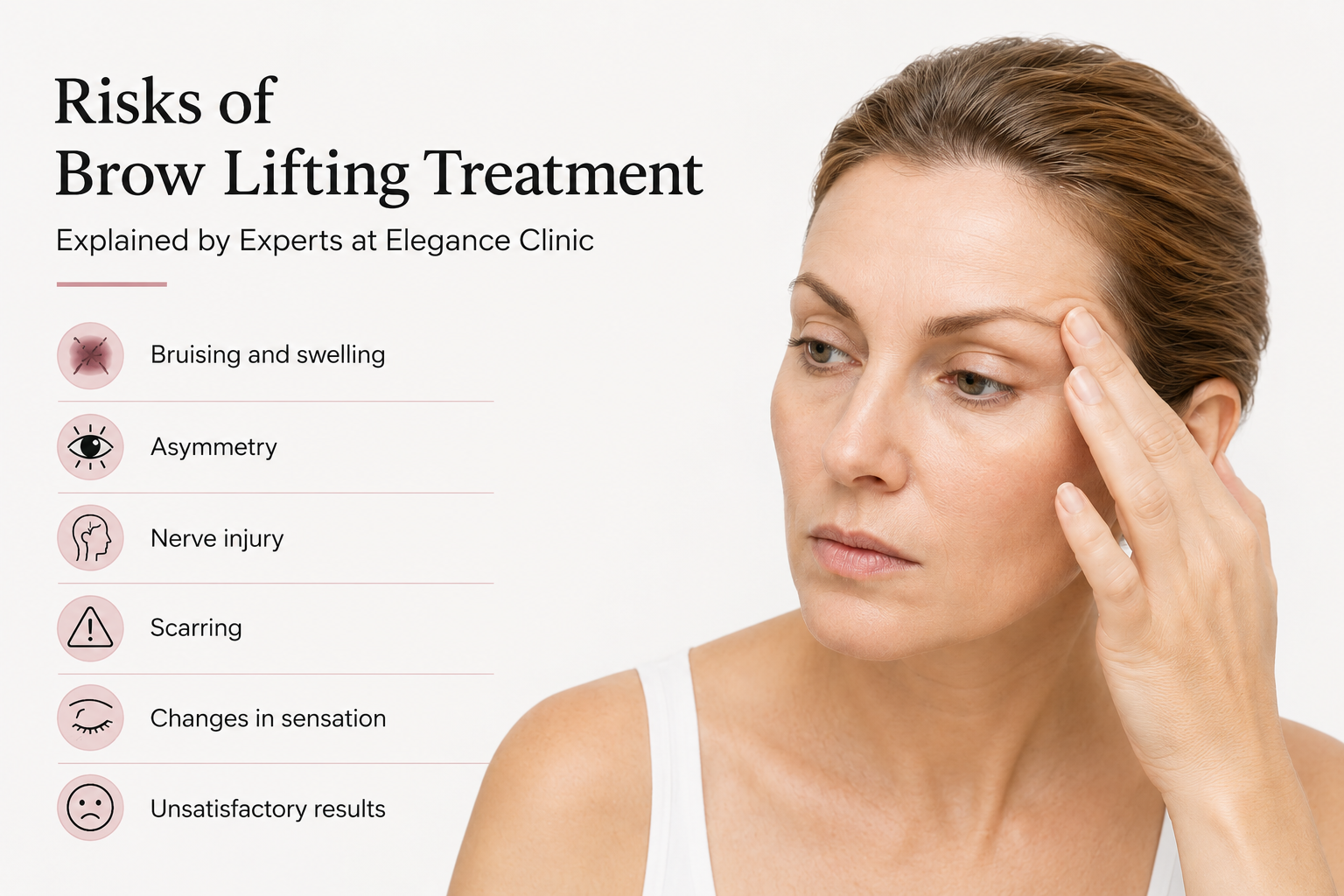
Brow lift risks depend on the technique. Endoscopic lifts carry temporary scalp numbness and some relapse risk, hairline (pretrichial) lifts leave a scar at the hairline but suit high foreheads, direct lifts leave a scar above the brow, and thread lifts have lower downtime but shorter results and a risk of palpable or visible threads.
A brow lift is performed to improve drooping eyebrows, forehead heaviness or changes in the upper face associated with ageing.
However, not every patient needs the same type of brow correction.
Some people have naturally low eyebrows, while others experience skin laxity, forehead wrinkles or excess upper-eyelid skin.
Understanding brow lift risks before treatment helps patients compare surgical and non-surgical options and make informed decisions.
Which Brow Lift Techniques Are Used and How Do They Differ?
Brow lifting techniques differ in incision placement, how tissues are repositioned, recovery time and the durability of results.
1. Endoscopic Brow Lift
An endoscopic brow lift is performed through several small incisions, usually hidden within the scalp.
The surgeon uses specialised instruments and a camera to release and reposition forehead tissues.
Potential advantages:
-
Small incisions concealed within the hair-bearing scalp
-
No long incision across the hairline
-
Can improve selected forms of brow descent
-
May provide a long-lasting correction
Possible limitations:
-
Temporary or persistent scalp numbness
-
Hair thinning around incision sites
-
Swelling and bruising
-
Asymmetry or insufficient correction
-
Recurrence of brow descent
An endoscopic lift may also elevate the hairline, making it less suitable for some patients who already have a high forehead.
2. Hairline or Pretrichial Brow Lift
A hairline brow lift uses an incision along the frontal hairline.
The surgeon removes or repositions tissue to lift the eyebrows while controlling the hairline position.
This technique may be considered for patients who have brow descent combined with a high forehead.
Possible risks include:
-
Visible scar along the hairline
-
Temporary or persistent numbness
-
Hair loss near the incision
-
Changes in hairline appearance
-
Asymmetry or recurrence
Scar visibility depends on hair density, incision design, skin characteristics and healing.
A hairline approach is not automatically the correct option for every patient with a high forehead.
3. Direct Brow Lift
A direct brow lift involves an incision immediately above the eyebrow.
It allows the surgeon to remove excess skin and reposition the eyebrow directly.
This technique may be useful for selected patients with significant brow drooping or functional concerns.
Possible risks include:
-
A visible scar above the eyebrow
-
Uneven brow height
-
Numbness
-
Altered eyebrow contour
-
Wound-healing problems
Because the incision is close to the eyebrow, scar visibility is an important consideration.
4. Thread Brow Lift
A thread brow lift is a minimally invasive procedure that uses specialised threads to provide limited tissue lifting.
It does not involve the same tissue repositioning as surgical brow lifting.
Possible risks include:
-
Bruising and swelling
-
Skin dimpling or puckering
-
Palpable or visible threads
-
Infection
-
Thread extrusion or migration
-
Uneven lifting
-
Shorter-lasting results
A thread lift may suit selected patients seeking a modest improvement, but it cannot reliably replace surgery for significant brow descent.
Patients can explore the non-surgical thread lift to understand how thread-based facial lifting differs from surgery.
What Are the Specific Risks of Each Brow Lift Technique?
Although all brow lifting procedures involve some risk, the likelihood and nature of complications differ according to the technique.
The following table helps compare the main considerations.
Brow Lift Risk Comparison Table
| Technique | Incision and scar | Numbness | Hair loss risk | Relapse or recurrence | Typical longevity | Best suited for |
|---|---|---|---|---|---|---|
| Endoscopic brow lift | Small scalp incisions, usually hidden in hair | Temporary scalp numbness is possible; persistent changes can occur | Possible near incisions | Possible | Often several years; ageing continues | Selected patients with brow descent and suitable hairline position |
| Hairline brow lift | Incision along frontal hairline | Temporary or persistent forehead numbness possible | Possible near scar | Possible | Often several years; ageing continues | Selected patients with high forehead and brow descent |
| Direct brow lift | Scar immediately above eyebrow | Possible local numbness | Possible eyebrow-hair disruption near incision | Possible | Often long-lasting, but not permanent | Selected patients needing direct correction of significant brow descent |
| Thread brow lift | Small entry points rather than a long incision | Temporary altered sensation possible | Not a typical major concern, but local tissue injury is possible | Loss of lifting effect is relatively common | Often months to around 1–2 years, with substantial variation | Selected patients seeking modest, temporary lifting |
Important: These are general comparisons, not individual risk percentages or guarantees. Surgical results can last for years, but the face continues to age. Thread-lift longevity varies substantially with the product, technique and patient.
Can a Brow Lift Cause Permanent Numbness?
Yes, persistent sensory changes are possible, although many patients experience gradual improvement.
Forehead and scalp sensation depends on nerves that may be stretched or disturbed during surgery.
Temporary numbness can last weeks or months. Some patients may experience longer-lasting changes.
Can Brow Lift Surgery Cause Hair Loss?
Hair loss can occur near scalp or hairline incisions.
It may be related to temporary follicle stress, scar formation or tissue tension.
Patients with existing hair thinning should discuss the risk of visible scars and further hair loss before choosing an incision.
Can Brow Lift Results Become Uneven?
Some asymmetry can occur because natural eyebrows are rarely identical.
Temporary differences may also result from swelling.
Persistent asymmetry, excessive elevation or undercorrection may occasionally require additional treatment.
Which Technique Suits a High Forehead or Heavy Brows?
The correct procedure depends on the cause of brow descent, forehead proportions, hairline position and skin elasticity.
If You Have a High Forehead
A hairline brow lift may be considered because it can raise the eyebrows without necessarily increasing forehead height.
However, the surgeon must also assess hair density, scar visibility and the amount of correction required.
An endoscopic lift may be less desirable if the planned technique would raise an already high hairline.
This is a planning consideration rather than an absolute rule.
Patients concerned about forehead proportions can also read about forehead reduction.
If You Have Heavy or Drooping Eyebrows
The surgeon needs to determine whether the heaviness comes from:
-
Brow descent
-
Excess upper-eyelid skin
-
Forehead muscle activity
-
Natural eyebrow position
-
A combination of these factors
A surgical brow lift may be considered when tissue repositioning is necessary.
A thread lift generally provides a more limited correction and may not adequately address significant brow descent.
If Your Upper Eyelids Look Heavy
Drooping eyebrows can contribute to upper-eyelid hooding.
However, excess eyelid skin can also occur independently of brow position.
In some patients, eyelid lift surgery may be more appropriate, or both procedures may be considered.
An examination helps avoid treating the wrong anatomical problem.
How Long Does Each Type of Brow Lift Last?
The duration of brow lift results depends on the procedure, tissue characteristics, ageing and individual healing.
Endoscopic Brow Lift Longevity
Endoscopic brow lifting can provide improvement lasting several years.
However, some degree of brow descent may return as tissues continue to age.
The amount of initial correction and the fixation technique can influence the result.
Hairline Brow Lift Longevity
A hairline brow lift can also provide long-lasting improvement.
Its main distinguishing feature is the location of the incision and the ability to manage the hairline position.
The result is not permanent protection against future ageing.
Direct Brow Lift Longevity
Direct brow lifting provides targeted correction and can have durable results.
However, eyebrow position may still change over time.
The visible scar remains an important trade-off.
Thread Brow Lift Longevity
Thread brow lifting generally produces less durable results than surgery.
The lifting effect may diminish over months, and some patients experience improvement lasting around one to two years.
Actual duration varies, and repeat procedures may be considered only after reassessing benefits and risks.
A longer-lasting result does not automatically make a procedure safer or more suitable.
Who Should Not Have a Brow Lift?
Not every person with forehead wrinkles or low eyebrows is a suitable candidate.
A surgeon may recommend delaying or avoiding treatment when the risks outweigh the expected benefits.
1. Patients With Active or Progressive Hair Loss
Scalp incisions may become more visible if hair density decreases.
Patients with significant hair thinning require careful incision planning.
2. Patients With Unrealistic Expectations
Brow lifting cannot guarantee perfect facial symmetry, permanent results or a completely scar-free appearance.
Excessive eyebrow elevation can also create an unnatural or surprised appearance.
3. Patients With Uncontrolled Medical Conditions
Poorly controlled diabetes, certain bleeding disorders, active infection and other medical conditions may increase surgical risks.
Suitability depends on individual assessment and whether the condition can be optimised.
4. Patients Who Smoke or Use Nicotine
Nicotine exposure can impair circulation and wound healing.
Patients should discuss smoking, vaping and nicotine products with their surgeon before planning surgery.
5. Patients With Dry Eyes or Previous Eyelid Surgery
Dry-eye symptoms, incomplete eyelid closure or previous eyelid procedures require particular attention.
When brow lifting is combined with eyelid surgery, excessive tissue correction may affect eye comfort or closure.
The surgeon should evaluate eyelid function before recommending a combined procedure.
6. Patients Seeking a Major Lift From Threads Alone
Thread lifting is unlikely to produce the same correction as a surgical brow lift.
Patients with substantial brow descent should understand these limitations before proceeding.
Brow Lift Near Bhatar: What Should You Discuss Before Treatment?
If you are considering a brow lift near bhatar, the consultation should focus on the reason your eyebrows appear low and the potential risks of each procedure.
Questions worth asking include:
-
Is my concern caused by brow descent or excess eyelid skin?
-
Which technique is appropriate for my forehead and hairline?
-
Where will the incision or entry points be?
-
What is my risk of numbness or visible scarring?
-
Could the procedure affect my hairline?
-
How much brow elevation is realistic?
-
What happens if the eyebrows become uneven?
-
How long should I expect the result to last?
-
What follow-up care will be required?
At Elegance Clinic, Dr. Ashutosh Shah can evaluate eyebrow position, forehead proportions, skin laxity and upper-eyelid concerns to discuss suitable treatment options, possible complications and realistic expectations.
The consultation should include both the potential benefits and the limitations of surgery or thread lifting.
Patients can also read about eyebrow tightening treatment to understand related facial rejuvenation approaches.
What Is Recovery Like After a Brow Lift?
Recovery varies significantly between surgical and thread-based procedures.
Surgical Brow Lift Recovery
Patients may experience:
-
Forehead swelling
-
Bruising around the eyes
-
Tightness or tenderness
-
Temporary numbness
-
Incision discomfort
Many patients need approximately one to two weeks before returning to public-facing activities, although bruising and swelling may take longer to settle.
Strenuous exercise and activities that place pressure on the incisions should wait until the surgeon provides clearance.
Scars continue to mature over several months.
Thread Brow Lift Recovery
Thread procedures usually involve less downtime than surgical brow lifting.
However, bruising, tenderness, swelling and dimpling may still occur.
Patients may need to avoid facial massage, strong pressure and certain activities for a period recommended by the treating clinician.
A shorter recovery does not mean that the procedure is risk-free.
Key Takeaways
-
Brow lift risks differ according to the surgical or non-surgical technique.
-
Endoscopic brow lifts may cause scalp numbness, hair loss near incisions or recurrence.
-
Hairline brow lifts can help selected patients with high foreheads but leave a hairline scar.
-
Direct brow lifts offer targeted correction but involve a potentially visible eyebrow scar.
-
Thread brow lifts generally involve less downtime but may cause dimpling, thread-related complications and shorter-lasting results.
-
A high forehead does not automatically mean that one particular brow lift technique is appropriate.
-
Upper-eyelid heaviness may require eyelid assessment rather than brow lifting alone.
-
Results, scars and symmetry depend on individual anatomy and healing.
-
A qualified surgeon should explain the benefits, limitations and alternatives before treatment.
Conclusion: Which Brow Lift Technique Has the Lowest Risk?
There is no single brow lift technique that has the lowest risk for every patient.
An endoscopic lift may offer concealed scalp incisions, but it still carries risks of numbness, hair loss and recurrence.
A hairline lift may be useful when forehead height matters, but the hairline scar must be considered.
A direct lift provides targeted correction with a more visible incision, while a thread lift offers a less invasive approach with different complications and less predictable longevity.
Understanding brow lift risks means comparing the type of correction needed, incision placement, recovery, expected durability and possible complications.
The safest treatment decision is based on a personalised examination and realistic expectations rather than choosing a technique solely because it is described as minimally invasive or long-lasting.