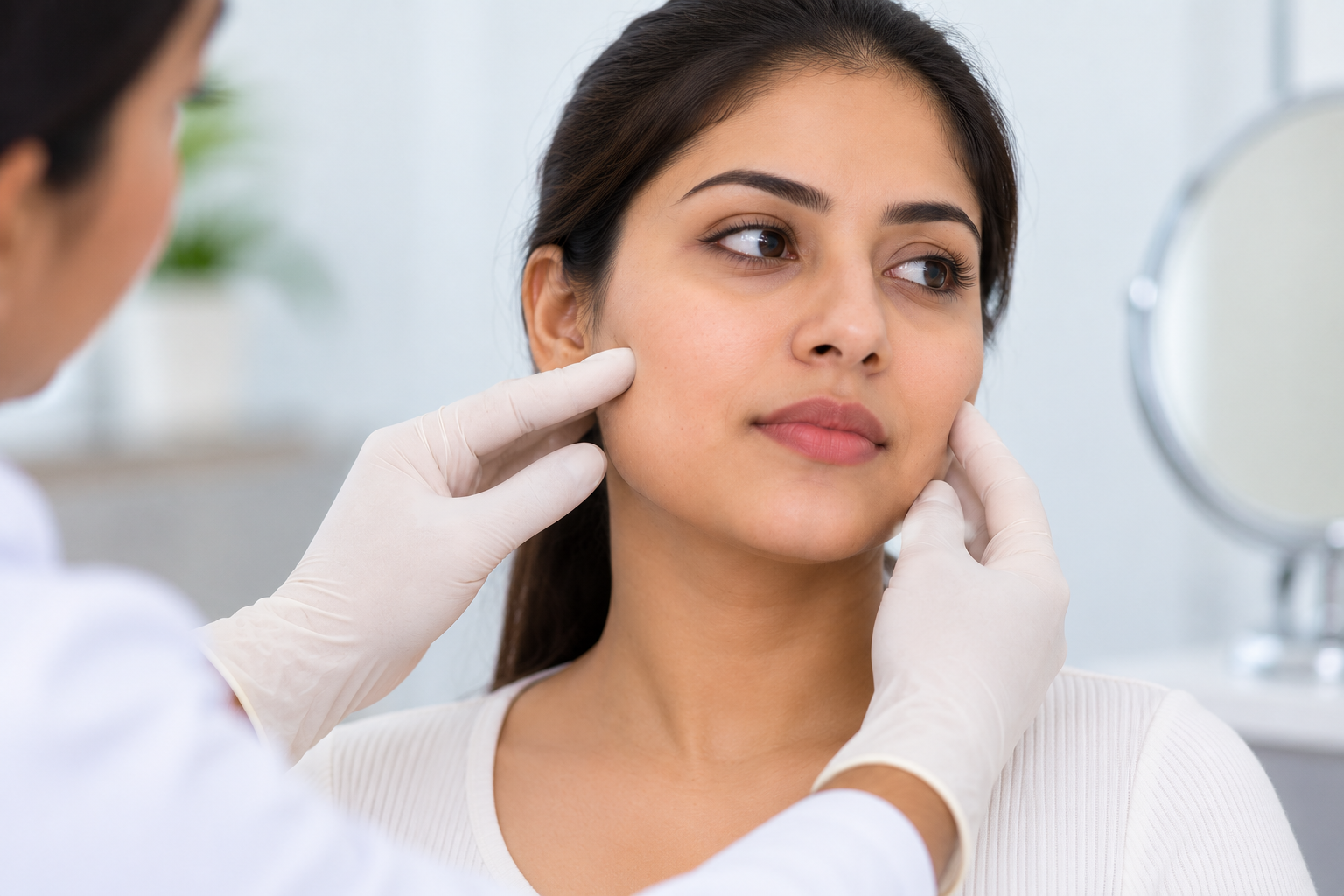
Buccal Fat Removal: Who Is Actually A Candidate
Good candidates have a genuinely full lower cheek, a rounded face at a stable weight, and enough underlying support that removing a small pad will not hollow the mid-face with age. Slim faces, thin patients and people whose fullness comes from jaw muscle are not candidates.
Choosing the right buccal fat removal candidate is more important than simply deciding that a face looks round in photographs. Lower-face width can come from buccal fat, superficial facial fat, jaw muscle, bone structure, swelling or a combination of these factors.
That is why cheek fat reduction surgery should begin with facial assessment rather than with a request to “make the face slimmer.”
Removing buccal fat from someone whose facial width is actually caused by prominent masseter muscles may provide little benefit. Removing too much from an already narrow face can create a hollow appearance that may become more noticeable as facial volume naturally changes with age.
What Is the Buccal Fat Pad and What Does Removing It Change?
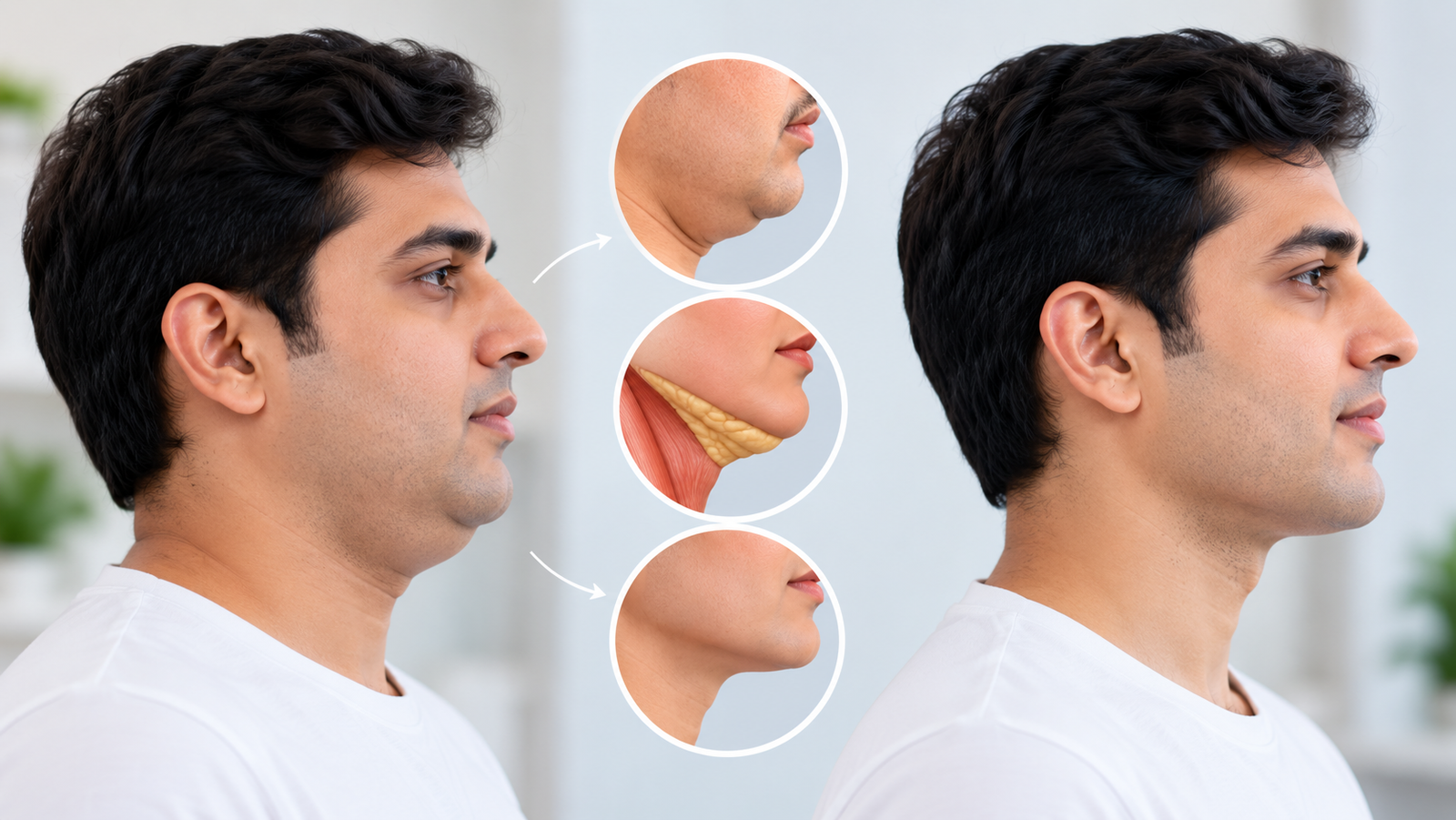
The buccal fat pad is a deeper pocket of fat within the cheek. Part of it contributes to fullness in the lower cheek.
Buccal fat removal aims to reduce selected lower-cheek fullness by removing an appropriate portion of this fat through an incision made inside the mouth.
Because the incision is intraoral, there is generally no external skin incision for the procedure itself.
The operation is not designed to remove every type of facial fat.
It does not directly change:
- Jawbone width
- Chin projection
- Prominent masseter muscles
- Loose facial skin
- General facial swelling
- Every form of superficial cheek fullness
This distinction matters because patients often use terms such as “chubby cheeks,” “round face” and “wide jaw” to describe very different anatomical problems.
What Change Can Buccal Fat Removal Produce?
In an appropriately selected patient, reducing the buccal fat pad can create more definition between the cheekbone and lower jaw.
The change should be considered facial contouring rather than major weight loss from the face.
The aim is not to create the deepest possible cheek hollow.
Removing excessive volume may make the face appear gaunt rather than naturally defined.
For this reason, assessment should consider the entire face, including:
- Cheekbone projection
- Mid-face volume
- Lower-cheek fullness
- Jaw width
- Chin shape
- Skin quality
- Overall facial proportions
Patients considering broader changes can read about lower face contouring by face shape.
Which Face Shapes Benefit and Which Will Look Hollow With Age?
The ideal buccal fat removal candidate generally has persistent lower-cheek fullness despite being at a stable and appropriate body weight.
The face may appear rounded or bottom-heavy because of genuine buccal fat prominence.
Potentially suitable features can include:
- Persistent full lower cheeks
- Rounded facial appearance
- Stable body weight
- Adequate mid-face volume
- Good underlying facial support
- Realistic expectations about the amount of slimming possible
Not every round face meets these criteria.
Who May Not Be a Good Candidate?
Buccal fat removal may be unsuitable when the face is already naturally slim or when reducing deeper cheek volume could create excessive hollowness.
Extra caution is needed with:
- Naturally narrow faces
- Thin or underweight patients
- Existing cheek hollows
- Low mid-face volume
- Significant facial volume loss
- Facial width caused mainly by muscle or bone
- Patients expecting dramatic overall facial slimming
One of the important buccal fat pad removal risks is over-reduction.
A result that looks sharply contoured shortly after recovery may not necessarily age well if too much structural fullness has been removed.
Will My Face Look Hollow Later?
It can if the patient is poorly selected or too much fat is removed.
Facial volume changes naturally with age. A patient who already has limited mid-face volume may therefore become more hollow over time.
The decision should consider not only how the face looks today but also whether it has enough underlying support to tolerate reduction of deep cheek fat.
The goal should be appropriate contouring rather than maximum removal.
Buccal Fat Removal Candidacy Checklist
| Facial finding | Suitability | What may be considered instead | Risk if treated anyway |
|---|---|---|---|
| Genuine persistent lower-cheek fullness at stable weight | Potentially suitable | Buccal fat removal may be considered after assessment | Over-removal if excessive fat is taken |
| Rounded face with adequate mid-face support | Potentially suitable | Conservative facial contouring plan | Excessive hollowing if aggressively treated |
| Naturally slim or narrow face | Usually unsuitable | Preserve volume and assess facial balance | Hollow or gaunt appearance |
| Existing cheek hollows | Usually unsuitable | Volume-preserving approach | Hollows may become more pronounced |
| Lower-face width mainly from masseter muscle | Better managed non-surgically when appropriate | Jaw muscle assessment/treatment | Buccal fat removal may not correct the actual cause |
| Facial width mainly from bone structure | Buccal fat removal may have limited benefit | Structural facial assessment | Little improvement despite surgery |
| Temporary swelling or fluctuating fullness | Unsuitable until the cause is identified | Investigate and reassess | Surgery may treat the wrong problem |
| Unstable body weight | Delay assessment | Stabilise weight first | Facial contour may change with later weight loss or gain |
For patients looking at facial proportions more broadly, face enhancement surgery for facial balance explains why one facial feature should not be assessed in isolation.
How Is Fullness From Fat Separated From Fullness From Masseter Muscle or Swelling?
This is one of the most important steps before considering slimmer face surgery.
A broad or rounded lower face does not automatically mean there is excess buccal fat.
The surgeon needs to determine what is actually creating the width.
Buccal Fat Fullness
Buccal fat contributes more to the soft fullness of the lower cheek.
When it is genuinely prominent, the cheek can remain rounded even when the patient is otherwise at a stable, healthy weight.
Masseter Muscle Fullness
The masseter is a chewing muscle positioned near the angle of the jaw.
In some people, the muscle is naturally prominent or enlarged. This can create a wider or squarer lower face.
If the width comes primarily from the masseter, removing buccal fat does not directly reduce the muscle.
During assessment, the patient may be asked to clench the jaw so the muscle can be examined.
When muscle prominence is the main issue, a non-surgical approach may sometimes be more appropriate. Patients can read about jaw muscle treatment on the dedicated injectables site.
Bone Structure
A naturally broad jawbone or facial skeleton can also produce a wider lower face.
Again, buccal fat removal cannot narrow the bone itself.
This is why facial photographs alone are not enough to decide whether the procedure is appropriate.
Swelling
Facial puffiness or swelling can sometimes be mistaken for excess facial fat.
If fullness fluctuates, appeared recently or is associated with another symptom, its cause should be assessed before cosmetic surgery is considered.
The principle is simple:
Treat the structure that is actually creating the fullness.
Removing buccal fat when the problem is muscle, bone or swelling may expose the patient to surgery without delivering the expected change.
What Does Recovery Look Like and When Is the Result Final?
Buccal fat removal is performed through the inside of the mouth, so early recovery involves both cheek swelling and healing of the intraoral incision.
Immediately after surgery, the face can temporarily appear fuller rather than slimmer because of swelling.
Patients should therefore not judge the final result during the early recovery period.
Early Recovery
The exact instructions depend on the procedure and surgeon, but recovery may involve:
- Cheek swelling
- Mild bruising
- Tenderness
- Tightness
- Temporary changes in facial appearance
- Care of the incision inside the mouth
- Dietary or oral-hygiene instructions
Following the surgeon's mouth-care and postoperative instructions is important because the incision heals within the oral environment.
When Does the Face Start Looking Slimmer?
As swelling settles, the lower-cheek contour gradually becomes easier to assess.
The change is not normally an immediate sharp hollow.
The tissues need time to settle before the final contour can be judged.
When Is the Final Shape Visible?
There is no identical timeline for every patient. Swelling and tissue settling vary according to the individual and the extent of surgery.
The final result should therefore be judged after adequate healing rather than during the first few days or weeks.
Patients should attend scheduled follow-up appointments so healing and symmetry can be assessed.
Is the Result Permanent?
Removed buccal fat does not simply regenerate in the same way as temporary swelling.
However, the face continues to change throughout life.
Weight changes, ageing, skin laxity and changes in other facial fat compartments can alter the overall appearance even after a technically stable surgical result.
The procedure should therefore be considered a long-term structural change, not a guarantee that the face will look identical forever.
Patients considering other surgical options can review facial surgery at Elegance Clinic.
What Are the Reversal Limits if Too Much Is Taken?
This is an important part of informed decision-making.
Buccal fat removal should not be approached as a procedure that can simply be reversed if the patient later changes their mind.
Once buccal fat has been removed, restoring the exact original anatomy may not be possible.
Can Removed Buccal Fat Simply Be Put Back?
Not in the simple sense of replacing the original fat pad exactly as it was.
If a patient later develops unwanted hollowness, correction may involve assessment for volume restoration. Depending on the problem, options could include fat grafting or other volume-restoring approaches.
However, adding volume later is not the same as restoring the untouched original buccal fat pad.
Results can also be influenced by:
- Scar tissue
- Amount originally removed
- Remaining facial fat
- Skin quality
- Age-related volume changes
- Exact location of the hollowing
This is why conservative patient selection matters.
Why Is Over-Removal a Concern?
Removing more fat does not automatically create a better or slimmer face.
Excessive reduction can create:
- Unnatural cheek hollows
- A gaunt appearance
- Imbalance between the mid-face and lower face
- More obvious volume loss with ageing
- A result that is difficult to reverse precisely
The surgeon therefore needs to decide not only whether buccal fat should be reduced but also whether enough facial support will remain afterwards.
What About Younger Patients?
Age alone should not be used as the only test for candidacy.
In younger people, facial shape and fat distribution may still change, and some natural cheek fullness may reduce with maturation.
A patient requesting surgery primarily because of a temporary trend or a desire for extremely hollow cheeks should understand that the long-term face may look different from the immediate cosmetic ideal.
The decision should be based on stable anatomy, facial proportions and realistic long-term expectations.
A good buccal fat removal candidate is therefore not simply someone who wants a slimmer face. The patient should have genuine buccal fat prominence, appropriate facial support and an understanding that the procedure has limits and is not precisely reversible.
Conclusion
Buccal fat removal can reduce genuine lower-cheek fullness, but it is not the correct treatment for every round or wide face.
The most important step is identifying whether the fullness actually comes from buccal fat, masseter muscle, bone structure, swelling or another facial compartment.
A suitable buccal fat removal candidate generally has persistent lower-cheek fullness, a stable weight and enough facial support to reduce the risk of unwanted hollowness.
Slim faces, existing cheek hollows and faces widened mainly by jaw muscle require a different approach.
Because the original buccal fat pad cannot simply be restored after excessive removal, conservative planning and long-term facial balance matter more than trying to create the sharpest possible contour.