
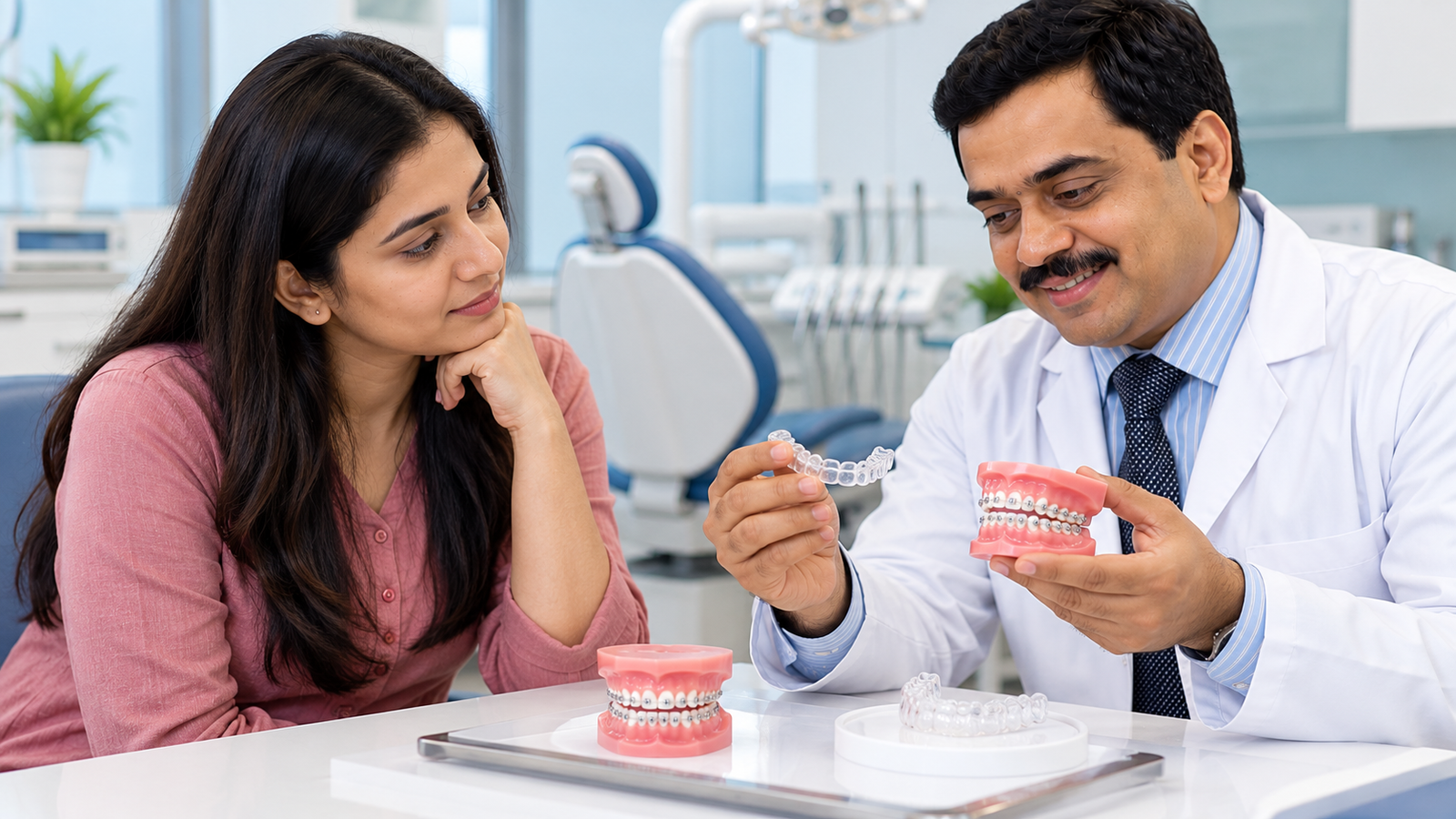
Clear Aligners Or Braces For Adults: A Side-By-Side Look At Time, Cost Drivers, Visits And Discipline
Clear aligners and fixed braces both straighten adult teeth, usually over 6 to 24 months. Aligners are removable and nearly invisible but only work if worn about 22 hours a day. Fixed braces handle complex rotations, large bite corrections and extraction cases more predictably. Gum health and bone levels must be checked first in adults.
Many adults want straighter teeth but hesitate because they associate orthodontic treatment with teenagers wearing metal braces.
Today, adults can choose between transparent removable aligners and several types of fixed braces.
Both approaches can improve tooth alignment, but they work differently.
The right choice depends on more than appearance. Your bite, gum health, bone support, treatment goals and ability to follow instructions all affect the result.
Understanding these differences helps you choose a treatment that fits both your dental needs and your daily routine.
How Do Clear Aligners and Braces Differ for Adults?
Clear aligners and fixed braces both apply controlled forces to move teeth gradually.
However, the way they deliver those forces is different.
How Clear Aligners Work
Clear aligners are transparent, removable trays made to fit over the teeth.
A planned series of trays gradually guides teeth toward their intended positions.
Depending on the case, treatment may involve small tooth-coloured attachments, interproximal enamel reduction or other orthodontic techniques.
Patients generally wear aligners for approximately 20–22 hours daily, following their orthodontist's instructions.
They remove the trays for meals and most drinks other than plain water.
For more information, explore clear aligner treatment.
How Fixed Braces Work
Fixed braces use brackets attached to the teeth and wires that apply orthodontic forces.
Braces remain in place throughout treatment.
They can provide precise control of many tooth movements, including difficult rotations and complex bite corrections.
Patients do not need to remember to wear an appliance, although oral hygiene and avoiding foods that damage brackets remain important.
Clear Aligners vs Braces for Adults: Side-by-Side Comparison
| Factor | Clear aligners | Fixed braces |
|---|---|---|
| Appearance | Nearly transparent | Metal or ceramic brackets are visible |
| Removability | Removable for eating and cleaning | Fixed to teeth |
| Daily wear discipline | Usually 20–22 hours | Continuous because brackets stay attached |
| Mild crowding | Often suitable | Suitable |
| Spacing between teeth | Often suitable | Suitable |
| Complex rotations | May require attachments or additional techniques | Often more predictable |
| Major bite correction | Possible in selected cases, with limitations | Often preferred for complex cases |
| Extraction cases | Possible in selected patients | Frequently offers greater control |
| Eating | Remove trays before meals | Avoid foods that may damage brackets |
| Cleaning | Brush teeth and clean trays separately | Extra cleaning around brackets |
| Clinic visits | Regular monitoring; interval varies | Regular adjustment visits |
| Typical duration | Often 6–24 months | Often 6–24 months or longer |
| Cost drivers | Number of trays, complexity, refinements | Bracket type, complexity, duration |
| After treatment | Retainers required | Retainers required |
Neither treatment is automatically better for every adult.
An orthodontist should recommend the option that can achieve the required tooth movements safely and predictably.
Which Cases Can Aligners Handle and Which Need Braces?
One of the most important questions in clear aligners vs braces for adults is whether the planned tooth movements are suitable for removable trays.
Mild Crowding
Mild crowding occurs when teeth overlap because there is insufficient space.
Clear aligners can often correct mild crowding effectively.
Fixed braces are also suitable.
The choice may depend on appearance, cost, patient preference and the exact movement required.
Small Gaps Between Teeth
Aligners can often close small gaps.
However, the orthodontist must identify why the gaps developed.
Spacing caused by gum disease, missing teeth or abnormal tooth proportions may require additional treatment.
Moderate Tooth Rotation
Some rotated teeth can be corrected with aligners.
More difficult rotations may require attachments, refinements or fixed appliances.
The shape and position of the tooth influence treatment predictability.
Severe Crowding
Severe crowding may require extra space through enamel reduction, expansion within safe limits or tooth extraction.
Some cases can be managed with aligners, but fixed braces may offer more predictable control.
Deep Bite and Overbite
Patients often ask, can aligners fix overbite?
Clear aligners can correct selected deep-bite problems, sometimes with bite ramps, attachments or other techniques.
However, severe skeletal discrepancies or complicated bite relationships may require fixed appliances, additional orthodontic devices or combined surgical planning.
Extraction Cases
Aligners can be used in selected extraction cases, but moving teeth through large spaces requires careful control.
Fixed braces may be preferable when substantial root movement, anchorage control or complex tooth positioning is required.
Case-Suitability Matrix
| Dental condition | Clear aligners | Fixed braces |
|---|---|---|
| Mild crowding | Often suitable | Suitable |
| Small gaps | Often suitable | Suitable |
| Mild tooth rotations | Often suitable | Suitable |
| Severe rotations | Case-dependent | Often preferred |
| Significant bite discrepancies | Case-dependent | Often preferred |
| Complex extraction treatment | Selected cases | Often preferred |
| Poor appliance-wear discipline | Less suitable | Often more practical |
| Active untreated gum disease | Treatment should wait | Treatment should wait |
Important: These are general patterns, not absolute rules. Modern aligner systems can manage some complex cases, while braces may also need additional appliances or surgical support.
What Decides the Treatment Time and Cost?
Patients comparing clear aligners vs braces for adults often focus on price and treatment duration.
However, both depend on the complexity of the case.
How Long Do Aligners Take for Adults?
For adults with mild alignment problems, treatment may take around six to twelve months.
Moderate cases may require twelve to eighteen months.
Complex orthodontic cases can take eighteen to twenty-four months or longer.
Fixed braces follow similarly variable timelines.
These ranges are estimates rather than guarantees.
Factors That Affect Treatment Duration
Treatment may take longer when a patient has:
-
Severe crowding
-
Large spaces between teeth
-
Difficult tooth rotations
-
Significant bite discrepancies
-
Teeth requiring substantial root movement
-
Previous orthodontic relapse
-
Missed appointments
-
Inconsistent aligner wear
-
Gum or periodontal problems
Additional aligner refinements may also extend treatment.
What Affects the Cost of Clear Aligners?
The cost depends on several factors:
-
Complexity of tooth movement
-
Number of aligner trays
-
Aligner system selected
-
Need for refinements
-
Diagnostic scans and records
-
Additional orthodontic procedures
-
Treatment monitoring
-
Retainers and follow-up care
What Affects the Cost of Braces?
Braces costs may depend on:
-
Metal, ceramic or other bracket systems
-
Treatment complexity
-
Number of adjustment appointments
-
Duration of treatment
-
Additional orthodontic appliances
-
Repairs or replacements
-
Retention after treatment
A cheaper initial quotation may not include every stage of treatment.
Patients should request a written estimate showing what is included.
Is the Most Expensive Option Always Better?
No.
Higher cost does not guarantee a better outcome.
The most appropriate treatment is the one that can achieve the planned correction safely while fitting the patient's clinical needs and ability to follow instructions.
Why Must Aligners Be Worn About 22 Hours a Day?
Clear aligners work only when they remain on the teeth for the prescribed time.
Many orthodontists recommend approximately 22 hours of aligner wear each day, although the exact instructions depend on the system and treatment plan.
What Happens If You Wear Aligners for Only 12 Hours?
Insufficient wear can interfere with planned tooth movement.
The teeth may not track correctly into the next tray.
This can cause:
-
Poor aligner fit
-
Delayed progress
-
Additional refinements
-
Longer treatment
-
Less predictable results
When Should You Remove Aligners?
Remove aligners when:
-
Eating meals
-
Drinking beverages other than plain water, unless advised otherwise
-
Brushing and flossing
-
Cleaning the trays
After meals, clean your teeth before reinserting the aligners whenever practical.
Who May Find Fixed Braces Easier?
Adults who frequently forget appliances, snack throughout the day or cannot consistently follow the wear schedule may find fixed braces more practical.
Braces eliminate the need to remember daily wear, although they require careful cleaning and maintenance.
How Many Clinic Visits Does Each Option Need?
Clinic visits are another important factor when choosing clear aligners vs braces for adults.
Both treatments require professional monitoring.
Clear Aligner Appointments
Patients commonly attend reviews every six to twelve weeks, although some cases need more frequent visits.
Appointments may include:
-
Checking tooth movement
-
Assessing aligner fit
-
Reviewing attachments
-
Monitoring bite changes
-
Providing additional trays
-
Deciding whether refinements are needed
Some monitoring may be supported remotely, but remote reviews do not replace all clinical examinations.
Fixed Braces Appointments
Braces patients commonly attend appointments every four to eight weeks, depending on the treatment plan.
The orthodontist may:
-
Adjust wires
-
Change elastics
-
Check bracket positions
-
Monitor tooth movement
-
Evaluate oral hygiene
-
Assess bite correction
Broken brackets or loose wires may require extra appointments.
Are Aligners Always Faster?
No.
Aligners may be efficient for selected mild cases, but treatment can take longer if patients do not wear them consistently.
Braces may be more predictable for certain complex movements.
Treatment duration should be based on the planned correction rather than the appliance alone.
What Must Be Checked Before an Adult Starts Straightening?
Adult orthodontic treatment requires careful assessment of gum health, bone support and existing dental restorations.
1. Gum Health
Adults may have gingivitis or periodontal disease.
Active gum disease should be treated and stabilised before orthodontic tooth movement.
Moving teeth when supporting tissues are unhealthy can increase the risk of further damage.
2. Bone Support
Teeth move through the surrounding jawbone.
Reduced bone support may affect how much movement is safe and how forces should be applied.
3. Existing Crowns, Bridges and Implants
Crowns and bridges may affect appliance planning.
Dental implants do not move like natural teeth because they are integrated with bone.
The orthodontist must account for these restorations.
4. Bite Relationship
Straight teeth do not automatically mean a healthy bite.
The clinician must examine how the upper and lower teeth meet.
Patients with significant bite problems may require a broader bite and occlusion correction assessment.
5. Dental Hygiene
Untreated cavities, plaque accumulation and gum inflammation should be addressed before treatment.
Both aligners and braces require good daily oral hygiene.
6. Treatment Expectations
Some patients want straighter teeth, while others are primarily concerned about the appearance of their smile.
A complete smile designing assessment may help identify whether orthodontics, restorative treatment or a combination is appropriate.
What Happens After Aligners or Braces Are Removed?
Orthodontic treatment does not end when the teeth reach their planned positions.
Teeth can shift over time.
Why Retainers Are Necessary
Retainers help maintain the corrected alignment.
Without retention, teeth may gradually move toward their previous positions or develop new alignment changes.
Types of Retainers
Common options include:
-
Removable clear retainers
-
Removable wire-and-acrylic retainers
-
Fixed bonded retainers
The orthodontist selects the type according to the patient's needs.
How Long Must Adults Wear Retainers?
Long-term retention is generally necessary.
Many patients require nighttime removable retainer wear indefinitely, or maintenance of a bonded retainer with regular checks.
The exact schedule depends on the orthodontist's instructions.
A retainer should be replaced or repaired if it becomes damaged or no longer fits correctly.
Clear Aligners Near Adajan: Which Option Should You Choose?
Adults considering clear aligners near adajan should begin with a comprehensive dental and orthodontic examination rather than selecting treatment based only on appearance.
A qualified dentist or orthodontist should assess:
-
Tooth alignment and crowding
-
Bite relationships
-
Gum health and bone support
-
Existing dental restorations
-
Need for tooth extraction
-
Suitability for aligner attachments
-
Ability to follow the wear schedule
-
Expected treatment duration
-
Total treatment cost
-
Retention requirements
Questions to Ask Before Starting
-
Can aligners correct my specific bite problem?
-
Would braces provide better control?
-
How many months might treatment take?
-
What happens if the teeth do not track as planned?
-
Are refinements included in the quotation?
-
How often will I need appointments?
-
Will I need tooth extraction?
-
What type of retainer will I need?
-
What is the expected total cost?
The most suitable appliance depends on the diagnosis and treatment plan.
For additional information, review the clear aligner FAQs.
Key Takeaways
-
Clear aligners vs braces for adults should be decided according to bite complexity, dental health and daily discipline.
-
Both treatments can straighten adult teeth.
-
Mild alignment problems may take around six to twelve months.
-
More complex cases may require eighteen to twenty-four months or longer.
-
Aligners are removable and nearly invisible.
-
Aligners generally require approximately 20–22 hours of daily wear.
-
Fixed braces often offer more predictable control for selected complex movements.
-
Both options require regular clinic monitoring.
-
Treatment costs depend on complexity, appliance type and duration.
-
Adults should have gum health and bone support assessed before treatment.
-
Retainers are necessary after both aligners and braces.
-
The treating orthodontist should determine which approach is appropriate.
Conclusion: Which Is Better for Adult Teeth Straightening?
The choice between clear aligners vs braces for adults is not simply about appearance.
Clear aligners offer a discreet, removable option that works well for many mild and moderate alignment problems.
Fixed braces remain valuable for complex rotations, significant bite discrepancies and cases requiring detailed control of tooth movement.
Both methods can produce successful results when properly planned and monitored.
The best decision starts with a thorough orthodontic examination, realistic expectations about treatment time and a clear understanding of the commitment required.
Whichever option you choose, maintaining healthy gums, attending follow-up appointments and wearing retainers are essential for protecting your results.