
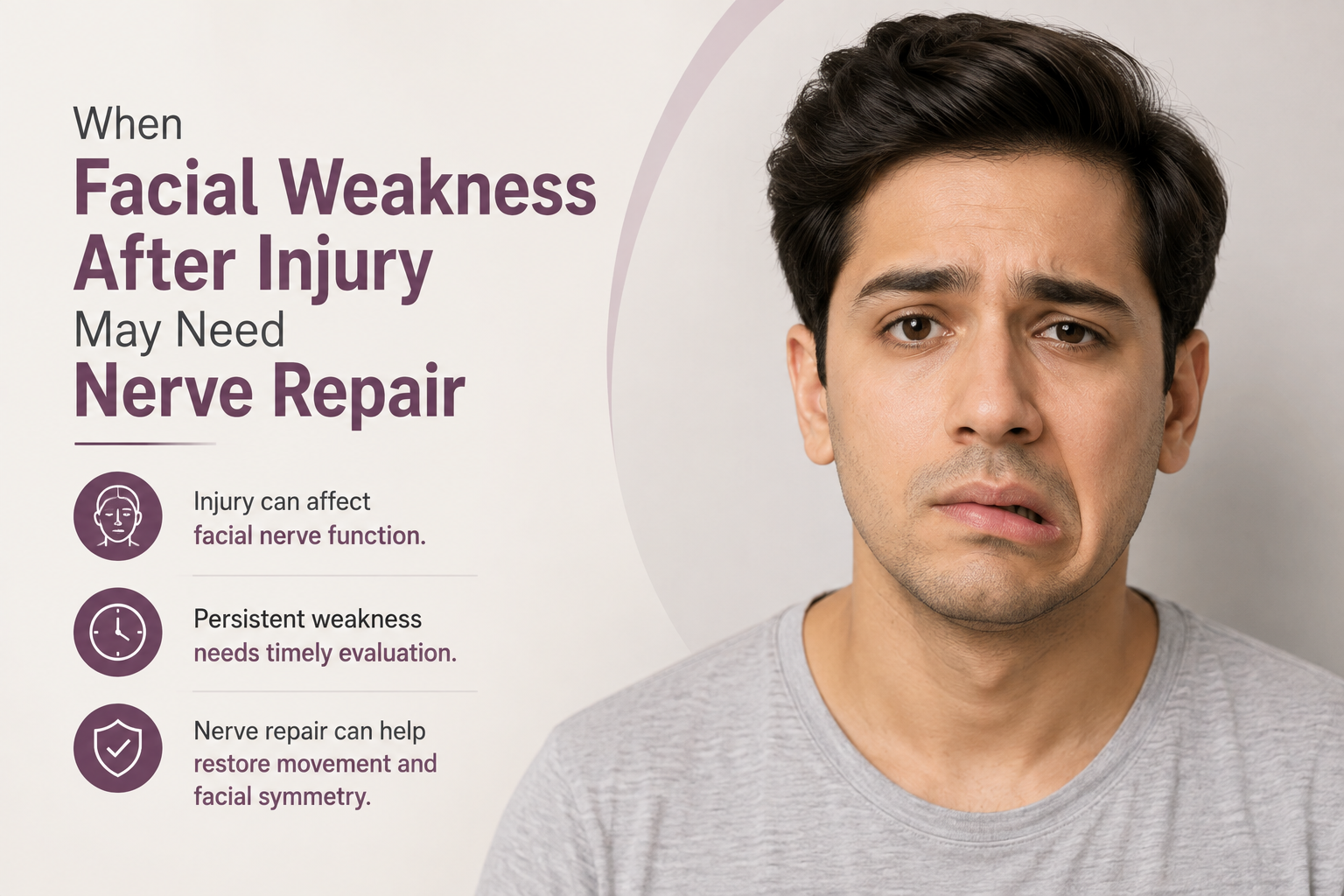
When Facial Weakness After Injury May Need Nerve Repair
Weakness in face after injury may occur when trauma damages the facial nerve or one of its branches. Mild nerve injuries can sometimes improve with observation and appropriate treatment, while a severely damaged or completely divided facial nerve may require surgical repair, nerve grafting, or another facial reanimation procedure. The appropriate treatment depends on the location and severity of the injury, how long ago it occurred, and whether the facial muscles remain capable of responding to nerve signals.
For people experiencing persistent facial weakness following an accident, cut, surgical injury, or other trauma, an early specialist assessment can help determine whether nerve repair or another treatment approach is appropriate.
What Causes Weakness in the Face After an Injury?
The facial nerve controls many of the muscles responsible for facial expression, including movements involved in smiling, closing the eyes, raising the eyebrows and moving the lips.
When this nerve is stretched, compressed, bruised or completely divided during an injury, the affected side of the face may become weak or partially paralysed.
Common situations associated with facial nerve injury include:
- Facial cuts or lacerations
- Road traffic or other accidents
- Penetrating facial trauma
- Fractures involving areas through which the facial nerve travels
- Previous facial or ear surgery
- Trauma around the parotid region
- Severe soft-tissue injuries
The symptoms can range from subtle weakness to almost complete facial paralysis, depending on the extent and location of nerve damage.
Signs You Should Not Ignore
If you have weakness in face after injury, pay attention to changes such as:
| Symptom | What It May Indicate |
|---|---|
| Difficulty smiling | Reduced facial muscle movement |
| One side of the mouth appears lower | Facial nerve weakness |
| Difficulty closing one eye | More significant facial nerve dysfunction |
| Reduced eyebrow movement | Involvement of facial nerve branches |
| Drooling or difficulty controlling the lips | Reduced facial muscle control |
| Facial asymmetry | Unequal facial nerve function |
| Difficulty making facial expressions | Impaired facial nerve signalling |
Eye closure is particularly important because incomplete eyelid closure can expose the eye and create ocular complications.
When Does Facial Weakness After Injury Need Nerve Repair?
Not every case of facial weakness requires surgery.
The key question is whether the facial nerve is still capable of recovering on its own or whether the nerve has been significantly disrupted.
1. Mild or Incomplete Nerve Injury
If the nerve has been bruised or stretched but remains structurally intact, spontaneous recovery may be possible.
In these cases, a specialist may recommend observation, appropriate medical management, facial rehabilitation and monitoring rather than immediate nerve surgery.
2. Severe Nerve Damage
If the nerve has been severely damaged or its continuity has been disrupted, surgical reconstruction may be considered.
For an acute traumatic nerve transection, direct end-to-end nerve repair is generally preferred when the nerve ends can be brought together without tension. If a gap prevents direct repair, an interposition nerve graft may be considered.
3. Persistent Facial Weakness
Sometimes the injury is not recognized immediately, or the person continues to experience facial weakness after the initial treatment.
This does not automatically mean that treatment is impossible. Depending on the duration of paralysis and the condition of the facial muscles, delayed nerve repair, nerve grafting, nerve transfer or other facial reanimation procedures may be considered.
Why Timing Matters in Facial Nerve Injury
One of the most important factors in facial nerve reconstruction is time.
When the facial nerve is completely disrupted during trauma, early repair can provide the best opportunity to restore nerve continuity. Research on traumatic and iatrogenic facial nerve injuries supports prompt evaluation and repair when appropriate.
However, a delayed presentation does not necessarily mean that a patient has no treatment options.
The facial muscles need to remain viable for successful reinnervation. As denervation continues, muscles can gradually undergo atrophy and fibrosis, which may reduce the potential benefit of conventional nerve repair.
This is why someone experiencing weakness in face after injury should not simply wait indefinitely for improvement without professional assessment.
How Is Facial Nerve Damage Evaluated?
Before recommending nerve repair, a specialist needs to understand what happened to the nerve and how much function remains.
Depending on the injury, evaluation may include:
Clinical Examination
The face is assessed at rest and during different expressions, including:
- Smiling
- Raising the eyebrows
- Closing the eyes
- Showing the teeth
- Puckering the lips
- Moving the cheeks
Electrodiagnostic Testing
Tests such as electroneurography (ENoG) and electromyography (EMG) can provide information about nerve degeneration and whether facial muscles retain signs of viable nerve activity.
Imaging
Depending on the mechanism of injury, imaging may help identify fractures, structural damage or the location of the injury.
Injury History
The timing of the trauma is particularly important. A facial injury that occurred yesterday is managed differently from facial weakness that has persisted for several months.
What Are the Treatment Options?
There is no single treatment that works for every facial nerve injury.
Treatment may include:
Observation and rehabilitation
Appropriate for selected injuries where the nerve remains intact and recovery is expected.
Direct nerve repair
When the damaged nerve ends can be brought together without excessive tension, direct repair may be possible.
Nerve grafting
When there is a gap between the nerve ends, an interposition graft may be used to bridge the damaged area. Common donor nerves include the greater auricular and sural nerves.
Nerve transfer
When the original nerve cannot be directly reconnected, a different functioning nerve may sometimes be used to provide a new source of nerve input to the affected facial muscles.
Facial reanimation procedures
For selected patients with longstanding facial paralysis, other dynamic or static facial reanimation techniques may be more appropriate than conventional nerve repair.
The choice depends on the injury pattern, duration, muscle viability, available nerve segments and individual functional goals.
Can Facial Weakness Improve After Nerve Repair?
Facial nerve repair can improve facial movement and symmetry, but recovery is usually gradual rather than immediate.
After repair, nerve fibres need time to regenerate toward the facial muscles. Clinical improvement may therefore take months, and rehabilitation can be an important part of recovery.
Patients should also understand that nerve repair does not guarantee a completely normal return of facial movement. Outcomes vary according to factors such as:
- Severity of the original injury
- Location of nerve damage
- Time between injury and treatment
- Patient age and general health
- Condition of the facial muscles
- Type of reconstruction performed
- Rehabilitation after treatment
Some patients may experience involuntary linked movements, known as synkinesis, during recovery.
Why Early Specialist Assessment Matters
A common mistake is assuming that facial weakness will automatically disappear after an accident.
Sometimes it does improve. However, persistent or severe facial weakness can indicate significant facial nerve damage, and delaying evaluation may affect which reconstructive options remain suitable.
If the weakness began immediately after a traumatic facial injury, particularly if there is difficulty closing the eye or marked facial asymmetry, specialist assessment should not be unnecessarily delayed.
Facial Nerve Repair in Surat
For individuals searching for facial nerve repair surgery in Surat, evaluation should focus on identifying the underlying cause of facial weakness rather than treating facial asymmetry alone.
At Elegance Clinic, Dr. Ashutosh Shah can assess facial changes following trauma and discuss whether nerve repair or another reconstructive approach may be appropriate based on the individual case.
Treatment planning should be personalized because facial nerve injuries differ considerably in location, severity and duration.
Weakness in Face After Injury: Key Takeaways
- Weakness in face after injury can be a sign of facial nerve damage.
- Trauma can cause facial nerve bruising, stretching, compression or complete disruption.
- Not every facial nerve injury requires surgery.
- Severe nerve disruption may require direct nerve repair or nerve grafting.
- Nerve transfer or facial reanimation may be considered in selected delayed or longstanding cases.
- Earlier assessment is important because treatment options can depend on the time since injury and the condition of the facial muscles.
- Recovery after nerve repair is gradual and may take months.
- Rehabilitation can help patients maximise functional recovery.
- Persistent facial weakness after trauma should be evaluated rather than ignored.
Conclusion: Don't Ignore Persistent Facial Weakness After Trauma
Weakness in face after injury should not always be considered a temporary cosmetic concern. It can indicate damage to the facial nerve, particularly when weakness affects smiling, eye closure, eyebrow movement or overall facial symmetry.
The right treatment depends on the type and severity of nerve injury and how much time has passed since the trauma. Early specialist evaluation can help identify whether the nerve may recover naturally or whether reconstruction, nerve grafting, nerve transfer or another facial reanimation procedure should be considered.
Experiencing weakness in your face after an injury? Book a consultation with Elegance Clinic in Surat to understand the cause and explore appropriate facial nerve repair or reconstructive treatment options.