Veneers, Bonding Or Whitening: Which Smile Treatment Fits Your Problem
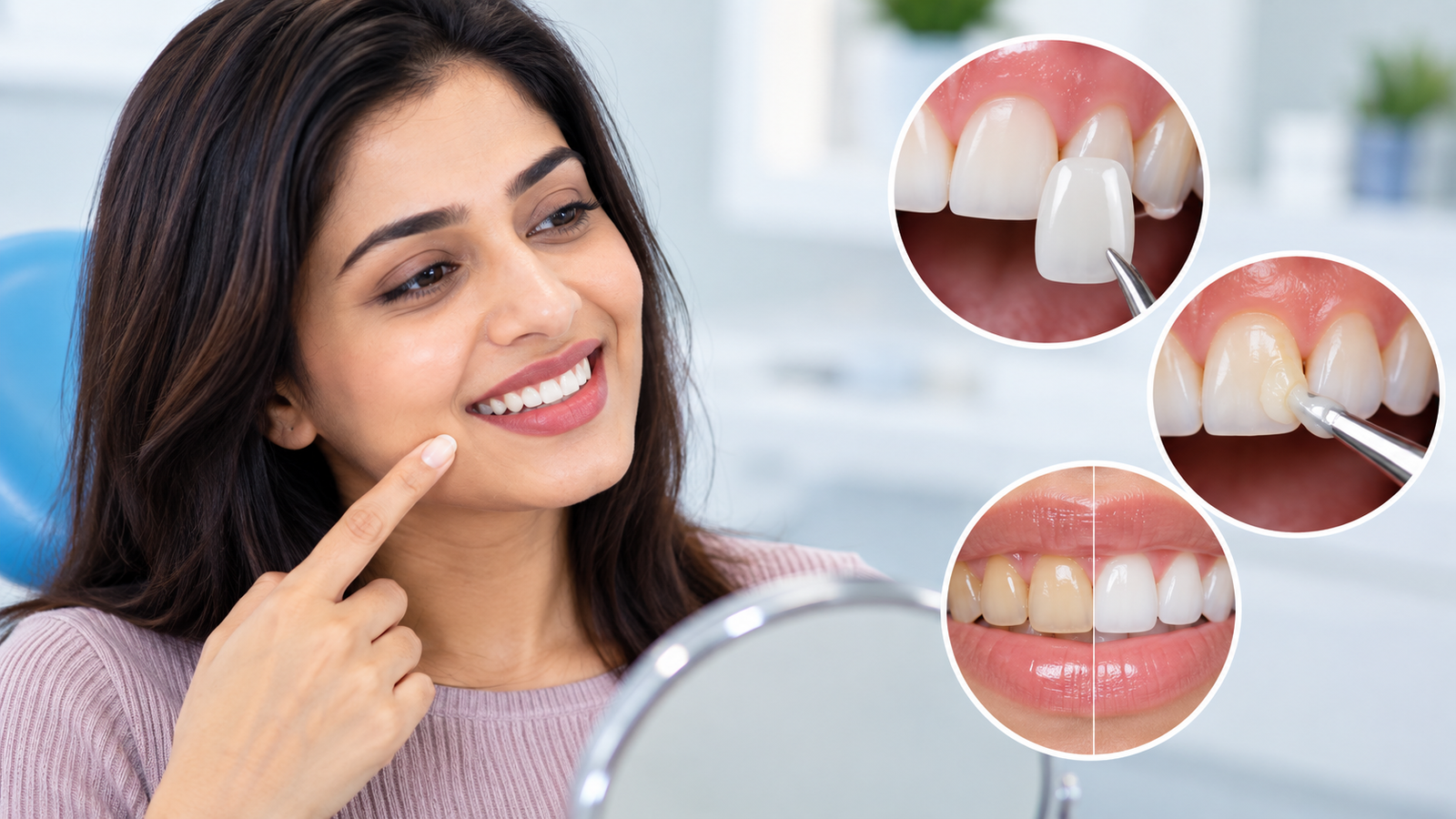
Whitening changes colour only. Bonding rebuilds a chip or closes a small gap in one visit and is repairable. Veneers reshape the visible surface and usually involve removing a thin layer of enamel, which cannot be reversed. Match the treatment to the actual problem, not the trend.
Choosing between veneers vs bonding vs whitening becomes easier when the treatment is matched to what you actually want to change. A stained tooth does not necessarily need a veneer, while whitening cannot repair a chipped edge or change an uneven tooth shape.
At Elegance Clinic, treatment planning with Dr. Ashutosh Shah focuses on assessing the overall smile, tooth structure, colour, alignment and facial balance before deciding which cosmetic option may be appropriate.
What Problem Does Each Treatment Actually Solve?
Although whitening, bonding and veneers can all improve a smile, they work in very different ways.
Teeth Whitening
Whitening primarily changes the colour of natural teeth.
It may be considered when teeth are generally healthy but appear yellow or stained because of food, drinks, smoking or natural colour changes.
Whitening does not:
- Repair chipped teeth
- Close significant gaps
- Straighten crowded teeth
- Change tooth shape
- Whiten existing crowns, veneers or fillings
If colour is the main concern, whitening may be the most conservative place to start.
Patients considering whitening can also read about Sensitive teeth after whitening.
Composite Bonding
Composite bonding uses tooth-coloured resin that is shaped and attached to the tooth.
It can be useful for small chips, minor gaps, uneven tooth edges, small shape differences and selected areas of wear.
A major advantage is that bonding can often be completed with little or no removal of natural tooth structure. Composite can also usually be repaired if part of it chips later.
Veneers
Veneers are thin restorations placed over the visible surface of teeth.
They can change several features at the same time, including tooth colour, shape, proportion, worn edges and selected gaps or minor alignment concerns.
However, veneers usually involve some alteration of natural enamel. Once enamel has been prepared for veneers, the tooth generally continues to require a restoration in the future.
For patients considering a broader cosmetic plan, What smile designing can fix explains how several dental concerns can be assessed together.
Veneers vs Bonding vs Whitening: How Do You Choose?
The right choice depends on the problem rather than which treatment is currently popular.
| Problem | Recommended Option | Tooth Structure Removed | Longevity | Reversibility | Ten-Year Cost Consideration |
|---|---|---|---|---|---|
| General yellowing or staining | Whitening | None | Requires maintenance | Yes | Repeat whitening may be needed |
| Small chipped tooth | Composite bonding | Usually minimal or none | May need repair | More conservative | Repairs may be needed |
| Small gap | Bonding in suitable cases | Usually minimal | May require maintenance | More conservative | Maintenance should be considered |
| Colour plus shape change | Veneers may be considered | Usually some enamel | Longer-term restoration | Generally not reversible | Future replacement should be considered |
| Worn tooth edge | Bonding or veneer | Depends on option | Depends on bite/material | Depends on treatment | Maintenance varies |
| Mild shape irregularity | Bonding or veneer | Minimal with bonding; more with veneers | Varies | Depends on treatment | Consider future maintenance |
| Significant crowding | Orthodontic assessment | Depends on treatment | — | — | Compare with orthodontic treatment |
How Much Natural Tooth Is Changed, and What Is Reversible?
Preserving healthy natural tooth structure should be an important part of cosmetic dental planning.
Whitening changes colour without reshaping the tooth. Composite bonding generally adds material and may require little or no enamel removal in suitable cases.
Veneers are different. They often require preparation of the visible tooth surface. Once enamel has been removed, the treatment should generally not be considered reversible.
This difference is important when comparing veneers vs bonding vs whitening, particularly for patients with otherwise healthy natural teeth.
How Long Does Each Option Last and What Maintenance Does It Need?
No cosmetic dental treatment should be considered completely maintenance-free.
Whitening may require periodic touch-ups as staining gradually returns.
Composite bonding can remain satisfactory for years, but its longevity depends on the bite, tooth position, oral habits, diet and maintenance. Composite may eventually stain, wear or chip, although localised damage can often be repaired.
Veneers are intended as longer-term restorations but are not lifetime treatments. Their longevity depends on the material, tooth preparation, bite, oral hygiene and habits such as teeth grinding.
Regular dental examinations remain important whichever treatment is selected.
How Do Costs Compare Over Ten Years?
Comparing only the initial treatment price can be misleading.
Whitening generally has a lower initial cost but may require repeated maintenance. Bonding can also have a lower initial cost than veneers but may need polishing, repair or replacement.
Veneers usually involve a higher initial investment, and eventual replacement should also be considered.
A long-term comparison should therefore consider:
- Initial treatment
- Number of teeth involved
- Maintenance
- Repairs
- Whitening touch-ups
- Restoration replacement
- Protective night guard if needed
- Routine dental reviews
The treatment should first fit the dental problem rather than being selected on price alone.
How Is a Combined Smile Plan Built When Several Issues Exist Together?
Many patients have more than one concern.
For example, someone may have stained teeth together with one chipped front tooth and a small gap. This does not automatically mean every visible tooth requires veneers.
A more conservative plan might involve whitening the natural teeth first and then using composite bonding for the chip or gap.
A complete smile assessment may consider:
- Gum health
- Tooth decay
- Existing restorations
- Bite and alignment
- Tooth colour
- Chips and worn edges
- Gaps
- Tooth proportions
- The desired degree of cosmetic change
For a broader overview, see Smile improvement treatment in Surat.
Patients can also explore Dental and smile treatments at Elegance Clinic.
When Might None of These Three Be the Right First Treatment?
Not every cosmetic concern should immediately be treated with whitening, bonding or veneers.
Significant crowding or bite problems may require orthodontic assessment. Active gum disease should be treated before cosmetic work, while tooth decay or structural damage may require restorative treatment first.
Likewise, severe teeth grinding can affect the longevity of bonding and veneers if the underlying problem is not addressed.
At Elegance Clinic, this broader assessment helps determine whether cosmetic treatment should proceed immediately or whether another dental concern should be managed first.
Conclusion
When comparing veneers vs bonding vs whitening, start with the problem that actually needs correcting.
Whitening primarily changes colour. Composite bonding can conservatively repair small chips, gaps and shape irregularities. Veneers can make larger changes to colour, shape and proportion but usually involve alteration of natural enamel.
Dr. Ashutosh Shah and the team at Elegance Clinic can assess the teeth, smile proportions and overall facial balance to help determine which approach is appropriate for the individual concern. Where several issues exist together, the treatment plan may combine different options rather than applying the same procedure to every tooth.
The goal should be an appropriate smile improvement while preserving healthy natural tooth structure wherever possible and considering maintenance, longevity, reversibility and long-term care.