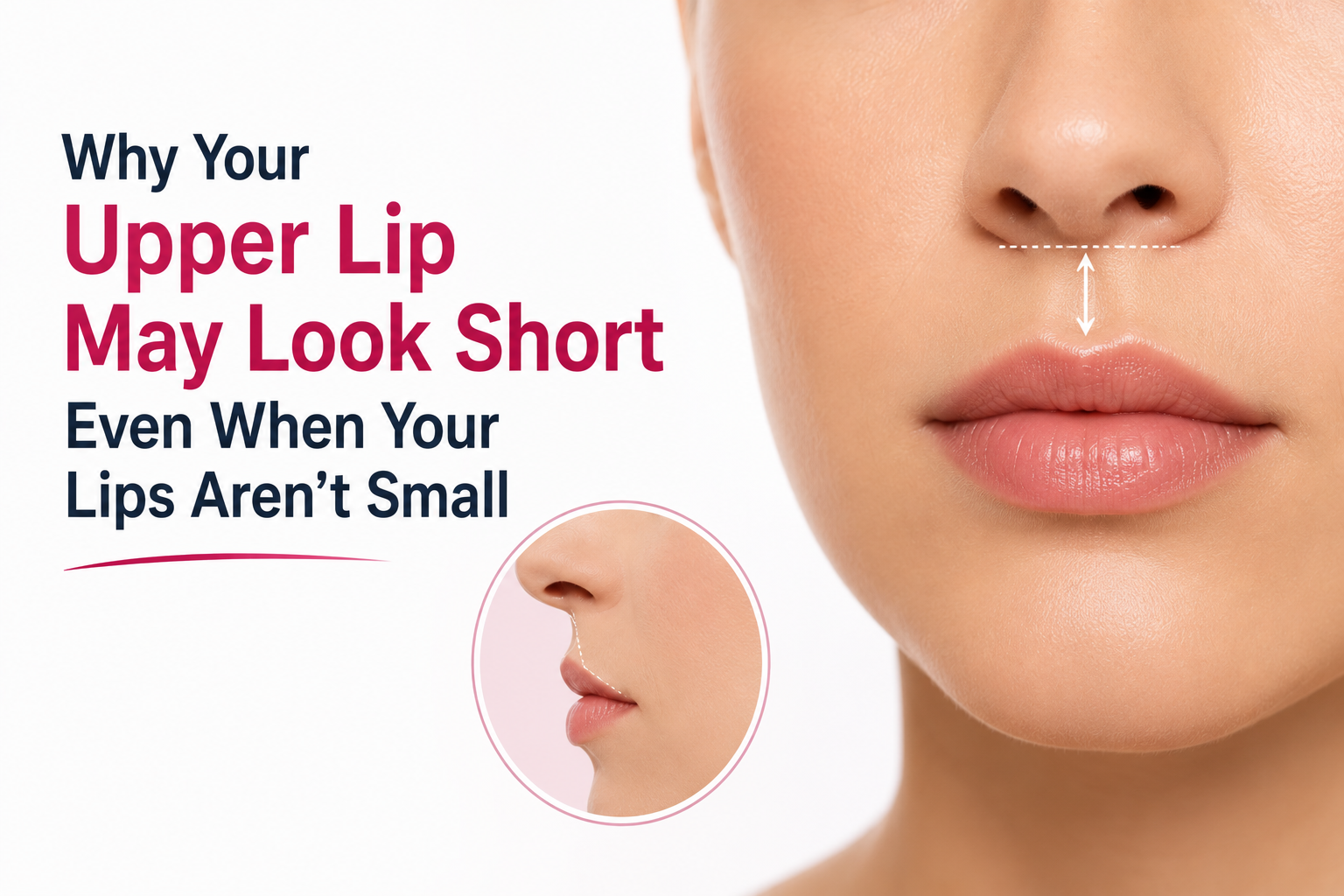
Why Your Upper Lip May Look Short Even When Your Lips Aren’t Small
When people feel their upper lip looks “too short,” they often assume the solution is simply to make the lips larger. But lip size is only one part of how the upper lip appears.
The upper lip can look short because of the relationship between the nose, philtrum, upper lip, teeth and overall facial proportions. In some cases, the lip itself has adequate volume, but the distance between the nose and upper lip or the amount of visible upper lip changes the way the area is perceived.
This is why Short Upper Lip Correction in Surat is not necessarily about adding more lip volume. The right approach depends on what is creating the short-looking appearance in the first place.
What Does a “Short Upper Lip” Actually Mean?
A short-looking upper lip can refer to different things.
Some people have a naturally shorter upper lip, while others have a longer philtrum—the vertical area between the base of the nose and the upper lip which can make the upper lip appear smaller or less visible.
The appearance can also change with:
- Natural facial anatomy
- Age-related changes
- Changes in lip position
- Reduced visibility of the upper lip
- Dental or skeletal proportions
- Previous cosmetic treatments
- Individual facial structure
Therefore, simply looking at lip volume does not always tell you whether the upper lip is actually “small.”
The important distinction
Lip volume and lip position are different things.
A person can have reasonably full lips but still feel that the upper lip looks short, hidden or disproportionate to the rest of the face.
The Overlooked Role of the Philtrum
One of the most overlooked factors in upper-lip appearance is the philtrum.
The philtrum is the vertical area extending from the base of the nose toward the upper lip. Its length and relationship with the lips influence how the middle third of the face looks.
When this area appears relatively long, the upper lip may appear less prominent even when the actual lip tissue is not particularly small.
This is one reason why evaluating facial proportions can be more useful than focusing only on lip size.
Why this matters for treatment
If the underlying concern is related to the relationship between the nose, philtrum and upper lip, increasing lip volume may not address the main concern.
Instead, an appropriate patient assessment can help determine whether structural reshaping, a lip lift or another cosmetic approach would be more suitable.
Why Lip Fillers May Not Always Correct a Short-Looking Upper Lip
Lip fillers primarily increase lip volume.
That can be useful when someone wants fuller lips, but it does not shorten the philtrum or reposition the upper lip in the same way that a surgical lip lift can.
This distinction is important.
Lip filler generally focuses on:
- Increasing lip volume
- Improving lip fullness
- Enhancing lip contour
- Creating temporary changes in lip shape
Lip lift surgery focuses on a different structural relationship
A lip lift can alter the distance between the nose and upper lip and increase the amount of visible upper lip.
That does not mean everyone with a short-looking upper lip needs surgery. Instead, the appropriate option depends on the individual's anatomy, goals and examination.
What Is Short Upper Lip Correction?
Short Upper Lip Correction in Surat refers to cosmetic assessment and treatment aimed at improving the appearance or proportion of an upper lip that looks short, less visible or disproportionate to the surrounding facial features.
Depending on the cause, treatment may involve:
- Lip lift surgery
- Lip reshaping
- Lip volume enhancement
- A combination of approaches
- No treatment, if the anatomy is already proportionate
A consultation is therefore important before deciding on a specific procedure.
How a Lip Lift Can Change Upper-Lip Proportion
A surgical lip lift is designed to modify the relationship between the base of the nose and the upper lip.
In a commonly performed subnasal or “bullhorn” lip lift, an incision is placed near the base of the nose. A carefully planned amount of tissue is removed, and the upper lip is repositioned upward.
The objective is not simply to make the lips “bigger.”
Instead, the procedure may help:
- Increase visible upper-lip show
- Reduce the apparent length of the philtrum
- Improve upper-lip proportion
- Create greater balance between the nose and lips
- Enhance the appearance of the smile and lower face in selected patients
The result should be planned according to the individual's facial structure rather than a standard measurement or trend.
Who May Consider Short Upper Lip Correction?
Short upper lip correction may be considered by adults who feel that their upper lip appears disproportionate or insufficiently visible.
A consultation may be appropriate if you notice:
- A relatively long distance between the nose and upper lip
- Limited upper-lip show
- An upper lip that appears less prominent despite adequate volume
- Facial imbalance around the nose and mouth
- A desire for a more defined upper-lip shape
- Dissatisfaction with previous volume-based lip treatments
However, not every person with these concerns is a candidate for a lip lift.
A qualified surgeon needs to assess your anatomy, skin characteristics, lip movement, facial proportions and expectations before recommending treatment.
Short Upper Lip Correction Is About Balance, Not Maximum Lip Size
One common misconception is that cosmetic lip correction should create very large or highly projected lips.
That is not necessarily the goal.
For many patients, the objective is proportion.
A subtle change in the upper lip can sometimes make a noticeable difference to how the central portion of the face is perceived.
This is particularly important because the upper lip sits directly beneath the nose and above the chin. Even a relatively small change can affect the visual relationship between several facial features.
Natural-looking correction generally considers:
Nose → Philtrum → Upper Lip → Lower Lip → Chin
Rather than evaluating the lips in isolation, the surgeon can consider how they fit into the entire facial profile.
How Is Short Upper Lip Correction Planned?
A personalised consultation is an important part of treatment planning.
The assessment may consider:
1. Upper-lip anatomy
The surgeon evaluates the natural shape, thickness and position of the upper lip.
2. Philtrum appearance
The distance between the nose and upper lip can influence whether the lip appears short or less prominent.
3. Facial proportions
The upper lip is assessed in relation to the nose, lower lip, chin and surrounding facial features.
4. Lip movement
Dynamic movement can affect how the upper lip appears while speaking, smiling and at rest.
5. Skin and tissue characteristics
Skin elasticity and tissue quality can influence surgical planning and healing.
6. Patient expectations
The desired degree of change should be realistic and compatible with the person's existing anatomy.
This detailed evaluation helps prevent the common mistake of choosing a treatment simply because it is popular.
Lip Lift vs Lip Filler: Which One Is Better?
There is no universal answer because they address different concerns.
| Feature | Lip Lift | Lip Filler |
|---|---|---|
| Main purpose | Changes upper-lip position/proportion | Adds volume |
| Philtrum appearance | Can reduce apparent vertical distance | Does not structurally shorten it |
| Upper-lip show | Can increase it | May increase fullness |
| Duration | Surgical/long-lasting | Temporary |
| Procedure type | Surgical | Injectable |
| Best suited to | Selected anatomical concerns | Volume/contour enhancement |
A person who wants fuller lips may benefit from a volume-based approach, while someone whose main concern is the relationship between the nose, philtrum and upper lip may need a different assessment.
What About Scarring After a Lip Lift?
Because a lip lift involves an incision, scarring is an important consideration.
The incision is generally planned near the natural crease at the base of the nose. However, individual healing varies, and no surgical scar can be guaranteed to become completely invisible.
Factors that can influence scar appearance include:
- Individual healing response
- Skin type
- Surgical technique
- Aftercare
- Genetics
- Exposure to environmental factors
This should be discussed honestly during consultation before deciding on surgery.
What Is Recovery Like?
Recovery varies between individuals and depends on the exact procedure performed.
After a surgical lip lift, temporary effects may include:
- Swelling
- Tightness
- Bruising
- Mild discomfort
- Temporary changes in lip movement or sensation
The initial appearance should not be considered the final result because swelling and tissue healing can take time.
Your surgeon will provide personalised instructions regarding wound care, activity, medications and follow-up.
Why an In-Person Assessment Matters in Surat
Searching for Short Upper Lip Correction in Surat can help you find treatment providers, but online information cannot determine whether a particular procedure is appropriate for your face.
Two people may have similar concerns but completely different anatomical reasons for them.
A proper consultation allows the surgeon to examine:
- Facial proportions
- Lip anatomy
- Philtrum length and appearance
- Upper-lip movement
- Skin quality
- Existing asymmetry
- Desired outcome
At Elegance Clinic, treatment planning can be personalised around the individual's facial anatomy and aesthetic goals. Dr. Ashutosh Shah can assess whether a lip lift or another approach is appropriate based on the patient's specific concerns.
What Should You Ask During a Consultation?
If you are considering Short Upper Lip Correction in Surat, asking the right questions can make your consultation more useful.
Consider asking:
- Why does my upper lip appear short?
- Is the issue related to lip volume or facial proportion?
- Would a lip lift actually address my concern?
- Would filler be appropriate instead?
- Where would the incision be placed?
- What type of scar should I expect?
- How much change is realistic?
- What is the expected recovery period?
- What are the potential risks?
- How will the procedure affect my smile?
- Are there alternatives to surgery?
These questions can help you understand whether the proposed treatment matches your actual concern.
Key Takeaways
- A short-looking upper lip does not always mean the lips lack volume.
- The philtrum and overall facial proportions can strongly influence upper-lip appearance.
- Lip fillers add volume but do not structurally shorten the philtrum.
- A lip lift may be considered for selected patients who want to improve upper-lip position or facial proportion.
- Natural-looking correction focuses on balance rather than excessive lip size.
- Individual assessment is essential before choosing Short Upper Lip Correction in Surat.
- Surgical procedures involve risks, recovery and potential scarring, which should be discussed during consultation.
Conclusion: Is Short Upper Lip Correction Right for You?
If your upper lip looks short even though you already have reasonable lip volume, the underlying issue may be facial proportion rather than lip size.
The relationship between the nose, philtrum and upper lip can significantly influence how the central face appears. For some patients, a lip lift may provide a more appropriate solution than simply adding volume. For others, a different cosmetic approach—or no procedure at all may be more suitable.
If you are considering Short Upper Lip Correction in Surat, a personalised evaluation is the best way to understand what is contributing to your concern and which options may realistically address it.
Thinking about correcting a short-looking upper lip? Schedule a consultation at Elegance Clinic in Surat to discuss your facial proportions, treatment options, expected results and recovery with a qualified cosmetic surgeon.