
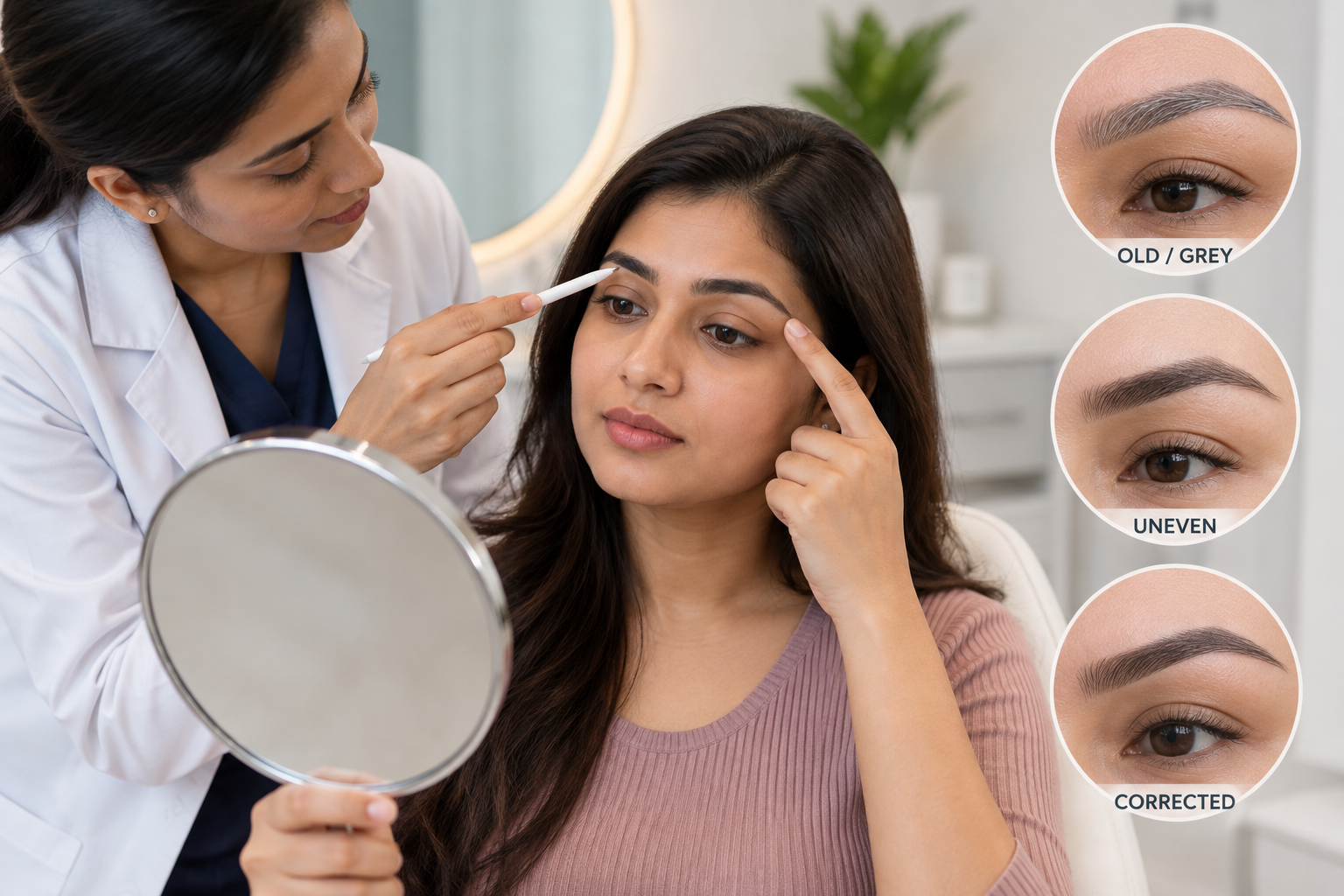
Fixing Old, Grey Or Uneven Microblading: Correction Options Explained
Old pigment shifts as its warm tones fade first, leaving grey, blue or orange behind. Light, patchy work can often be corrected over in one or two sessions. Dense, saturated or badly shaped work usually needs lightening or removal first, and microblading correction is planned across several months.
Old microblading does not always fade evenly. Some brows become grey or blue, others develop an unwanted warm or orange tone, and some are left with patchy pigment or an uneven shape.
The right microblading correction depends on what pigment remains in the skin, how saturated it is, the existing brow shape and whether adding new pigment would improve or worsen the result.
For some people, colour correction and reshaping may be possible. For others, lightening or removal needs to come first.
Why does old pigment turn grey, blue or orange over time?
Microblading pigment does not necessarily fade as one uniform colour.
Pigments contain different colour components, and those components can fade at different rates. As the original colour changes over time, the remaining pigment may appear cooler, warmer or simply different from the shade seen immediately after treatment.
This can leave brows looking:
- Grey or ashy
- Blue-grey
- Reddish
- Orange
- Uneven or patchy
- Different in colour from one area to another
Skin type, pigment choice, technique, depth, sun exposure, skincare products and previous treatments can all influence how permanent makeup changes over time.
Why do some brows become grey?
Grey brows after microblading may develop when cooler pigment becomes more visible as other components fade.
Pigment that was implanted too densely or remains strongly saturated can also make an old brow appear darker and cooler.
Simply adding more dark pigment is not always the answer because this can increase saturation without correcting the underlying colour problem.
Why can brows turn orange or red?
In other cases, warmer components remain more noticeable as the original colour fades.
The result may look reddish or orange rather than the intended natural brown.
A trained practitioner needs to assess the remaining colour before deciding whether colour correction is suitable.
Does this mean the original treatment was necessarily done badly?
Not always.
Permanent makeup changes as the pigment and surrounding skin change over time. However, unsuitable pigment selection, excessive saturation, inappropriate technique or poor placement can make later correction more difficult.
The current condition matters more than trying to judge the old procedure from colour alone.
For a broader overview, see Semi permanent makeup in Surat.
When can existing work be corrected over, and when must it be lightened first?
This is the most important decision in microblading correction.
Not every old brow should immediately receive another layer of pigment.
Light and faded old pigment
If the previous pigment is faint, reasonably shaped and no longer heavily saturated, correction may be possible without prior removal.
The practitioner may adjust the colour and refine the shape during a new permanent makeup treatment.
Patchy pigment
Patchiness may sometimes be improved by carefully rebuilding missing areas and balancing the overall colour.
However, the remaining pigment needs to be assessed first. Adding pigment repeatedly to already saturated areas can create a heavier result.
Grey, blue or orange pigment
A colour correction approach may sometimes be considered when the old pigment is light enough to work over.
The corrective colour is selected according to the unwanted tone and the desired healed result.
This is colour correction PMU, not simply choosing a darker brown and covering everything.
Dense or saturated pigment
If old pigment remains very dark or heavily saturated, there may be insufficient visual space to create a clean new result.
Adding more pigment can make the brow appear:
- Darker
- Wider
- Heavier
- More solid
- Less natural
In these situations, lightening or removal may need to be considered before new pigment is added.
Poorly positioned or badly shaped brows
Shape creates another problem.
Suppose the old brow extends too far outside the desired outline. Covering it with another brow does not make the misplaced pigment disappear.
Trying to conceal it may require creating an even larger brow.
That is why an old brow tattoo cover up is not suitable in every case.
When unwanted pigment lies outside the planned new shape, lightening or removal may be the more appropriate first step.
How many sessions does a realistic correction take?
There is no fixed number of microblading correction sessions that applies to every person.
According to the condition of the existing work, correction may require one or more stages.
A relatively light correction
Faded, light and reasonably shaped pigment may sometimes be improved over one or two treatment sessions, including a perfecting session after healing.
Colour correction
When an unwanted tone needs neutralisation, the process may require more than one session because the healed colour needs to be assessed before additional pigment is added.
Lightening followed by correction
Dense, misplaced or highly saturated pigment can require a longer pathway.
The sequence may involve:
- Assessment of the old pigment
- One or more lightening/removal sessions where appropriate
- Healing between sessions
- Reassessment
- New brow design
- Corrective pigmentation
- A later perfecting session if required
This can extend the process across several months.
Trying to complete everything quickly may not allow enough time to see how the skin and remaining pigment have healed.
At Elegance Clinic, Dr. Ashutosh Shah can assess facial and brow concerns as part of an individual treatment plan, while the suitability and technique for permanent makeup correction should be determined by an appropriately trained practitioner.
What results are honestly achievable on heavily saturated old work?
Heavily saturated old permanent makeup is one of the more difficult situations to correct.
The realistic goal may not be to erase every trace of previous pigment immediately.
Instead, treatment may aim to reduce the unwanted colour or density enough to allow a better new design later.
What microblading correction may improve
Depending on the starting condition, treatment may help improve:
- Unwanted grey or warm tones
- Patchy colour
- Minor asymmetry
- Faded sections
- Some irregular borders
- Overall brow balance
What correction cannot simply hide
Adding pigment alone cannot reliably make very dark underlying pigment disappear.
It also cannot easily conceal a badly positioned brow if the old pigment extends substantially outside the desired new shape.
In those situations, removal or lightening may be discussed first.
Why “perfect cover-up” promises should be treated cautiously
A practitioner cannot change the fact that old pigment already occupies space in the skin.
The darker and more saturated that pigment is, the less flexibility there may be for redesign.
A realistic consultation therefore explains both what can be improved and what may remain visible.
For information about facial permanent makeup options, see Permanent makeup for face in Surat.
How is the correction plan decided at consultation?
A proper microblading correction consultation should begin with the existing brows rather than immediately selecting a new pigment shade.
The practitioner should assess several factors.
Existing pigment colour
Is the pigment grey, blue, red, orange, brown or a mixture of tones?
This helps determine whether colour correction may be appropriate.
Pigment saturation
A lightly faded brow provides more flexibility than a dense block of old pigment.
Existing shape
The practitioner should compare the current pigment with the shape that would suit the face now.
Symmetry
If one brow sits differently from the other, the practitioner needs to determine whether reshaping can improve the difference without making both brows unnecessarily thick.
Skin condition
The skin should also be assessed for irritation, scarring, previous procedures or other factors that could affect treatment or healing.
Previous treatment history
Tell the practitioner about previous microblading, shading, tattooing, correction or removal sessions where known.
Desired result
Bring realistic references, but remember that another person's brows may not translate directly to your facial structure, existing pigment or skin.
A new brow outline can then be planned to determine how much of the old pigment sits inside or outside the desired shape.
For non-surgical facial treatment information, visit Non-surgical treatments at Elegance Clinic.
Microblading Correction Pathway
| Current State of Old Work | First Step | Likely Treatment Path | Realistic End Result | Time to Complete |
|---|---|---|---|---|
| Light, evenly faded pigment | Assess colour and shape | Correction + perfecting session if needed | Refreshed colour and definition | Several weeks to a few months |
| Light but patchy pigment | Map existing and desired brow | Fill/colour correction + review | More even appearance | Usually more than one visit |
| Grey or blue faded brows | Assess remaining saturation | Colour correction where suitable | Softer, more balanced brow tone | Depends on healing and sessions |
| Orange/red faded brows | Assess undertone | Corrective pigmentation where suitable | More balanced healed colour | May require staged sessions |
| Uneven shape with light pigment | Redesign and map | Selective correction/reshaping | Improved symmetry within existing limits | One or more sessions |
| Dense, dark saturated pigment | Assess for lightening/removal | Lighten first, then reassess | Greater flexibility for later redesign | Often several months |
| Pigment outside desired brow shape | Map new shape | Lightening/removal may come first | Cleaner future brow outline | Multiple stages may be needed |
| Multiple previous cover-ups | Detailed assessment | Often staged lightening and reassessment | Improvement rather than guaranteed complete correction | Individual timeline |
The exact number of sessions cannot be predicted from colour alone. Skin response and the amount of pigment remaining after each healed stage also matter.
Conclusion
Microblading correction is not simply a matter of putting fresh brown pigment over an old brow.
Light, faded or patchy work may sometimes be corrected directly, while grey or orange tones may require planned colour correction. Dense, saturated or badly positioned pigment may need to be lightened before a new brow can be designed.
The most important step is therefore a careful assessment of pigment colour, saturation, shape, symmetry and skin condition.
A staged plan may take longer, but it avoids repeatedly adding pigment to a brow that already has too much.
For an individual assessment, use the brow correction consultation page
.png)