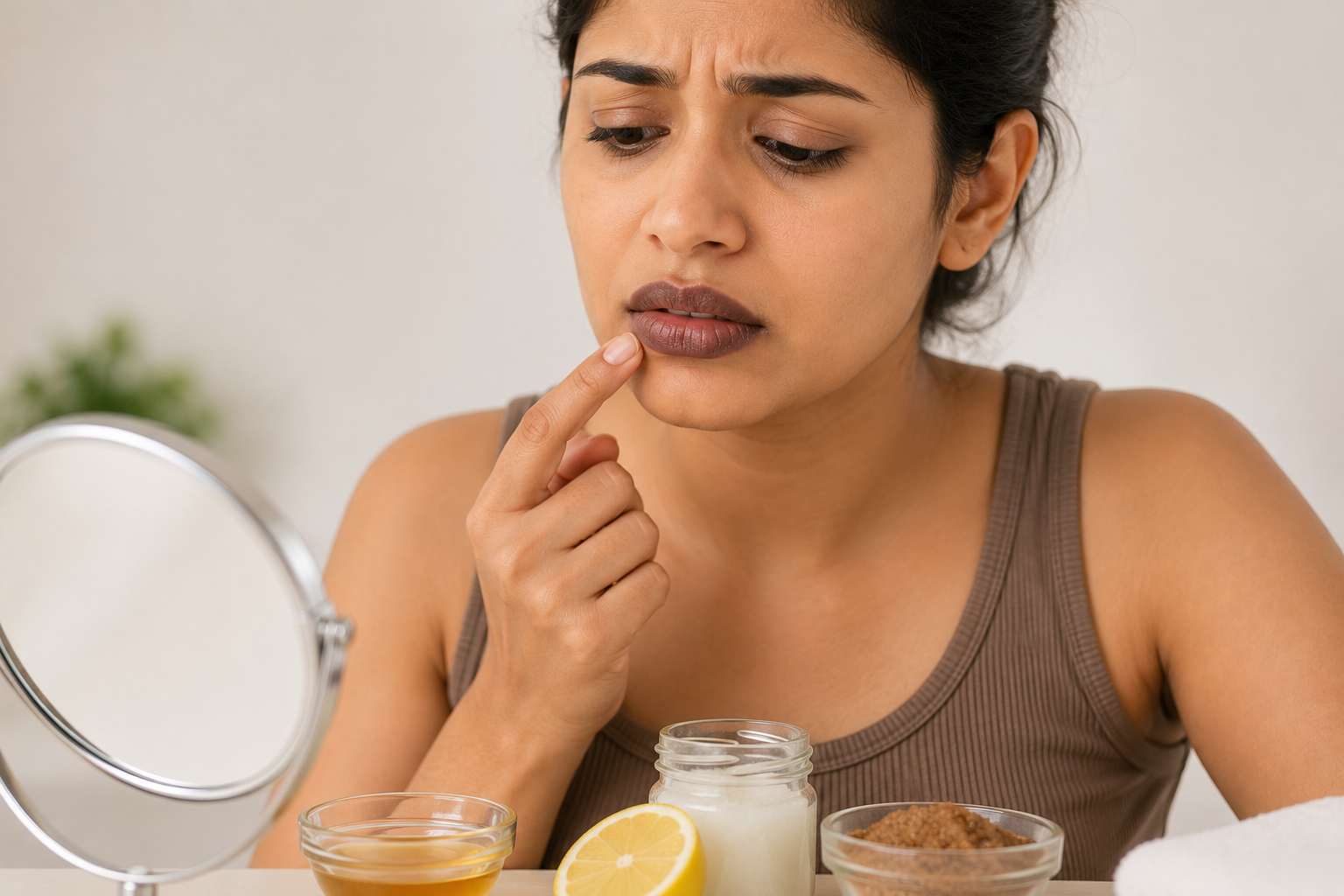
Why Lips Darken, And Which Home Habits Help Or Harm
Lips darken from sun exposure, smoking, chronic licking or biting, iron and vitamin B12 deficiency, and allergic reactions to lipstick and lip balm ingredients. Some are cosmetic and some point to a medical cause, so identifying the reason matters more than trying another remedy.
Understanding the causes of dark lips is the first step towards choosing appropriate care. Pigmentation may develop gradually because of everyday habits and environmental exposure, or it may appear after irritation from a cosmetic product. In some people, nutritional deficiency, medication or another health issue may also contribute.
This is why repeatedly trying home remedies for dark lips without identifying the cause may fail and irritating ingredients can sometimes make pigmentation worse.
What Actually Makes Lips Darken Over Time?
Normal lip colour varies considerably between individuals. Genetics and natural skin tone influence baseline colour, but lips can also become darker over time because of repeated exposure, irritation or inflammation.
Common lip pigmentation causes include sun exposure, smoking, repeated licking or biting, reactions to lip products, nutritional deficiencies and certain medications.
Sun Exposure
The lips are exposed to ultraviolet radiation whenever you are outdoors. Repeated sun exposure can contribute to pigmentation, particularly when lip protection is not used consistently.
A lip balm with appropriate sun protection and sensible sun avoidance can therefore be more useful than repeatedly trying to scrub pigmentation away.
Smoking
Smoking can contribute to darker lip pigmentation. Heat, repeated irritation and exposure associated with smoking may all affect the lips and surrounding tissues.
Stopping smoking is more meaningful than trying to cover the pigmentation with repeated home treatments while the trigger continues.
Chronic Licking or Biting
Lip licking can temporarily make dry lips feel better, but repeated licking may worsen dryness and irritation.
The same applies to habitual biting, picking or peeling.
Repeated inflammation can leave pigmentation behind, particularly in skin types that are prone to post-inflammatory hyperpigmentation.
If you frequently peel dry skin from your lips, the first goal should therefore be to break the irritation cycle rather than aggressively exfoliate the area.
Lipstick, Lip Balm and Other Products
A product intended to improve the lips can sometimes be the cause of the problem.
Lipsticks, balms, fragrances, flavourings and other cosmetic ingredients may trigger irritation or allergic contact reactions in susceptible people.
This is sometimes described as allergic cheilitis from lip products.
Clues can include:
- Burning
- Itching
- Dryness
- Scaling
- Cracking
- Recurrent irritation
- Darkening after repeated inflammation
If the problem repeatedly worsens after applying a particular product, simply changing to another shade from the same range may not solve it.
The suspected trigger needs to be identified and avoided.
Iron and Vitamin B12 Deficiency
Nutritional deficiencies can sometimes be associated with changes affecting the mouth, lips or surrounding tissues.
Dark lips alone cannot diagnose iron or vitamin B12 deficiency. Other symptoms, dietary history and appropriate medical assessment may be needed.
If pigmentation appears alongside unexplained fatigue, weakness or other symptoms, repeatedly applying cosmetic remedies is not an adequate substitute for evaluation.
Medication-Related Pigmentation
Certain medications can contribute to pigmentation changes.
If lip colour changed after starting a medicine, discuss the timing with your doctor rather than stopping prescribed treatment yourself.
Medication should not be discontinued solely because you suspect it is causing pigmentation without appropriate medical advice.
For patients considering professional treatment after the cause has been assessed, read about lip lightening treatment in Surat.
Cause and Action Table
| Likely cause | What you may also notice | What genuinely helps | What to avoid |
|---|---|---|---|
| Sun exposure | Gradual darkening with regular outdoor exposure | Lip sun protection and reducing unnecessary UV exposure | Repeated irritation or harsh exfoliation |
| Smoking | Persistent pigmentation with smoking history | Smoking cessation and gentle lip care | Continuing the trigger while relying on cosmetic remedies |
| Licking or biting | Dryness, peeling, irritation or recurrent cracking | Stop the habit and protect the lip barrier | Picking, peeling and repeated licking |
| Iron/B12 deficiency | May occur with other systemic symptoms | Medical assessment and correction if deficiency is confirmed | Self-diagnosing from lip colour alone |
| Product allergy/irritation | Burning, itching, scaling or worsening after a product | Stop the suspected trigger and seek assessment if persistent | Continuing irritating lipstick/balm |
| Medication | Pigmentation developing after certain treatments | Discuss with the prescribing doctor | Stopping prescribed medication without medical advice |
When Is Dark Lip Colour a Sign of a Medical Problem Rather Than a Cosmetic One?
Not every case of dark lips requires medical investigation.
If your lips have always been naturally darker and there has been no recent change, the colour may simply represent normal pigmentation.
A medical assessment becomes more important when the pigmentation is new, unexplained, changing or accompanied by other symptoms.
Look Beyond Colour Alone
Seek an assessment when darkening occurs with problems such as:
- Persistent soreness
- Recurrent cracking
- Burning or itching
- Scaling
- Ulceration
- Unexplained bleeding
- Significant swelling
- A persistent localised patch or lesion
- Pigmentation elsewhere that has appeared unexpectedly
- Other unexplained health symptoms
A clinician may need to distinguish simple pigmentation from inflammation, allergic cheilitis, nutritional problems or another medical cause.
Could Iron or B12 Deficiency Be Responsible?
Possibly, but pigmentation alone cannot confirm a deficiency.
If a deficiency is suspected because of your symptoms, medical history or diet, appropriate testing may be recommended.
Taking supplements without establishing whether a deficiency exists is not the best way to approach unexplained pigmentation.
What if the Colour Changed After Starting Medication?
Mention the timing to your prescribing doctor.
Some medication-related pigmentation changes are recognised, but the relationship needs to be assessed in context.
Do not stop essential medication simply to see whether the lip colour improves.
The broader principle is that why are my lips dark? is often a more useful question than “Which remedy will lighten them?”
Which Home Habits Genuinely Help?
Useful home care for dark lips is usually simple.
The aim is to reduce triggers, protect the lip barrier and prevent further irritation rather than aggressively trying to bleach or scrub away pigment.
Protect the Lips From Sun Exposure
Use appropriate lip sun protection when outdoors and reapply it as directed by the product.
Sun protection is particularly important if pigmentation worsens with outdoor exposure.
Stop Licking, Biting and Picking
If your lips are repeatedly irritated, allow the barrier to recover.
Avoid:
- Biting dry skin
- Peeling flakes
- Constant lip licking
- Aggressive rubbing
- Repeated scrubbing
These habits can perpetuate inflammation.
Use Simple, Non-Irritating Lip Care
When lips are dry, a simple moisturising or barrier product may be more useful than a heavily fragranced or flavoured cosmetic.
If a particular balm causes burning, itching or recurrent peeling, stop using it.
Review Your Lip Products
If pigmentation developed alongside irritation, look at products that regularly contact the lips.
These can include:
- Lipstick
- Lip gloss
- Lip balm
- Lip plumper
- Toothpaste
- Mouth-care products
- Fragranced or flavoured cosmetics
Product-related reactions may require proper assessment when the trigger is not obvious.
Stop Smoking
If smoking is contributing to lip pigmentation, stopping the exposure addresses the cause rather than trying to lighten the lips while the trigger continues.
Treat a Confirmed Deficiency Properly
Iron or vitamin B12 deficiency should be managed according to the confirmed deficiency and medical advice not by relying on topical lip remedies.
If your overall skin also looks dull or uneven, why skin looks dull despite good skincare explains why identifying the underlying cause matters before adding more products.
Which Popular Home Remedies Make Pigmentation Worse?
Many online lists of home remedies for dark lips recommend ingredients simply because they are acidic, abrasive or associated with “brightening.”
That does not mean they are appropriate for delicate lip skin.
The existing version of this article previously recommended approaches such as lemon and sugar scrubs. The updated advice is different: repeatedly irritating the lips can worsen inflammation and may make pigmentation more noticeable rather than improving it.
Lemon
Lemon juice is acidic and can irritate the lips.
Using it repeatedly on already dry or sensitive lips can cause burning and inflammation. Citrus exposure combined with sunlight can also produce phototoxic skin reactions.
Lemon should therefore not be treated as a routine lip-lightening treatment.
Baking Soda
Baking soda is another popular DIY recommendation.
Its abrasive and alkaline nature can disrupt and irritate the lip surface. A temporary feeling of smoothness does not mean the underlying pigmentation is being safely treated.
Sugar Scrubs
Scrubbing removes surface flakes temporarily, but aggressive or frequent exfoliation can injure already irritated lips.
If darkening is partly driven by inflammation, repeatedly creating more irritation works against the goal.
Toothbrush Scrubbing
Rubbing the lips with a toothbrush is not necessary for treating pigmentation.
Repeated friction can cause irritation and make peeling worse.
Picking and Peeling
Removing flakes manually may seem harmless, but pulling away healing skin can prolong inflammation.
Allow dry skin to separate naturally while supporting the lip barrier.
DIY Acids or Bleaching Products
Do not apply unprescribed strong acids, bleaching agents or products intended for other areas of the skin to the lips.
The lip surface is different from normal facial skin, and inappropriate products can cause significant irritation.
The key principle is straightforward:
If a home remedy burns, stings, peels or repeatedly inflames your lips, it is not a good long-term strategy for pigmentation.
Professional non-surgical treatments at Elegance Clinic can be discussed when pigmentation remains bothersome after obvious triggers have been addressed.
When Should You See a Doctor Rather Than Keep Treating It at Home?
See a doctor when the pigmentation is unexplained, persistent, changing or accompanied by symptoms that suggest something more than normal cosmetic variation.
Assessment is particularly useful when:
- Lip colour has changed noticeably without an obvious reason
- Pigmentation is rapidly changing
- One area looks very different from the rest
- The lips remain inflamed despite stopping suspected products
- There is persistent itching, burning or scaling
- Cracks or sores repeatedly return
- A lesion does not heal
- Pigmentation started after a new medication
- You have symptoms suggesting a possible nutritional deficiency
- Home treatments have repeatedly irritated the area
What Happens During an Assessment?
The first step is usually history and examination.
You may be asked:
- When did the pigmentation begin?
- Has it changed recently?
- Do you smoke?
- Do you lick or bite your lips?
- Which lipstick, balm and oral-care products do you use?
- Does anything cause itching or burning?
- Have you started any new medication?
- Are there other symptoms?
- Have you already tried irritating home remedies?
Further investigation depends on what the assessment suggests.
If a nutritional deficiency is suspected, testing may be appropriate. If a product reaction is suspected, avoiding the likely trigger and further evaluation may be advised.
When Is Cosmetic Treatment Considered?
Once active irritation and relevant medical causes have been addressed, persistent pigmentation may be assessed for cosmetic treatment.
The correct option depends on the cause, depth and pattern of pigmentation rather than simply how dark the lips look.
That distinction is important because professional treatment cannot compensate for an ongoing trigger. Continuing to smoke, repeatedly licking the lips or using a product that causes inflammation can undermine attempts to improve pigmentation.
For an individual evaluation, you can book a lip assessment.