Facial Fat Grafting: How Much Of The Transferred Fat Actually Survives
Only part of the transferred fat establishes a blood supply and stays, so surgeons plan for partial take rather than full survival. What does survive behaves like your own tissue and can last for years. A second, smaller session is commonly planned once swelling has fully settled.
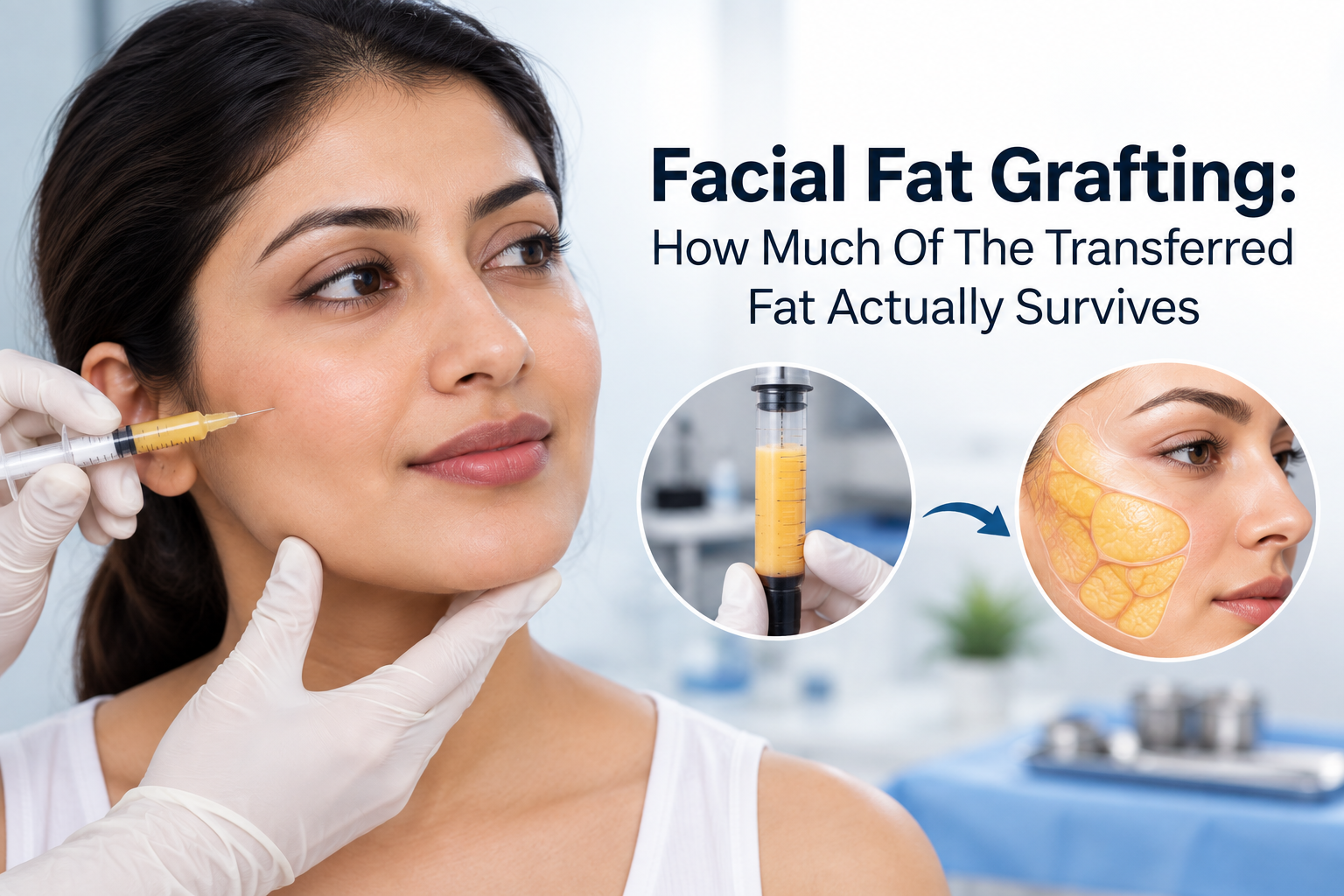
Facial fat grafting uses a patient's own fat to restore or add volume to selected areas of the face. Fat is usually harvested from another body area, processed, and carefully transferred into areas where additional volume or contour is required.
Unlike a temporary injectable product, successful fat transfer to face becomes living tissue in its new location. The important limitation is predictability: not every transferred fat cell survives. Some volume is naturally lost during healing, which is why the early postoperative appearance should never be treated as the final result.
The procedure is therefore planned around three questions: how much volume is needed, how much transferred fat is likely to remain, and whether another smaller session may eventually be useful.
Patients considering facial proportions more broadly can also read about face enhancement surgery for facial balance.
How Does Fat Grafting Differ From Dermal Filler As a Volume Solution?
Both fat grafting and dermal filler can add facial volume, but they do so in fundamentally different ways.
Dermal filler uses an injectable material to change contour or restore volume. Depending on the product, location and patient, the effect is temporary and may require maintenance.
Fat grafting uses tissue harvested from the patient's own body. Once part of that transferred fat develops a stable blood supply and survives, it behaves as living fat tissue.
Fat Grafting Can Treat Larger Volume Deficits
One advantage of facial fat grafting is the ability to transfer more volume when several areas of the face need restoration.
It may be considered for:
- Cheek volume
- Mid-face hollowness
- Selected temple hollowing
- Facial depressions
- Contour irregularities
- Broader facial volume restoration
However, more volume does not automatically mean a better result. Placement has to respect facial anatomy and proportions.
Filler Is Usually More Predictable Immediately
Filler allows the clinician to place a measured amount of product and assess much of the contour change at the treatment session.
Fat grafting is less predictable because some transferred fat will not survive.
Early swelling also makes it difficult to determine how much permanent volume has actually remained.
Fat Grafting Is Not Simply a “Permanent Filler”
The two treatments should not be viewed as identical procedures with different durations.
Fat grafting involves:
- Harvesting fat from a donor area.
- Processing the harvested tissue.
- Transferring small amounts into selected facial areas.
- Allowing the grafted fat to establish a blood supply.
- Waiting for swelling and temporary volume to settle.
Filler does not require a donor site or fat-harvesting procedure.
Fat Grafting vs Filler
| Factor | Facial fat grafting | Dermal filler |
|---|---|---|
| Downtime | More, because both donor and facial areas heal | Usually shorter |
| Longevity | Surviving fat can remain for years | Temporary; duration varies by product and area |
| Volume achievable | Useful when broader or larger volume restoration is needed | Often suited to smaller, targeted corrections |
| Revision options | Additional grafting may be needed after healing | Further filler can be added; some filler types may be dissolvable |
| Predictability | Variable because only part of transferred fat survives | More predictable initial volume |
| Cost | Higher initial procedural commitment | Lower initial commitment but maintenance may add cumulative cost |
The choice in fat grafting vs filler should therefore depend on anatomy, required volume, tolerance for downtime, desired longevity and willingness to accept variability in fat survival.
What Proportion of Transferred Fat Typically Survives, and Why Is a Second Session Planned?
The most important fact about facial fat grafting is that 100% survival should not be expected.
Transferred fat initially relies on the surrounding tissue for nourishment. For long-term survival, the grafted fat must establish an adequate blood supply.
Some transferred cells successfully integrate. Others do not survive and are gradually absorbed by the body.
Why Is Fat Survival Variable?
Fat survival can be influenced by several factors, including:
- Harvesting technique
- Processing of the fat
- Placement technique
- Size and distribution of transferred fat deposits
- Blood supply in the recipient area
- Smoking
- Individual healing
- Previous surgery or scarring
- Amount of fat placed in one location
Fat is generally transferred in carefully distributed amounts rather than as one large deposit because the grafted cells need close contact with well-vascularised tissue.
What Percentage of Facial Fat Transfer Survives?
There is no single percentage that can be promised to every patient.
Published survival estimates vary because techniques, facial areas, measurement methods and follow-up periods differ. In practice, surgeons plan around partial graft survival, not an assumption that every transferred cell will remain.
This is also why the question how long does facial fat transfer last? has two parts.
The portion that does not establish a blood supply is lost during the settling period. The portion that successfully integrates can behave like the patient's other fat tissue and may remain for years.
Why Is a Second Session Sometimes Needed?
A second session does not automatically mean that the first procedure failed.
It may be planned because:
- More fat was absorbed than expected
- The patient wants additional volume
- Small asymmetries remain after healing
- Conservative first-stage correction was intentionally chosen
- The surgeon wants to refine a particular area
The important point is timing.
Additional fat should not be planned simply because the face looks different during early swelling. The tissues need sufficient time to settle before residual volume is assessed.
Which Areas of the Face Respond Best?
Facial fat grafting can be used in several areas, but suitability depends on the type of volume loss, tissue quality and amount of correction required.
Mid-Face and Cheeks
The cheeks and mid-face are common areas for fat restoration because loss of volume here can make the face look flatter or more hollow.
Adding carefully planned volume may help restore facial contours and support the transition between the lower eyelid and cheek.
Patients considering changes to overall lower-face proportions can also read about lower face contouring by face shape.
Temples
Hollow temples can make the upper face appear narrower or more skeletal.
Fat grafting may be considered when enough donor fat is available and the anatomy is suitable.
Facial Hollows and Depressions
Selected depressions or contour irregularities may also be treated with fat grafting.
However, previous scars, surgery or altered blood supply can affect planning and predictability.
Can Fat Be Used Everywhere Filler Is Used?
Not necessarily.
Some areas require very precise, small-volume correction where another technique may be preferable. The risks and anatomy of each facial area must also be considered separately.
Treatment therefore needs to be planned according to the specific facial region rather than assuming fat is automatically better because it comes from the patient's own body.
Where Is the Fat Harvested From?
Fat is commonly collected from an area where a suitable amount is available, such as the abdomen or thighs.
Only a relatively small amount may be required for facial treatment compared with body-contouring procedures.
The donor site must still be suitable for harvesting.
This is important because very lean patients may not have enough accessible donor fat for the planned correction.
Patients exploring surgical facial procedures can review facial surgery at Elegance Clinic.
What Does Swelling and Settling Look Like Over Three Months?
Understanding cheek fat transfer recovery is important because the face seen immediately after surgery is not the final result.
The early appearance includes several components:
- Transferred fat
- Surgical swelling
- Temporary inflammation
- Fluid retention
- Bruising in some patients
As swelling resolves and some transferred fat is naturally absorbed, facial volume changes.
First Few Days
Swelling is generally most noticeable during the early recovery period.
The face may appear fuller than expected, and the donor area may also feel sore or bruised.
This is not the time to judge symmetry or final volume.
First Few Weeks
Swelling gradually decreases.
The face begins to look more natural, but the volume may continue to change as healing progresses.
Patients sometimes worry that the procedure has “lost too much fat” when early swelling disappears. In reality, part of the apparent reduction is simply the resolution of postoperative swelling.
Around One to Three Months
The facial contour becomes progressively easier to assess as tissues settle.
By this stage, the difference between temporary postoperative fullness and retained volume becomes clearer.
Exact timelines vary, so follow-up with the treating surgeon is more useful than comparing your recovery with photographs from another patient.
Three-Month Settling Guide
| Stage | What you may see | What it means |
|---|---|---|
| First days | Noticeable swelling and temporary fullness | Too early to assess retained fat |
| First weeks | Swelling gradually decreases | Facial volume starts becoming easier to judge |
| 1–2 months | Contour continues settling | Retained volume becomes clearer |
| Around 3 months | More stable facial contour | Surgeon can better assess whether refinement may be useful |
When Can the Final Result Be Judged?
There is no exact identical date for every patient.
A meaningful assessment should wait until substantial swelling has resolved and the graft has had time to stabilise.
Only then should a second session or other refinement be considered.
For more information about the procedure itself, see facial fat grafting on our body and face surgery site.
Who Is Not a Candidate, Including Very Lean Patients?
Not everyone seeking facial volume is automatically suitable for fat grafting.
The first practical requirement is having enough appropriate donor fat to harvest.
Very Lean Patients
Very lean patients may not have sufficient accessible donor fat for the desired treatment.
Even when a small amount can technically be harvested, the available volume may not match the correction required.
In these situations, another volume-restoration option may be more practical.
Patients With Unstable Weight
Stable body weight matters because surviving grafted fat behaves like living fat tissue.
Significant future weight gain or loss can therefore affect facial volume.
Someone actively losing a substantial amount of weight may be advised to reach a more stable point before final facial-volume planning.
Smoking and Healing Concerns
Because transferred fat depends on blood supply for survival, factors that impair healing or circulation need to be considered during candidacy assessment.
Patients should disclose smoking and relevant medical conditions rather than treating facial fat transfer as a simple cosmetic injection.
Unrealistic Expectations
Fat grafting cannot guarantee an exact amount of permanent volume.
A patient expecting every transferred millilitre to survive is unlikely to have realistic expectations about the procedure.
Similarly, fat grafting cannot freeze facial ageing.
The face continues to change with:
- Age
- Weight fluctuations
- Skin laxity
- Bone changes
- Changes in other facial fat compartments
Does Weight Gain Change the Grafted Areas?
Yes, surviving grafted fat behaves like the patient's own living fat tissue.
This means substantial weight gain may increase volume in grafted areas, while significant weight loss may reduce it.
This is another reason why stable weight is preferable before treatment.
Who May Need Another Option?
Another treatment may be more appropriate when:
- There is insufficient donor fat
- Only a very small, highly precise correction is required
- The patient wants minimal downtime
- Temporary and reversible correction is preferred
- Weight is currently changing significantly
- Medical or healing factors make surgery unsuitable
The best candidate for facial fat grafting is therefore someone with a genuine facial-volume deficit, adequate donor fat, stable health and weight, and realistic expectations about partial survival and possible staged treatment.
Conclusion
Facial fat grafting offers a different approach to facial-volume restoration because the material being transferred is the patient's own tissue.
The central limitation is that not all transferred fat survives. Surgeons therefore plan around partial graft take, allow swelling to settle, and may recommend a second smaller session if additional volume or refinement is needed.
The fat that successfully establishes a blood supply can remain for years, although it continues to respond to ageing and weight changes like other living fat.
When choosing fat grafting vs filler, the decision should consider the amount of volume required, predictability, downtime, longevity, donor-fat availability and whether the patient wants a temporary or longer-term solution.
.png)