Facelift Recovery Week By Week: When You Look Like Yourself Again
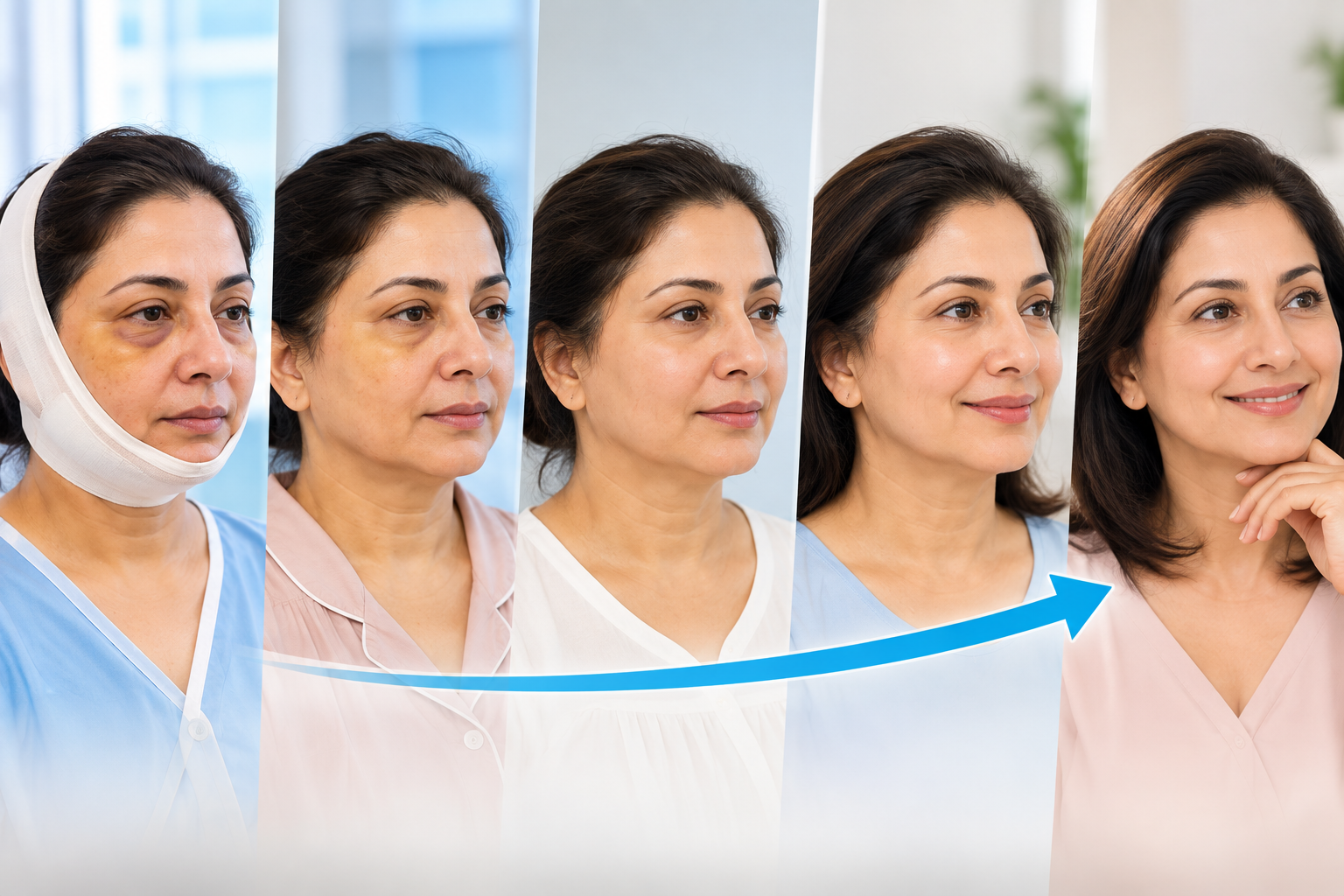
<style type="text/css"> </style> Week one is swelling, bruising and dressings, with stitches usually removed around days seven to ten. Most people feel presentable at two to three weeks with makeup. Residual firmness and numbness settle over two to three months, and the final refined result appears at around six months.
Facelift recovery week by week changes significantly during the first few months. Week one usually involves swelling, bruising and dressings, with stitches typically removed around days seven to ten. Most people feel presentable at two to three weeks with makeup. Residual firmness and numbness settle over two to three months, while the final refined result appears at around six months.
Understanding this timeline before surgery can make the recovery period easier to plan. A facelift does not look fully settled as soon as the initial bruising disappears. Different stages of healing continue beneath the skin for several months.
At Elegance Clinic, facelift planning with Dr. Ashutosh A Shah includes discussing the expected recovery period, review visits and when patients can gradually return to everyday activities.
What Happens in the First 72 Hours After a Facelift?
The first three days are the earliest phase of facelift recovery.
Swelling, bruising and dressings are expected during this period. The face will not yet look like the final result, so these first few days should be viewed as the beginning of healing rather than an indication of the eventual outcome.
Patients should concentrate on the postoperative care instructions given by their surgical team and attend the planned review.
This is also the stage when practical help at home can be useful because normal routines may not yet feel comfortable.
Facelift Recovery Week by Week: What Does Week One Look Like?
Week one is primarily about early healing.
Swelling and bruising are still visible, and dressings form part of the early postoperative period. Patients should not judge the cosmetic result during this stage.
The supplied recovery plan states that stitches are usually removed around days 7–10.
The exact timing of stitch removal and dressing changes should follow the individual surgical plan.
During this stage, the face can look different from day to day as early swelling changes.
What Happens During Week Two?
By week two, the recovery has progressed beyond the immediate postoperative phase.
Some visible signs of surgery may still remain. This does not necessarily mean healing is delayed.
The important milestone in the supplied plan is that most people feel presentable at approximately two to three weeks with makeup.
This makes the second and third weeks particularly relevant for patients deciding when to return to office work or social situations.
When Will I Look Like Myself Again?
For many patients, the practical question is not when every trace of healing disappears but when they feel comfortable being seen by other people.
The plan indicates that many people feel presentable at around two to three weeks, particularly with makeup.
This does not mean that the facelift has completely settled by that stage.
Residual:
-
swelling
-
firmness
-
numbness
may continue after the patient already feels comfortable returning to social activities.
When Can You Return to Work After a Facelift?
The supplied plan specifically asks the article to address when can I return to work after a facelift.
It indicates that most people feel presentable at around two to three weeks with makeup.
For someone working in an office or another public-facing setting, this can be a useful planning point.
However, looking presentable and being completely healed are not the same thing.
Your individual return-to-work timing should consider how you are healing and the nature of your job.
When Can You Socialise After a Facelift?
The two-to-three-week period is also the main point identified in the plan for feeling presentable.
This can help patients plan social commitments.
Someone with an important event should remember that residual swelling, firmness or numbness can persist beyond the point at which the face looks socially presentable.
Avoid scheduling surgery based solely on the assumption that every patient will look identical at a specific number of days.
When Can You Drive After a Facelift?
Driving is one of the activities the content plan requires the article to address.
However, the supplied plan does not provide an exact day for restarting driving.
For that reason, this article should not invent a fixed driving timeline.
Driving should resume according to the postoperative instructions and individual recovery rather than simply because a particular number of days has passed.
Facelift Swelling Timeline
The facelift swelling timeline is not limited to the first week.
Week one is the main period of visible swelling and bruising described in the content plan.
As healing progresses, the obvious signs reduce, but some residual firmness and numbness can continue for two to three months.
This distinction matters because patients can look presentable before the tissues have completely settled.
The recovery should therefore be considered in stages:
Early recovery: swelling, bruising and dressings.
Social recovery: generally around two to three weeks for many patients.
Continued settling: residual firmness and numbness improve over two to three months.
Refined result: approximately six months.
Facelift Recovery Timeline
| Recovery Stage | Appearance | Activity | Care Needed | Review |
|---|---|---|---|---|
| Days 0–3 | Early swelling, bruising and dressings | Early recovery period | Follow postoperative instructions | As scheduled |
| Week 1 | Swelling and bruising remain visible | Gradual early recovery | Dressing and incision care as instructed | Stitches usually removed around days 7–10 |
| Week 2 | Visible recovery continues | Gradual return toward routine | Continue prescribed care | According to individual plan |
| Weeks 3–6 | Many patients are already socially presentable | Activities gradually normalise according to recovery | Continue scar and postoperative care as advised | As required |
| Months 2–3 | Residual firmness and numbness continue settling | Recovery continues | Ongoing observation and care | Follow-up as advised |
| Month 6 | Result appears more refined and settled | Long-term recovery stage | Continue advised scar care | Result assessment |
This facelift recovery week by week timeline provides general planning milestones rather than a guarantee that every patient will recover at exactly the same speed.
How Long Does Numbness Last After a Facelift?
Numbness does not necessarily disappear when the bruising has resolved.
According to the supplied content plan, residual firmness and numbness can take around two to three months to settle.
This is why patients should not assume that something is wrong simply because the face still feels different after they have returned to normal social activities.
The recovery process continues underneath the skin after the obvious signs of surgery become less noticeable.
How Do Facelift Scars Mature?
Scar healing is another process that extends beyond the early recovery period.
The content plan requires scar maturation to be discussed across the first year.
However, it does not provide specific month-by-month changes in scar colour, thickness or texture.
For this reason, the article should avoid inventing a detailed scar timeline.
The key point is that scar appearance continues to evolve after the initial incision has healed.
Patients should follow their surgeon's scar-care instructions and attend recommended reviews so healing can be assessed over time.
When Can Makeup Be Used?
The supplied plan states that most patients feel presentable at around two to three weeks with makeup.
However, it does not specify an exact postoperative day when makeup can safely be applied directly over healing scars.
This should therefore be confirmed during postoperative review.
Patients should not assume that makeup can be placed over an incision simply because surrounding bruising has started to improve.
When Is the Final Facelift Result Visible?
One of the most important things to understand about how long is facelift recovery is that looking socially presentable is very different from seeing the final result.
The supplied plan gives three useful milestones:
2–3 weeks: Most people feel presentable with makeup.
2–3 months: Residual firmness and numbness continue settling.
Around 6 months: The final refined result becomes apparent.
Patients should therefore avoid judging their final facial contour too early.
Why the Six-Month Result Matters
Early photographs can show meaningful improvement, but they do not necessarily represent the final refined outcome.
At six months, the tissues have had considerably more time to settle than they had at two or three weeks.
This is why the content plan places final-result assessment at approximately the six-month point.
The recovery process is gradual rather than a sudden change from “healing” to “finished.”
Planning Work and Social Events Around Facelift Recovery
Patients often organise facelift surgery around work commitments, family functions, weddings or travel.
A practical plan should consider the difference between:
-
the first postoperative days
-
stitch removal
-
returning to office work
-
feeling comfortable socially
-
residual swelling and firmness
-
long-term scar maturation
-
the final refined result
If you need to look presentable for a specific event, do not use the final result timeline as your only guide.
The two-to-three-week social recovery milestone can help with planning, but individual recovery still varies.
Patients considering facial rejuvenation can also read about why your face can look older without more wrinkles and why your jawline disappears before you expect it.
Surgical and Non-Surgical Facial Rejuvenation
Not every person concerned about facial ageing necessarily needs the same treatment.
The appropriate option depends on what is creating the aged appearance and what degree of correction is being considered.
Patients exploring operative options can review facial surgery at Elegance Clinic.
For procedure-specific information about surgical facelift techniques, the Deep plane facelift on our surgery site page provides additional information.
Key Takeaways
-
Facelift recovery week by week begins with swelling, bruising and dressings.
-
Stitches are usually removed around days 7–10.
-
Most people feel presentable at approximately 2–3 weeks with makeup.
-
Looking presentable does not mean healing is complete.
-
Residual firmness and numbness may settle over 2–3 months.
-
The final refined result appears at approximately 6 months.
-
Scar maturation continues beyond the early recovery period.
-
Return to driving and other activities should follow individual postoperative advice rather than a universal date.
Conclusion
Understanding facelift recovery week by week helps patients distinguish early healing from the final result. The first week involves swelling, bruising, dressings and usually the period leading up to stitch removal. By two to three weeks, many patients feel presentable, while residual firmness and numbness may continue improving for several months.
The final refined result should not be judged too early. According to the planned recovery timeline, approximately six months is a more appropriate point for assessing the settled facelift result.