Eyebrow Tattoo Removal: Saline, Laser Or Waiting It Out
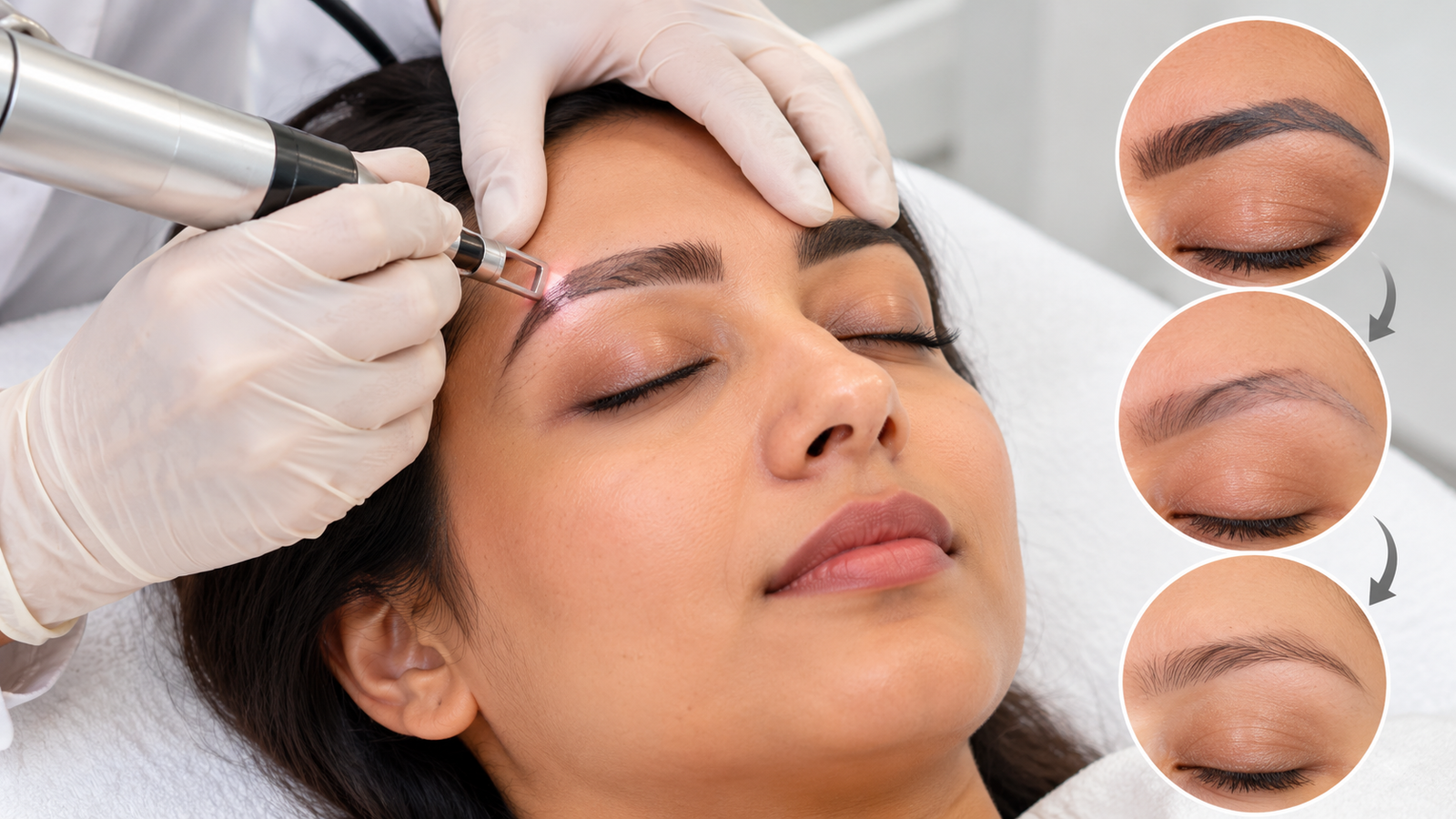
Saline lightening draws pigment upward over several spaced sessions and suits shallow cosmetic work. Laser breaks pigment down faster but can turn certain shades orange or grey before they clear. Light, faded work often needs neither, and can simply be corrected over.
Old eyebrow tattoos and microblading can change over time. Pigment may become grey, blue, red or orange, while the original brow shape may no longer suit the face. However, seeing an unwanted colour or shape does not automatically mean that every trace of pigment needs to be removed.
The best approach depends on the colour, depth and saturation of the existing pigment, the condition of the skin, previous permanent makeup sessions and what you want your new brows to look like.
In some cases, correction can be performed over sufficiently faded pigment. In others, saline removal brows or laser brow tattoo removal may be needed to lighten the existing work before new permanent makeup is considered.
When Does Old Brow Work Actually Need Removing Rather Than Correcting?
Not every grey, faded or uneven eyebrow tattoo needs removal. If the remaining pigment is light, the basic shape is acceptable and there is enough flexibility to create a suitable new brow design, correction may be possible without complete removal.
Removal or lightening is more likely to be considered when the old work is:
- Very dark or heavily saturated
- Significantly uneven or asymmetrical
- Positioned outside the desired brow shape
- Grey, blue, red or otherwise discoloured
- Too dense for another layer of pigment
- Made up of several previous layers of permanent makeup
Trying to remove old microblading is also not automatically the first step. The practitioner should determine whether removal is actually necessary or whether controlled correction can achieve the intended result.
People considering new cosmetic brow work can first understand Semi permanent makeup in Surat and how modern permanent makeup is planned.
How Does Saline Lightening Work, and How Many Sessions Does It Take?
Saline removal is designed to gradually lighten existing cosmetic tattoo pigment. A specialised saline solution is introduced into the tattooed skin using a controlled technique.
During healing, the process aims to encourage some pigment toward the skin surface so that the old colour becomes progressively lighter.
Unlike an eraser, saline treatment does not normally make the eyebrow tattoo disappear in one sitting.
The number of permanent makeup removal sessions required can depend on:
- How deeply the pigment was originally implanted
- How saturated the old brows are
- The number of previous permanent makeup procedures
- Pigment composition and colour
- Individual skin healing
- Whether partial lightening or maximum possible removal is required
For some people, the objective is simply to lighten the old tattoo enough for a better brow design rather than trying to remove every visible trace.
Adequate healing time between sessions is important because repeatedly treating skin before it has recovered can increase the risk of irritation and unwanted skin changes.
You can also explore Non-surgical treatments at Elegance Clinic for other available aesthetic treatment options.
How Does Laser Removal Differ, and Why Can Pigment Change Colour First?
Laser treatment works differently from saline removal. Laser energy targets pigment particles in the skin and breaks them into smaller fragments that the body gradually clears.
However, cosmetic brow pigments can contain mixtures of different colour components. Because individual components may respond differently to laser wavelengths, the visible colour can sometimes change during treatment.
For example, previously brown pigment may temporarily appear:
- Orange
- Red
- Grey
- Darker
- Patchy or uneven
This colour change does not necessarily mean that laser brow tattoo removal has failed. It can occur because one component of the original pigment has responded before another.
The type and history of the cosmetic pigment should therefore be considered before laser treatment is selected.
Saline vs Laser vs Waiting for the Pigment to Fade
There is no single eyebrow tattoo removal technique that suits every person.
| Method | Suits Which Work | Sessions Typically Needed | Spacing Between Sessions | Main Risks/Considerations | Wait Before New Work |
|---|---|---|---|---|---|
| Saline lightening | Shallow cosmetic pigment needing gradual lightening | Often multiple | Several weeks depending on healing | Redness, tenderness, crusting and skin changes if overtreated | Until completely healed |
| Laser removal | Selected darker or resistant pigments | Often multiple | Usually several weeks or longer | Temporary pigment colour changes, irritation and skin pigmentation changes | Until treatment and healing are complete |
| Fade and correct over | Light, faded work with an acceptable underlying shape | Removal may not be required | Depends on existing pigment | Old colour may influence the new result if still too saturated | Once correction suitability is confirmed |
The exact number of sessions cannot be guaranteed before assessment because pigment depth, composition and previous treatments vary considerably.
What Are the Risks to the Brow Hair and the Skin?
One common concern with eyebrow tattoo removal is whether treatment will damage natural eyebrow hair.
Because the natural brow hairs are located in the same area as the tattoo pigment, treatment must be carefully planned. Depending on the laser or technique used, temporary changes to the appearance of brow hair may occur.
The skin itself also needs protection.
Possible temporary effects following removal can include:
- Redness
- Swelling
- Tenderness
- Crusting
- Temporary pigment changes
More significant skin injury or scarring is possible if treatment is too aggressive, inappropriate for the pigment or skin type, or repeated before adequate healing.
Anyone with a history of abnormal scarring or significant pigmentation changes should discuss these issues before treatment.
Can You Simply Wait for Old Microblading to Fade?
Yes, in selected cases.
Permanent makeup gradually fades. If your old microblading is already light and the shape is reasonably acceptable, waiting may avoid unnecessary treatment.
How quickly pigment fades depends on several factors, including:
- Original pigment depth
- Pigment formulation
- Skin characteristics
- Sun exposure
- Skincare products
- Number of previous brow procedures
Waiting can be particularly reasonable when there is no urgent need for new brows.
However, very saturated or repeatedly tattooed brows may remain visible for a long time and may not fade sufficiently for a clean correction.
Read more about Permanent makeup for face in Surat before deciding whether new pigmentation is appropriate.
How Long Must You Wait Before New Work Can Be Placed?
New permanent makeup should not be placed over skin that is still recovering from eyebrow tattoo removal.
Even when the surface looks normal, deeper healing may still be occurring. Applying new pigment too early can interfere with healing and may affect how evenly the new pigment settles.
The appropriate waiting period depends on:
- Whether saline or laser was used
- Number of removal sessions
- Skin response
- Residual redness or sensitivity
- Remaining pigment
- Planned new brow technique
Instead of relying only on a fixed number of weeks, the treated area should be assessed to confirm that the skin is fully healed and stable.
How Is the Right Removal Plan Chosen?
A brow assessment should start with the existing tattoo rather than automatically choosing laser or saline.
The practitioner should evaluate the current pigment colour, depth, saturation, shape, skin condition, previous procedures and desired new brow design.
From there, there are generally four possible pathways:
Correct directly: The old pigment is sufficiently faded and its position does not interfere with the new design.
Lighten first: Some old pigment needs to be reduced before new permanent makeup can be performed.
Remove more extensively: The old tattoo is too dark, saturated or poorly positioned to create a suitable correction.
Wait and reassess: The pigment is already fading and additional natural fading may make future correction easier.
The goal of eyebrow tattoo removal does not always need to be completely pigment-free skin. Sometimes controlled lightening is enough to provide a better base for future brow work.
For an individual assessment, you can Book a brow removal consultation.
Key Takeaways
- Eyebrow tattoo removal may involve saline lightening, laser treatment or simply waiting for natural fading.
- Light and faded microblading does not always need removal before correction.
- Saline treatment generally lightens superficial cosmetic pigment gradually.
- Laser breaks down pigment but may temporarily expose orange, red or grey tones.
- Several permanent makeup removal sessions may be required for heavily saturated work.
- Complete removal cannot always be guaranteed.
- Natural brow hair and surrounding skin need careful protection during treatment.
- New permanent makeup should only be performed after the treated skin has fully healed.
- The practical goal may be sufficient lightening for correction rather than complete pigment removal.