Dull Skin, Wrinkles or Acne Scars: Why One Treatment Does Not Fix All Three
Written by Dr. Ashutosh A Shah, M.B.B.S., M.S., M.Ch., D.N.B., Board Certified Plastic Surgeon, Elegance Face Makeover, Surat. Reg. no. [REG NO]. 22+ years in plastic and reconstructive surgery.
Medically reviewed by Dr. Ashutosh A Shah · Published 30 September 2026 · Last reviewed 30 September 2026
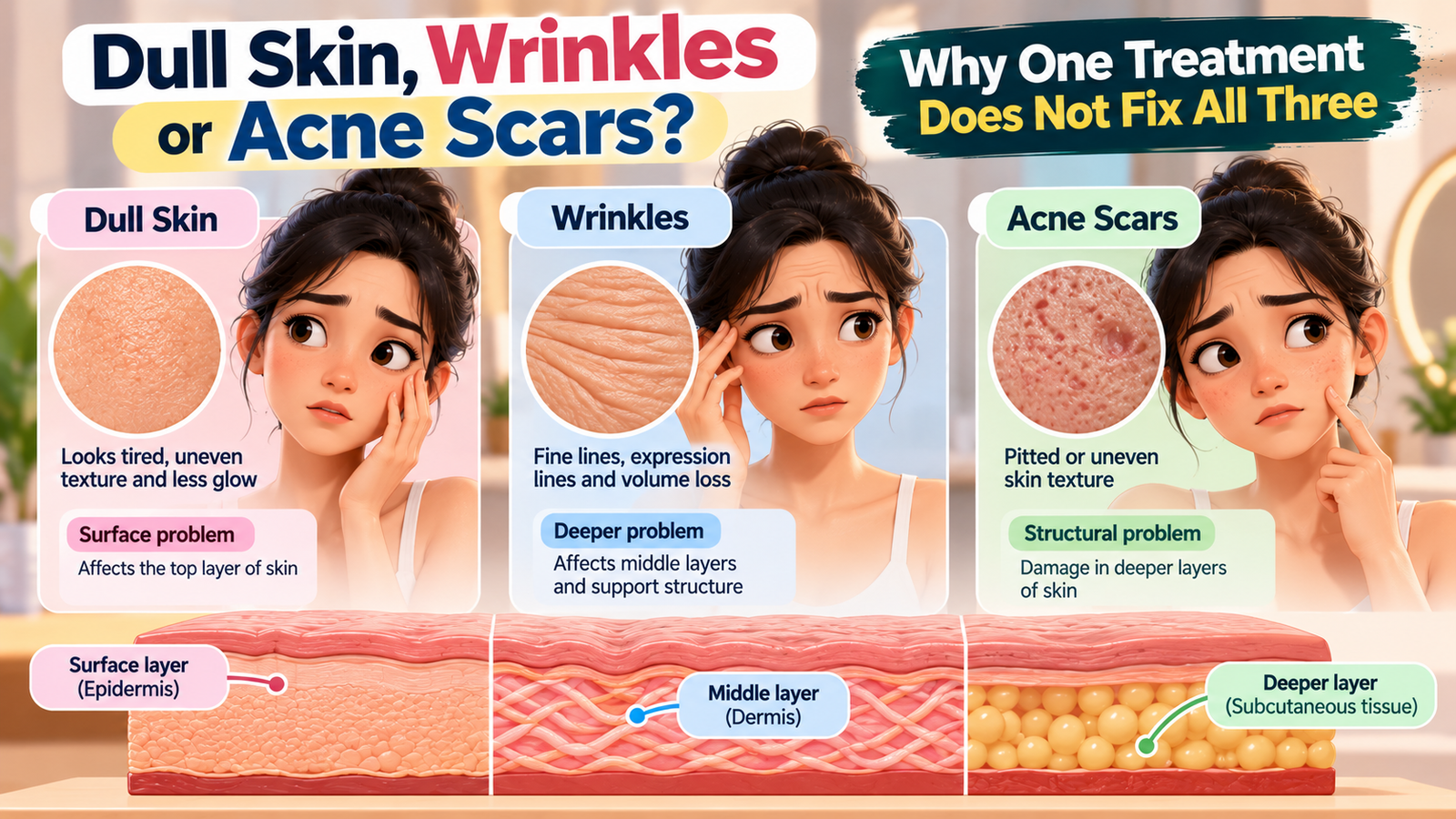
Dullness, wrinkles and acne scars are three different problems affecting three different depths of skin, and no single treatment corrects all three. Dullness is mostly a surface and barrier question, lines and volume loss sit deeper, and acne scars are structural damage. Matching the treatment to the depth is what decides the result.
Most people arrive with more than one of these and hope something will handle everything at once.
Nothing does, and the useful question is not which treatment is best but which of your concerns you are actually treating first.
Why does one treatment not fix all three problems?
Because they sit at different depths and a treatment only works where it reaches. A surface treatment cannot correct a structural problem, and a structural treatment is wasted on a surface one.
Think of it as three separate questions:
- Dullness is largely about the surface and the skin barrier, which is why it is the quickest of the three to change and the one that returns fastest if nothing else changes.
- Lines and volume loss sit deeper and are two distinct observations rather than one, which matters because they respond to different things.
- Acne scars are structural. Tissue has been lost or laid down abnormally, and no amount of surface work reaches that.
This is why a single package offered for "skin rejuvenation" is usually addressing one of the three well and the other two incidentally. The important thing to establish before you agree to anything is which one it is built for.
What actually causes skin to look dull?
Mostly surface texture and the condition of the skin barrier, which is why dullness is the most responsive of the three concerns and also the least durable. Improvements arrive quickly and fade quickly if the underlying routine does not change.
The common contributors are accumulation of dead cells at the surface, dehydration of the outer layer, uneven texture scattering light rather than reflecting it evenly, and pigmentation from sun exposure or previous inflammation.
The practical implication for this page is about sequencing rather than treatment. Dullness is the concern most likely to improve as a side effect of treating something else, and the one least worth paying for as a standalone course if you also have scarring or volume loss to address.
What causes dullness in more detail, and what hydration-focused treatments do about it, is covered on our sister site's page on dull and dry skin. That is the page to read if dullness is your only concern.
What causes wrinkles and volume loss, and are they the same thing?
They are not the same thing, and confusing them is the commonest reason a treatment disappoints. One is about the surface of the skin, the other about what sits underneath it.
A note on what this section does not claim. The biological mechanism usually given for skin ageing is widely repeated, and I could not verify it from a source I would cite for anything else on this page, so it is not stated here as fact. What follows is the distinction that actually changes the decision, which does not depend on the mechanism.
- Lines are a feature of the skin itself. Some appear with movement and are visible only when you make an expression. Others are present at rest.
- Volume loss is not a feature of the skin. It is a change in what supports the skin from below, and it shows as flattening, hollowing or a change in the shape of the face rather than as lines.
Why the distinction decides the treatment: a line on the surface and a loss of support underneath are addressed differently, and treating one when the problem is the other produces a result that looks smoother but not better, or fuller but not smoother. A reader who has been disappointed by a previous treatment has often had exactly that mismatch.
The useful test at a consultation is to ask which of the two you are being treated for, and to expect the answer to distinguish them rather than to say both.
Why are acne scars different from everything else on this list?
Because tissue has actually been lost or laid down abnormally, so this is a structural problem rather than a surface one. It is also the concern where expectations most often exceed what is achievable.
The British Association of Dermatologists describes how scarring arises: "Acne can leave scars or marks on the skin, particularly in the presence of nodules and cysts."
Note the language used for treatment, because it sets the realistic expectation better than anything I could write. The BAD says that various techniques "may also be used to improve the appearance of acne scars".
Improve the appearance of. That is the dermatological framing, and it is a different promise from removal. Scarring is structural change, and treatment makes that change less noticeable rather than undoing it. Anyone offering to remove acne scars is describing something other than what the evidence supports.
The BAD also notes that these techniques "are also not routinely available on the NHS", which is worth knowing as context: they are elective procedures rather than standard care, and that shapes how they are marketed.
Which treatment targets which layer?
Matching depth to concern is the whole exercise. This table is the short version of everything above and everything below.
| Concern | Depth involved | What targets it | Realistic timeframe |
|---|---|---|---|
| Dullness and uneven texture | Surface and barrier | Surface-level treatments and routine change | Quickest of the three, and least durable |
| Pigmentation | Surface to mid | Treatments directed at pigment specifically | Months, and prone to returning with sun exposure |
| Lines present at rest | Skin itself | Resurfacing and collagen-stimulating approaches | Months, with gradual change |
| Volume loss | Below the skin | Volume replacement rather than skin treatment | Immediate in appearance, but not a skin treatment |
| Indented, pitted or atrophic scars | Structural | Resurfacing, microneedling, subcision | Multiple sessions over many months |
| Raised, hypertrophic or keloid scars | Structural, excess tissue | A different approach entirely, including steroid injection | Months, and type-dependent |
| Active acne | Not a scarring question yet | Acne treatment, before any scar work | Months, and it comes first |
Notice the last two rows. Raised and indented scars are opposite problems, and active acne is not a scar problem at all. Both distinctions get lost when a clinic treats "acne scars" as one category.
Which acne scar types respond to which approach?
It depends entirely on whether the scar sits above or below the surrounding skin, and those two situations have almost nothing in common. This is the single most useful distinction if you have been offered one treatment for all your scarring.
The BAD sets out the two categories: scars "may be raised and lumpy (known as hypertrophic or keloid scars) or indented (known as pitted or atrophic scars)".
The approaches the BAD names:
- Laser resurfacing, which it describes as "an established technique requiring the skills of an experienced laser surgeon". Note the second half of that sentence, which is about who is holding the device rather than about the device.
- Steroid injections, which are directed at raised scar tissue rather than indented scars.
- Microneedling.
- Subcision, which addresses tethering beneath an indented scar rather than the surface of it.
The practical consequence is that a mixed pattern of scarring, which is what most people actually have, needs more than one approach and a decision about which to do first. A single-procedure recommendation for mixed scarring is worth questioning.
Why does the order of treatments matter?
Because some steps make the next ones work better and some make them pointless, and getting the order wrong is where money is most often wasted. This is the part almost nobody explains.
Active acne is treated before scarring. Always. The BAD's advice on this is about prevention: "However your acne affects you, it is important to take action to control it as soon as it appears. This helps to avoid permanent scarring and reduces embarrassment."
The logic follows straightforwardly. Scarring is the consequence of inflammation, so treating scars while inflammation continues means treating a target that is still being added to.
The general sequence:
- Control active acne first, so no new scarring is forming.
- Address structural scarring next, since it needs the most sessions and the longest time.
- Consider volume separately, because it is a different question from skin quality and is often better judged after resurfacing has settled.
- Surface concerns last or throughout, since dullness improves alongside most of the above and is the least durable gain.
Two common mistakes worth naming: starting scar work while acne is still active, and addressing volume before skin quality, which can make a face look fuller while the texture that prompted the visit is unchanged.
How long does each approach realistically take to show a result?
Months, for all of it. Nothing on this page produces a meaningful result in a week, and any timeframe given as a promise should be treated with suspicion.
The BAD gives a figure, and the scope of it matters: "In general, most treatments take two to four months to produce their maximum effect."
That sentence is about treatments for acne itself, not about scar treatment, and this page is not extending it to scar work, which generally takes longer and needs several sessions. It is quoted because it establishes the order of magnitude for the fastest thing in this field. If controlling acne takes two to four months, nothing structural is going to be quicker.
What that means for planning:
- Judge nothing at two weeks. It is too early for any of these to have done anything.
- Structural work is measured in sessions and months, not appointments and weeks.
- Surface improvements arrive first, which can make a course feel like it is working before the part you came for has changed at all.
- Take a photograph at the start, in consistent light, because gradual change is almost impossible to judge in a mirror.
What should a consultation actually assess before recommending anything?
Which of the three concerns you have, at what depth, and in what order they should be addressed. A recommendation made before that assessment is a product being sold rather than a plan being made.
What should happen:
- Your concerns, in your own words, and which one matters most to you, since that is not always the one a clinician would pick.
- Examination in good light, including whether scarring is raised, indented or mixed.
- Whether acne is still active, which changes the whole plan.
- A stated order, with reasons, rather than a bundle.
- What will not change, which is more useful than what will.
- How many sessions and over what period, before any money is discussed.
Questions worth asking: which of my concerns does this treat, and which does it not? Is my scarring raised, indented or both? Should anything be treated before this? How will we know at three months whether it is working? What happens if it does not?
The cost side of this, and why the cheapest option is often the most expensive over a full course, is covered in our page on cheap skin treatment.
How is a treatment plan built at the clinic in Surat?
By sorting the concerns before discussing any treatment, because the sorting is what determines everything afterwards. In our practice in Surat, people very often arrive with a treatment name rather than a concern.
That is understandable: procedures are what get advertised. But it means the first part of a consultation is usually working backwards from the treatment someone has asked for to the problem they actually want solved, and those do not always match.
The examination establishes the practical questions. Whether scarring is raised, indented or mixed, since that decides the approach entirely. Whether acne is still active, since that decides the order. Whether what is being described as lines is actually a volume question, since that changes what would help.
Where several concerns are present, which is usual, the plan is a sequence rather than a package, and it is set out with what comes first and why. Where one concern is much more treatable than another, that is said plainly, including when the most treatable one is not the one that prompted the visit.
Related pages: why a double chin is not reducing, and on our sister site, permanent lip makeup.
Next step
If you have more than one of these concerns, the useful first step is having them sorted rather than choosing a treatment. Which one is treatable, which is not, and what order they should be addressed in is a twenty-minute conversation that changes what you spend. Book a consultation with Dr. Ashutosh Shah in Surat.
This page is for education and is not a substitute for examination. It does not name specific devices, products or brands, and the approaches described are ones that exist rather than a statement of what is offered at any particular clinic. Acne scar treatment improves appearance rather than removing scarring. Please consult Dr. Ashutosh A Shah or another qualified clinician about your own skin.