Double Chin: Why Weight Loss Does Not Always Remove It, and What Does
Written by Dr. Ashutosh A Shah, M.B.B.S., M.S., M.Ch., D.N.B., Consultant Plastic, Cosmetic and Reconstructive Surgeon, Elegance Clinic, Surat. Reg. no. [REG NO]. 22+ years in facial contouring and body contouring surgery.
Medically reviewed by Dr. Ashutosh A Shah · Published [DD Month 2026] · Last reviewed [DD Month 2026]
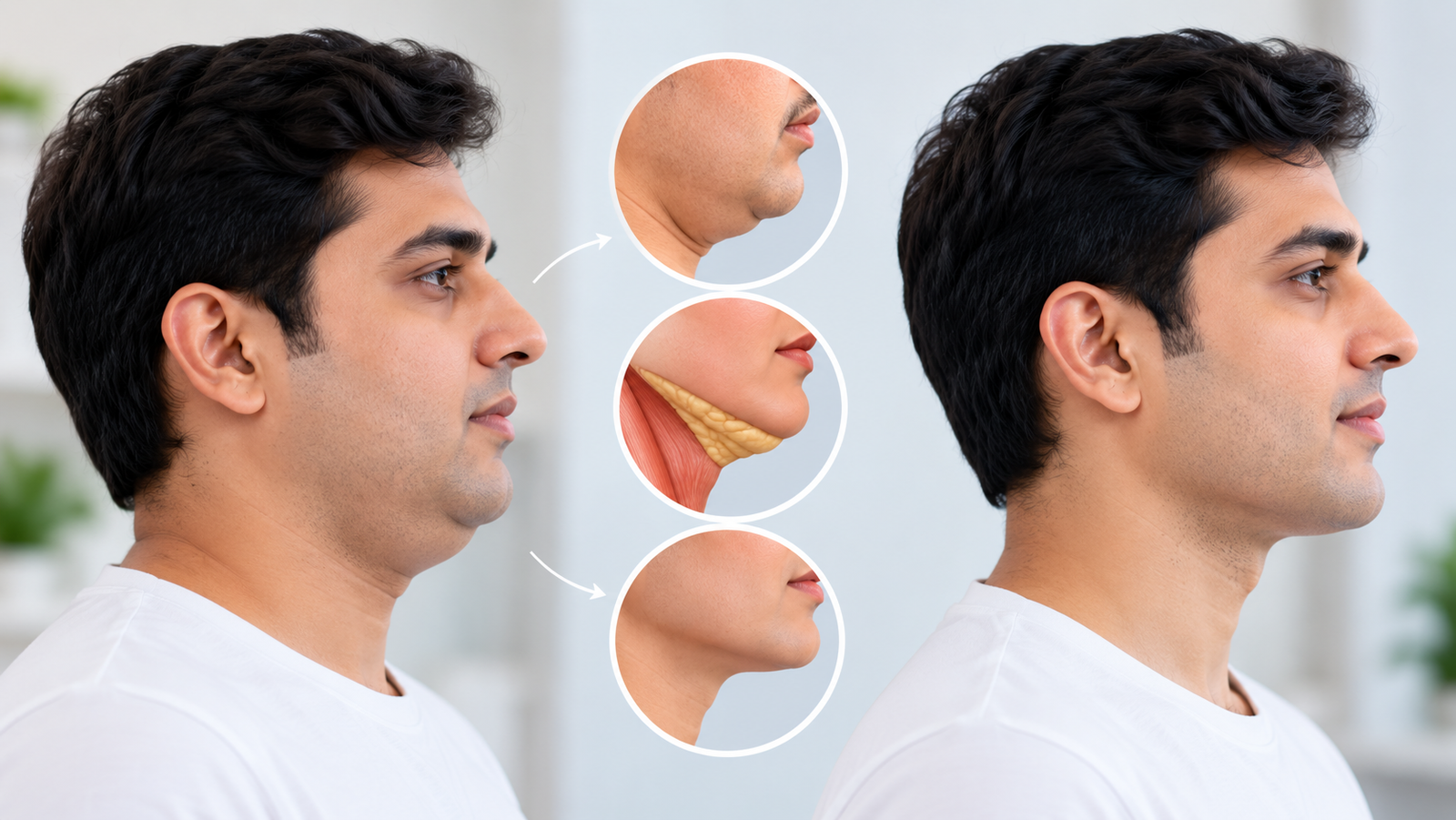
A double chin can come from submental fat, loose skin, a weak or receding jawline, or an enlarged salivary gland, and the cause decides the treatment. Weight loss removes fat but not loose skin or a recessed chin. Chin liposuction suits fat with good skin tone; loose skin needs tightening or a lift.
The most common story we hear in consultation is some version of this: "I lost eight kilos. Everything else changed. This did not."
That is not a failure of effort. It is a sign that the fullness under the chin was never mainly fat in the first place, or that it was fat sitting in a layer that dieting does not reach efficiently. This article explains how to tell which cause is yours, because that single question determines whether the answer is a lifestyle change, a non-surgical treatment, a small operation, or nothing at all.
What actually causes a double chin?
Four different things produce the same silhouette, and they need four different answers. A review of submental fat management published in Cosmoderma lists the contributors as skin laxity, excess fat, loss of muscle tone, submandibular gland hypertrophy and the skeletal framework itself.
Here is how each one looks, and what it responds to.
| Cause | How to identify it | What actually treats it |
|---|---|---|
| Submental fat | Soft, pinchable fullness. You can hold it between two fingers. Often changes a little with weight. | Fat reduction: liposuction where skin tone is good, or a non-surgical fat reduction option in milder cases. |
| Loose or lax skin | Nothing much to pinch. The area hangs or crepes rather than bulges. Usually worse after weight loss or with age. | Skin tightening, or a lift where laxity is significant. Fat removal alone can make this look worse. |
| Weak or receding chin (retrognathia) | Look at yourself in profile. The chin sits back relative to the lips. The jawline has no shelf for the neck to meet. | Structural correction to project the chin. No amount of fat removal creates a jawline that was never there. |
| Enlarged submandibular salivary gland | A firm, rounded fullness slightly to one or both sides under the jaw, not in the midline. Does not pinch. Does not change with weight. | Assessment first. This is a gland, not fat, and it must be identified before any fat treatment is planned. |
| Loss of muscle tone in the platysma | Vertical cords or bands visible in the neck, especially when you tense. | Addressed as part of neck treatment, not by fat removal. |
Most people have a mix. A common real-world combination in the forties is moderate fat plus early skin laxity plus a chin that was always slightly recessed. Treating only the fat in that person gives a disappointing result, and it is one of the main reasons people say a treatment "did not work".
Why does losing weight not always remove a double chin?
Because weight loss only helps with one of the five causes above, and even for that one it does not reach everywhere.
There is an anatomical detail here that explains a great deal. The fat under the chin sits in two layers, above and below the platysma muscle. The Cosmoderma review cites cadaver work putting the mean weight of pre-platysmal fat at 8.4 g and post-platysmal fat at 3.7 g, and makes a point that matters enormously for anyone choosing a treatment: only the pre-platysmal fat can be addressed by non-surgical methods.
So there are three separate reasons weight loss can leave the chin unchanged:
- The problem was never fat. Skin, chin projection and salivary gland size do not respond to a calorie deficit at all. This is why slim people have double chins.
- The fat is in the deeper layer. Fat below the muscle is not reachable by non-surgical treatments and does not always reduce proportionately with general weight loss.
- Weight loss made the skin worse. This is the cruel one. Losing fat from a neck whose skin has already lost elasticity can leave the area looser than it started. The volume went. The contour did not improve.
None of this is an argument against losing weight if you need to. It is an argument against expecting it to fix a problem it was never capable of fixing, and then concluding that nothing works.
Do double chin exercises and chewing gum actually work?
There is very little evidence that they do, and the mechanism does not support the claim.
Chin tucks, jaw exercisers, chewing gum and "neck yoga" all work the muscles of chewing and neck movement. Those muscles are not the tissue producing the problem. Submental fat sits in front of and behind the platysma, and skin elasticity is a property of the skin. Strengthening a muscle underneath a fat pad does not remove the fat pad, in the same way that strong abdominal muscles do not remove abdominal fat.
The evidence is thin but it points one way. A case report published on the efficacy of jaw exercising devices followed two people using a commercially available jaw exerciser for around three months. Neither saw a noticeable change in jaw appearance, and the authors concluded that such products may have limited efficacy in achieving their advertised results, while raising concerns about the marketing around them.
That is two people, and it should be read as two people rather than as proof. But it is more evidence than exists on the other side, and it matches what the anatomy predicts.
What this means practically. Exercises are not harmful and posture work has its own benefits. Just do not delay an assessment for six months waiting for them to work, and do not spend money on a device that promises jawline definition.
Two more claims worth retiring: no cream, oil or serum reaches subcutaneous fat, and no massage tool drains fat away. Skin care works on skin.
The jawline test: how do you work out which cause is yours?
You can get surprisingly close at home with a mirror, before you pay anyone anything. Do these four checks.
- The pinch test. Pinch the area under your chin between thumb and forefinger. A thick, soft, easily grasped roll points to fat. Almost nothing to grasp, with skin that stays creased for a moment after you let go, points to laxity.
- The profile test. Photograph yourself from the side, looking straight ahead, phone at eye level. The angle between the underside of your chin and the front of your neck is the cervicomental angle. The Cosmoderma review notes that an angle of roughly 90 to 105 degrees reads as defined, while beyond 120 degrees a double chin becomes visible. If your angle is obtuse but there is little fat to pinch, the issue is structural or skin, not fat.
- The chin projection test. On the same profile photo, draw an imaginary vertical line down from your lower lip. If your chin sits well behind that line, you have some degree of recession, and that is contributing regardless of your weight.
- The side-lump test. Feel under the jaw, a little to the left and right of the midline, rather than in the centre. A firm, discrete, rounded fullness there that does not pinch may be a salivary gland rather than fat. Do not assume. Have it examined.
These tests narrow it down. They do not replace an examination, and the fourth one in particular needs a clinician, because a firm lump under the jaw has a differential diagnosis that goes well beyond cosmetics.
Who suits chin liposuction, and what is recovery actually like?
Liposuction of the submental area is described in the Cosmoderma review as the gold standard for fat removal here, performed through a small incision of roughly 1 to 2 cm using an aspiration cannula.
It suits you if: the dominant problem is fat, you can pinch it, and your skin has enough elasticity to shrink back over the new contour. Younger patients and those with good skin tone generally do well.
It suits you less if: the fullness is mainly loose skin, the chin is significantly recessed, or the fullness is a salivary gland. In the first of those, removing fat can leave the skin with less to drape over and the result can look worse, not better. An honest assessment will say so.
Recovery, in general terms. Expect swelling and bruising that is at its most obvious in the first few days and settles over the following weeks. A support garment or chin strap is commonly used. Most people are presentable for work sooner than they expect and fully settled later than they expect, because the final contour continues to refine for some months as swelling resolves. Your surgeon will give you the specific timeline for your procedure, because it varies with how much was done and whether anything was combined with it.
Risks are real and should be discussed with you before you consent. The review lists complications including bruising that can progress to partial or total skin necrosis, haematoma which can cause airway obstruction, and cervical fasciitis. These are uncommon, and they are the reason this is done by a qualified surgeon in a proper setting rather than as a walk-in salon service.
You can read the procedure detail on our double chin reduction page.
What do fat dissolving injections realistically achieve?
Injectable deoxycholic acid works as a surfactant, disrupting the membrane of fat cells so they break down and are cleared. The Cosmoderma review reports that in the REFINE-1 trial, over 70% of treated subjects achieved at least a one-grade composite response, against 18.6% on placebo.
Read that honestly in both directions. It is a real effect, clearly better than placebo. It is also a one-grade improvement in most responders, not an erasure, and close to 30% did not reach even that.
Four things to be clear about before you consider it:
- It only reaches the fat above the muscle. The deeper layer is untouched. If your fullness is largely post-platysmal, injections will underdeliver and no one can tell you that from a photograph.
- It does nothing for loose skin or a recessed chin. Same limitation as every fat-targeting treatment.
- It takes more than one session. Treatment is staged, spaced out, and priced per session, so compare the total against a single surgical cost rather than comparing one session against it.
- Side effects are common and one is worth naming. The review lists injection site swelling, pain, bruising and numbness lasting up to four days as typical. It also reports that 4.3% of patients experienced temporary weakness of the jaw muscles, lasting a mean of 31 days. That is an asymmetric smile for roughly a month. It resolved, but you should know it is on the list before you agree.
Availability of this option varies between clinics and countries, so whether it is offered to you at all is something to establish at consultation rather than assume from an article.
Other non-surgical routes exist with the same basic constraint. Cryolipolysis, which reduces fat by controlled cooling, showed a mean reduction of around 4 mm in nine of ten subjects in one study cited by the review, with 83% reporting satisfaction after one or two treatments. Radiofrequency approaches showed a significant decrease in fat volume by the sixth month in a 22-patient study. These are modest, gradual changes in the right candidate, not alternatives to surgery in the wrong one.
Our full non-surgical menu is on the non-surgical treatments section.
When is skin tightening enough, and when is a lift the honest answer?
The dividing line is elasticity, and it is a judgement made by hand at an examination rather than by looking at a photo.
Skin with mild laxity and reasonable recoil can respond to energy-based tightening, which works by heating the deeper skin to contract existing collagen and stimulate new collagen over the following months. It is gradual and it is modest.
Skin with significant laxity, particularly after substantial weight loss or beyond a certain age, has passed the point where tightening alone changes the silhouette. At that stage the honest answer is that excess skin has to be removed and repositioned surgically, and a clinic that sells you three cycles of tightening instead is taking your money for a result it can predict you will not get.
Asking directly helps. "Is my skin going to retract over this, or am I going to need the skin dealt with separately?" is a fair question and a good clinician will give you a straight answer, including when the answer is that you are not a good candidate for the cheaper option.
Lifting procedures, how they differ from one another and who each suits is a subject in its own right, and we cover it separately rather than compressing it here.
What do genetics and age do to the jawline?
More than most people expect, and it is worth knowing because it reframes the whole question from a discipline problem into an anatomy problem.
Three things are largely inherited: where your body preferentially stores fat, including whether the submental area is one of those sites; the projection and shape of your jaw and chin, which is skeletal; and the quality and thickness of your skin. This is why a lean 25-year-old can have a visible double chin and a heavier person the same age may not. It is also why "just lose weight" is such poor advice to give without looking at someone first.
Age adds three more, independent of weight: skin elasticity declines, the platysma loses tone and can form visible bands, and the underlying bone of the jaw remodels and loses a little projection over the decades. The combined effect is that the same amount of fat that looked fine at 25 reads as a double chin at 50, because the framework holding it has changed.
The practical consequence is simple. If your double chin has been there since your teens and your weight has not changed, it is structural and it will not respond to a lifestyle approach. If it appeared in the last five years alongside weight gain, fat is more likely to be the main driver. If it appeared after weight loss, look at skin first.
What are the side effects, and who should not have each option?
Every option on this page has a downside, and the ones worth taking seriously are these.
| Option | Common, expected effects | Less common but important |
|---|---|---|
| Submental liposuction | Swelling, bruising, temporary numbness, a period of wearing a support garment. | Contour irregularity, skin necrosis from severe bruising, haematoma which can affect the airway, and cervical fasciitis. Rare, serious, and the reason setting and surgeon matter. |
| Injectable fat reduction | Swelling, pain, bruising and numbness at the injection site, typically lasting a few days. | Temporary weakness of the jaw muscles, reported in 4.3% of patients in the data cited above, lasting around a month on average. |
| Cryolipolysis | Swelling, numbness, bruising and redness. | Paradoxical adipose hyperplasia, in which the treated area enlarges instead of reducing. Rare, but it is a genuine reported event and you should be told about it. |
| Energy-based skin tightening | Redness, temporary tenderness, gradual and modest change. | Underwhelming results if candidate selection was wrong, which is a cost risk more than a safety risk. |
| Surgical lifting | Swelling, bruising, a longer recovery, scars in planned locations. | The usual risks of surgery, discussed with you individually at consultation. |
Some people should not proceed with any of it, at least not yet. If the fullness is a firm lump rather than soft fat, it needs a diagnosis before it needs a treatment. If you have an active infection or skin condition in the area, treatment waits. If you are pregnant or breastfeeding, elective cosmetic treatment waits. If you have a bleeding disorder or take blood-thinning medication, that changes the plan and must be declared. And if your expectation is a jawline you have seen on someone with a different skeleton, the most useful thing a surgeon can do is say so before you book anything.
What does double chin treatment cost in Surat?
These are researched market ranges across India in 2026, given so you can sanity-check any quote you receive. They are not a quotation from this clinic.
| Option | What it addresses | Typical market range, India 2026 |
|---|---|---|
| Injectable fat reduction, per session | Mild to moderate fat above the muscle | Rs 10,000 to Rs 30,000 per session, multiple sessions needed |
| Cryolipolysis, per session | Mild fat, gradual change | Rs 10,000 to Rs 30,000 per session |
| Thread lift | Mild laxity, temporary repositioning | Rs 15,000 to Rs 50,000 |
| Micro-focused ultrasound skin tightening | Mild to moderate skin laxity | Rs 40,000 to Rs 70,000 |
| Chin liposuction | Clear fat with good skin tone | Rs 45,000 to Rs 80,000 |
| Neck lift | Significant skin excess and laxity | Rs 50,000 to Rs 1,00,000 |
For context on the local market specifically, published ranges for liposuction in Surat sit at roughly Rs 40,000 to Rs 1,00,000 depending on the setting, with small clinics at the lower end and multi-speciality hospitals in the middle of that band.
Why the ranges are wide, and what actually moves your number:
- Whether you need one thing or a combination. Fat plus skin costs more than fat alone.
- Anaesthesia type and setting.
- Surgeon qualification and experience.
- Number of sessions, which is what makes per-session non-surgical options look cheaper than they finish up being.
- What is bundled: consultation, garment, follow-up visits, medication. Always ask what the quoted figure excludes.
A note on comparing prices. The cheapest quote in a category is often cheap because it is a different procedure done in a different setting, or because the follow-up is billed separately. Ask what is included before you compare two numbers. Men looking at combined treatments can see current packages on our male grooming combo offers page.
Double chin assessment at Elegance Clinic, Surat
Facial contouring of this area sits with plastic surgery, because getting it right means judging fat, skin and bone together and knowing when the answer is not a fat treatment at all.
Dr. Ashutosh A Shah is a Consultant Plastic, Cosmetic and Reconstructive Surgeon with M.Ch. and D.N.B. qualifications and over 22 years in practice, covering both the surgical and non-surgical ends of facial contouring. That range matters here more than it might elsewhere, because a clinic that only offers one modality will tend to find that every patient needs it.
What an assessment involves: an examination by hand, not just a look; a profile assessment of your chin projection and cervicomental angle; a clear statement of which of the five causes is dominant in your case; and a recommendation that may well be that the cheaper option is the right one, or that no treatment is the right one.
Two things we will not do. We will not quote you a price before examining you, and we will not tell you a result is permanent, because no soft tissue result is immune to further ageing or weight change.
More about the team is on our about us page.
Frequently asked questions about a double chin
What causes a double chin?
A double chin has five possible causes and most people have a mix: fat under the chin, loose or lax skin, a weak or receding chin, an enlarged submandibular salivary gland, and loss of tone in the platysma muscle of the neck. Only the fat responds to weight loss, which is why slim people can still have one and why losing weight sometimes changes nothing.
Can exercise remove a double chin?
There is very little evidence that chin exercises, jaw exercisers or chewing gum reduce a double chin. These target the chewing and neck muscles, which are not the tissue causing the fullness. A published case report following two people using a jaw exercising device for around three months found no noticeable change and concluded that such products may have limited efficacy. Exercises are not harmful, but they are not a treatment.
Does chin liposuction leave loose skin?
It can, if the skin did not have enough elasticity to retract over the new contour. This is why candidate selection matters more than technique. Younger patients with good skin tone usually see the skin redrape well. Where laxity is already significant, removing fat alone can make the area look looser, and skin tightening or surgical removal of excess skin needs to be part of the plan instead.
How long is recovery after chin liposuction?
Swelling and bruising are most obvious in the first few days and settle over the following weeks, usually with a support garment for part of that time. Most people return to routine activity well before the contour is final, because swelling continues to resolve and the result keeps refining for some months. Your surgeon will give you a specific timeline, since it depends on how much was done and whether anything was combined with it.
Do fat dissolving injections work on a double chin?
They produce a real but modest effect in the right candidate. In the trial data, over 70% of treated patients achieved at least a one-grade improvement against 18.6% on placebo, so the effect is clearly better than placebo but it is an improvement rather than an erasure. Injections only reach the fat layer above the platysma muscle, do nothing for loose skin or a recessed chin, and need several sessions.
Is a double chin genetic?
Partly, yes. Where your body stores fat, the projection and shape of your jaw and chin, and the quality of your skin are all substantially inherited. This is why a lean person can have a visible double chin. Age then adds declining skin elasticity, loss of platysma tone and gradual remodelling of the jaw bone, so the same amount of fat reads differently at 50 than it did at 25.
What does double chin treatment cost in Surat?
Researched market ranges in India for 2026 run from around Rs 10,000 to Rs 30,000 per session for injectable fat reduction or cryolipolysis, Rs 15,000 to Rs 50,000 for a thread lift, Rs 40,000 to Rs 70,000 for micro-focused ultrasound tightening, Rs 45,000 to Rs 80,000 for chin liposuction, and Rs 50,000 to Rs 1,00,000 for a neck lift. Your actual cost depends on which cause is being treated, how many sessions are needed and what the quote includes, so it can only be confirmed after an examination.
Next step
If weight loss has not changed your jawline, the useful next question is not which treatment to buy. It is which of the five causes you actually have.
- Take a profile photo at eye level before you come, so you can see the angle yourself
- Note when the fullness first appeared and whether your weight changed around then
- Bring a list of any medicines you take, especially anything affecting bleeding
Book a jawline and double chin assessment at Elegance Clinic, Surat
Medical disclaimer. This article is general health information and is not a substitute for examination, diagnosis or treatment by a qualified doctor. Cost figures are researched market ranges for orientation only and are not a quotation. Outcomes vary between individuals and no cosmetic result is protected from future ageing or weight change. A firm, fixed or growing lump under the jaw should be assessed by a doctor promptly rather than treated as a cosmetic concern.
.png)