
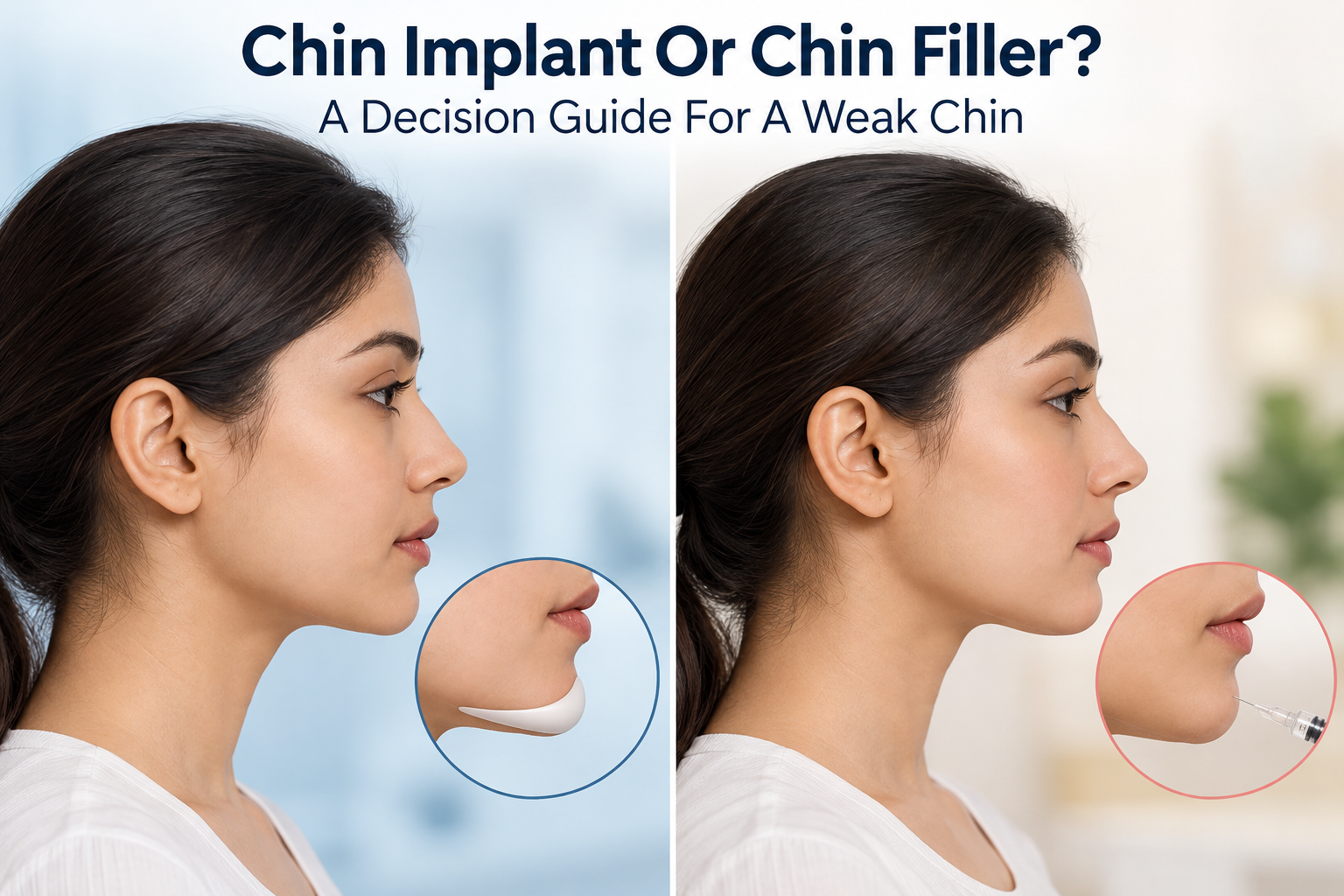
Chin Implant Or Chin Filler? A Decision Guide For A Weak Chin
Filler can add modest projection, is reversible and needs repeating every one to two years. An implant or genioplasty gives a larger, lasting change in one operation with a recovery period. Filler is often used first as a trial so you can see the profile change before committing to surgery.
Choosing between chin implant vs chin filler is not simply a choice between surgery and an injection. The right option depends on how much projection is needed, whether the problem is limited to the chin or involves the underlying jaw, how long you want the result to last, and whether reversibility is important.
A proper weak chin correction assessment should look at the entire profile rather than the chin alone. The relationship between the nose, lips, chin, jawline and neck can change how prominent or recessed the chin appears.
Patients considering broader facial changes can also read about face enhancement surgery for facial balance.
What Does a Weak Chin Change About the Jawline and Profile?
A weak or recessed chin can make the lower face appear less defined, even when the jaw itself is otherwise normal.
From the side, insufficient chin projection may make the nose appear relatively more prominent. It can also reduce the visual separation between the lower lip, chin and neck.
From the front, the effect may be different. Some patients have enough forward projection but lack width, height or symmetry.
This is why a request for a “stronger chin” needs to be translated into a specific anatomical goal.
The assessment may consider:
- Forward chin projection
- Chin width
- Chin height
- Symmetry
- Jawline definition
- Relationship between the chin and lower lip
- Nose-to-chin balance
- Neck and under-chin contour
- Dental or skeletal relationships when relevant
Why Profile Balance Matters
The chin does not exist in isolation.
A relatively prominent nose can make a mildly recessed chin appear weaker. Likewise, improving chin projection can sometimes create a more balanced profile without changing the nose.
However, adding projection alone will not correct every lower-face concern.
A patient may actually have:
- Chin asymmetry
- A short chin
- A narrow chin
- A skeletal jaw discrepancy
- Under-chin fullness
- Loose skin
- A combination of these features
This is why chin augmentation options should be selected after profile assessment rather than from photographs alone.
Patients with facial asymmetry can also read about non-surgical asymmetry correction.
What Can Filler Achieve and Where Does It Stop?
Chin filler can add controlled volume to selected areas of the chin without surgery.
It can be useful when the required change is modest and the underlying skeletal relationship does not require a larger structural correction.
Depending on the individual anatomy and treatment plan, filler may be used to improve:
- Modest forward projection
- Chin contour
- Mild asymmetry
- Selected width or shape concerns
- Overall profile balance
The result can be assessed immediately to a degree, although temporary swelling means the final appearance should not be judged straight after treatment.
How Much Projection Can Filler Add?
There is no single safe number that applies to every patient.
The amount of projection that can be created depends on the existing anatomy, soft tissues, product characteristics and how much volume can be added while maintaining a natural shape.
Filler works best when the desired correction is within the limits of soft-tissue augmentation.
Trying to create a major skeletal change by repeatedly adding filler can produce an overfilled or heavy-looking chin instead of a naturally stronger profile.
Where Does Filler Reach Its Limit?
Filler cannot physically move the chin bone.
It may therefore become a poor substitute when the patient needs:
- Large forward advancement
- Significant skeletal correction
- Major vertical change
- Correction of a substantial jaw discrepancy
- A permanent structural solution
This is where the discussion of genioplasty vs filler becomes important.
Filler adds volume around the existing structure. A genioplasty changes the position or shape of the patient's own chin bone.
They are therefore not simply temporary and permanent versions of exactly the same procedure.
Is Filler Reversible?
Some commonly used chin fillers can be dissolved when clinically appropriate, which makes reversibility one of the reasons patients may consider filler before permanent surgery.
However, “reversible” should not be interpreted as a reason to treat without careful planning.
Injection still carries risks and should be performed only after appropriate facial assessment.
Can Filler Be Used as a Trial?
Yes. For selected patients, filler can provide a useful preview of how additional chin projection changes the profile.
A patient uncertain about a permanent operation may prefer to experience a temporary change first.
This does not perfectly reproduce the shape or structural effect of an implant or genioplasty, but it can help clarify whether greater chin projection improves overall facial balance.
More information is available on non-surgical chin augmentation on the dedicated injectables site.
When Is an Implant or Genioplasty the More Sensible Answer?
When a larger or more lasting structural change is needed, surgical chin augmentation options may be more appropriate than repeatedly adding filler.
A chin implant is designed to add projection and/or contour using an implanted material positioned over the existing chin structure.
Genioplasty is different. It involves changing the position or shape of the patient's own chin bone.
The choice depends on the anatomical problem.
When May a Chin Implant Be Considered?
An implant may be considered when the patient needs a lasting increase in chin projection and the existing skeletal anatomy is suitable for augmentation.
Potential reasons include:
- More projection than filler can reasonably provide
- Desire for a long-lasting result
- Stable chin deficiency
- Preference to avoid repeated maintenance injections
- Need for more structural definition
An implant still requires surgery, recovery and consideration of implant-specific risks.
When May Genioplasty Be More Appropriate?
Genioplasty may be considered when the required correction involves the actual position or dimensions of the chin bone.
Depending on the anatomy, it can address aspects of:
- Forward projection
- Backward repositioning in selected cases
- Vertical chin dimensions
- Selected asymmetries
- Structural chin proportions
A significant jaw or bite discrepancy may require a broader maxillofacial assessment rather than cosmetic chin augmentation alone.
Is an Implant Permanent?
A chin implant is intended as a long-term surgical solution, but “permanent” should not be interpreted as meaning that it can never require further treatment.
Implants can occasionally require revision or removal because of problems such as position, infection, patient preference or other implant-related concerns.
Can a Chin Implant Be Reversed?
An implant can generally be surgically removed, but removal is another procedure.
The tissues may not necessarily return instantly or perfectly to their exact preoperative appearance.
That makes an implant removable, but not reversible in quite the same simple sense as dissolving an appropriate filler.
Patients exploring surgical facial procedures can review facial surgery at Elegance Clinic.
How Do Cost, Downtime and Reversibility Compare Over Five Years?
The short-term price of a treatment does not tell you its total long-term cost.
Filler generally has a lower initial commitment but requires maintenance if the patient wants to preserve the effect.
An implant or genioplasty has a higher upfront commitment because it involves surgery, but the structural result is intended to last rather than requiring routine repeat injections every one to two years.
The exact financial comparison depends on the individual treatment plan, filler quantity, product used, maintenance frequency, surgical procedure and whether any revision is ever required.
For that reason, a five-year comparison should be based on repeated treatment versus one-time structural treatment, not on an invented fixed price.
Chin Implant vs Chin Filler Decision Table
| Decision factor | Chin filler | Chin implant or genioplasty |
|---|---|---|
| Goal | Modest contour and projection change | Larger or more structural change |
| Projection needed | Usually best for modest augmentation | Better suited when greater structural correction is required |
| Downtime | Generally shorter | Surgical recovery required |
| Reversibility | Some fillers can be dissolved when appropriate | Implant can be removed surgically; genioplasty is a structural bone change |
| Five-year cost | Includes initial treatment plus repeat maintenance | Higher upfront cost; no routine filler-style maintenance schedule |
| Maintenance | Usually repeated periodically to maintain the effect | Implant/genioplasty intended as long-term correction |
| Trial value | Can help preview additional projection | Requires commitment to surgery |
| Skeletal change | Does not move the chin bone | Genioplasty can reposition the chin bone |
| Major deficiency | May reach its limit | Surgical assessment may be more appropriate |
| Procedure setting | Injection treatment | Surgical procedure |
Which Is Better Value Over Five Years?
There is no universal answer because value depends on the amount of correction required and whether the patient wants a temporary or long-term result.
For someone who wants only a modest change and values reversibility, repeat filler may remain appropriate.
For someone who repeatedly maintains substantial projection with filler, the cumulative cost over several years may become an important reason to discuss a surgical option.
However, cost alone should not determine the procedure.
The first question should always be:
Which option correctly addresses the anatomy and the amount of projection needed?
Only after answering that question should cost, downtime and maintenance be compared.
What About Recovery?
Filler generally involves a shorter recovery period, although swelling, bruising and tenderness can occur.
An implant or genioplasty involves surgical recovery. Swelling is expected, and patients need to follow postoperative instructions while tissues heal.
The exact time away from work and normal activity varies according to the procedure and the individual patient.
How Is the Decision Made at a Profile Assessment?
A profile assessment should identify what is actually making the chin appear weak before recommending chin implant vs chin filler.
The first question is not “Which treatment do you want?”
It is:
What anatomical change would improve the profile?
The assessment may examine the face from the front, side and three-quarter views.
The clinician may consider:
- Current chin projection
- Chin height and width
- Symmetry
- Lower-lip relationship
- Jawline shape
- Nose-to-chin balance
- Under-chin contour
- Skin and soft-tissue thickness
- Dental or skeletal relationships when relevant
When Filler May Make Sense
Filler may be considered when:
- The deficiency is modest
- The patient wants a temporary option
- Reversibility is important
- The patient is not ready for surgery
- A trial of additional projection would be useful
- The desired change can realistically be created with soft-tissue volume
When Surgery May Make More Sense
An implant or genioplasty may deserve consideration when:
- A larger structural change is required
- The patient wants a long-lasting correction
- Repeated filler would be needed to maintain substantial projection
- Filler cannot create the required shape without excessive volume
- The problem involves the underlying chin structure
Why the Decision Is Not Always Filler vs Implant
Some patients arrive expecting a simple choice between an injection and an implant, but assessment may show that neither is the complete answer.
For example, a significant skeletal or bite problem may require a different evaluation. Under-chin fullness may also affect the jawline even when chin projection is adequate.
Similarly, asymmetry may require a different strategy from straightforward forward augmentation.
The purpose of consultation is therefore to choose the treatment according to the anatomy rather than force every weak chin into the same two-option decision.
For someone seeking permanent chin correction, it is particularly important to distinguish between an implant that augments the existing chin and a genioplasty that changes the underlying bone.
Conclusion
The decision between chin implant vs chin filler depends primarily on how much projection is needed and whether the desired change can realistically be achieved by adding temporary soft-tissue volume.
Filler can provide modest projection, is reversible in appropriate circumstances and can be useful as a trial before surgery. Its main limitation is that the effect requires maintenance.
A chin implant provides a more lasting structural augmentation but involves surgery and recovery. Genioplasty can go further by changing the position or dimensions of the patient's own chin bone when anatomy requires it.
A profile assessment should therefore compare the nose, lips, chin, jawline and neck before deciding which option provides the most proportionate change.
.png)