Cheap Skin Treatments: What You Are Actually Paying Less For
Written by Dr. Ashutosh A Shah, M.B.B.S., M.S., M.Ch., D.N.B., Consultant Plastic, Cosmetic and Reconstructive Surgeon, Elegance Clinic, Surat. Reg. no. [REG NO]. 22+ years in aesthetic and reconstructive practice.
Medically reviewed by Dr. Ashutosh A Shah · Published 29 September 2026 · Last reviewed 29 September 2026
Cheap skin treatment pricing usually reflects a specific reduction: who operates the device, how the settings are chosen, or whether a test patch is done at all. On darker Indian skin those three decisions carry most of the risk, and pigment change from wrong settings is difficult and slow to correct.
A lower price is not dishonest by itself. Something was taken out to produce it, and the only question that matters is which thing.
This page is about the three reductions that carry almost all of the risk on Indian skin, what each one can lead to, and the questions that reveal which reduction you are being offered. It is not about which laser suits which skin tone, which is covered separately on our post about laser hair removal and Indian skin types.
What does a lower price usually mean was removed?
Almost always time and expertise rather than materials. A light-based treatment has very little consumable cost, so the price is mostly the assessment, the operator and the care taken.
That is what makes this category different from most things you buy cheaply. With a physical product, a lower price usually buys a lesser version of the same object. Here there is no object. What you are paying for is a set of decisions made about your skin, and decisions are exactly what can be skipped without anything looking different on the day.
The three that get removed, in rough order of how often:
- The assessment. Your skin type, your recent sun exposure, your medication, your history. Minutes of someone's attention.
- The individualised settings. Choosing parameters for your skin rather than running the same ones on everybody.
- The test patch. A small trial area done before anything else, and reviewed.
So the useful opening question is not what the treatment costs. It is what does this price include, in terms of assessment time and who performs it?
None of those three is visible to you. You cannot tell from the room, the receipt or the sensation whether they happened. That is precisely why they are the ones that go, and why the rest of this page is about how to find out.
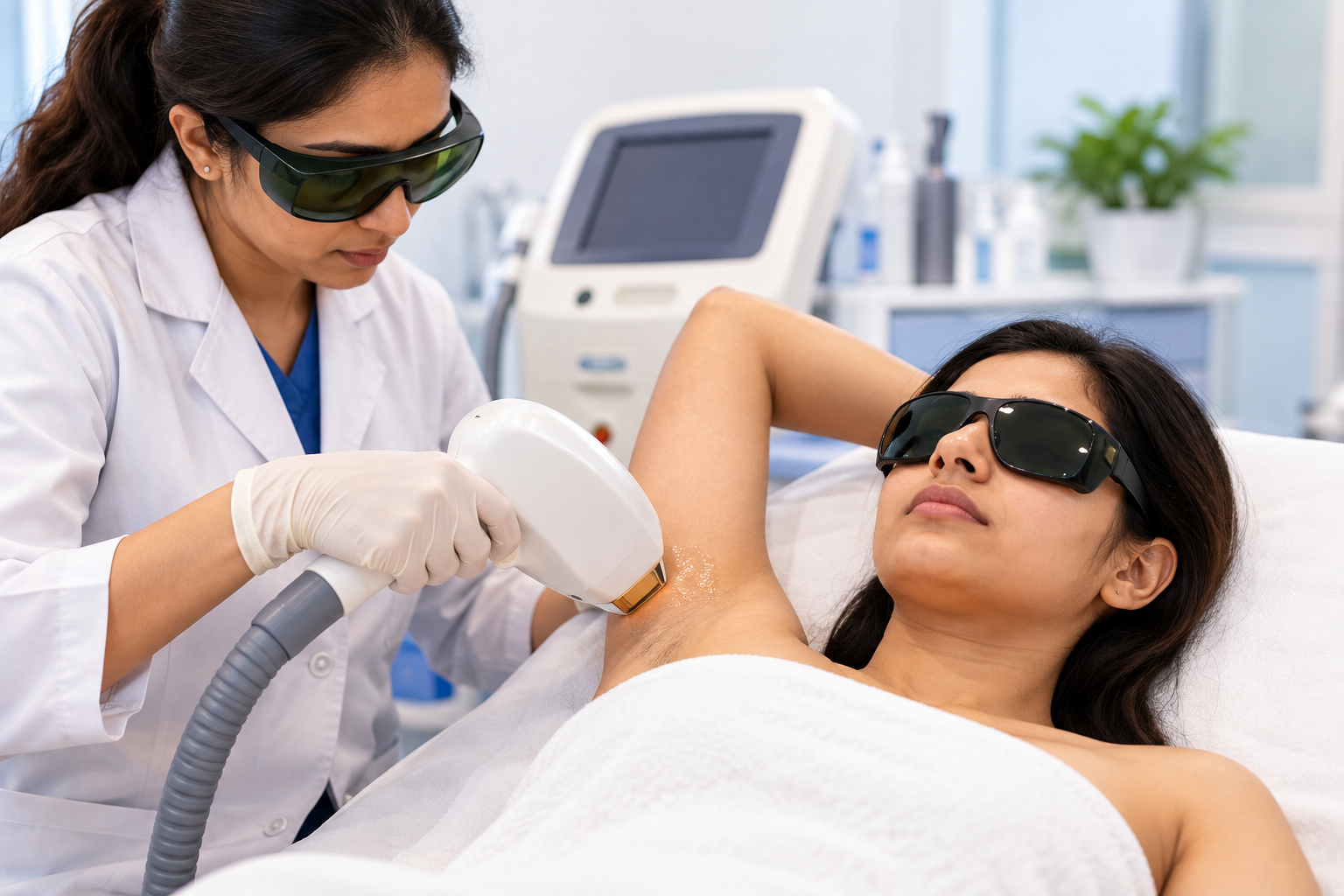
Who is actually holding the device?
Ask, by name and by qualification, before anything touches your skin. You are entitled to that answer and there is no awkwardness in asking for it.
The American Academy of Dermatology states the position in six words: "Laser hair removal can be dangerous in inexperienced hands." It goes on to say that "You can greatly reduce the risk of possible side effects by having your treatment performed by a medical doctor who is extremely skilled in using lasers and has in-depth knowledge of the skin."
Health Canada's guidance for facility owners reproduces provincial requirements, one of which reads: "The owner of a Class 3b or Class 4 laser must ensure that each operator of the laser or laser device is a duly qualified medical practitioner (or, in the case of a non-medical laser procedure, a person who has been formally trained to carry out the procedure for which the laser or laser device is to be used; and can demonstrate to the satisfaction of an officer his or her knowledge of the equipment, the biological effects associated with its use and the necessary safety procedures)."
Two honest caveats about that quotation. It is a Canadian provincial requirement reproduced in national guidance, not a rule that applies in Surat. And the standard it sets is not "a doctor or nothing": it allows a formally trained person for a non-medical procedure, provided that training can be demonstrated. That is a reasonable standard and it is the one worth borrowing.
So the question to ask is not whether the person is a doctor. It is:
- Who will operate the device on me, by name?
- What is their training in this specific treatment? Not in aesthetics generally.
- Are they a registered medical practitioner, and if not, who is supervising?
- Will the same person do every session, or does it vary?
If a price is low because the person operating the device has less training, you now know that is what you are buying, and you can decide. What you should not do is find out afterwards.
Why do settings matter far more on Indian skin?
Because most of these treatments work by targeting pigment, and darker skin has more pigment everywhere, not only where the treatment is aimed. The margin between effective and damaging is narrower.
Put simply, the energy is meant to be absorbed by a target. On lighter skin the surrounding skin absorbs comparatively little of it, so a setting that is slightly too high is often forgiving. On Fitzpatrick IV, V and VI skin, which covers most of India, the surrounding skin competes for that energy. The same setting that is safe on one skin type can injure another, and nothing about the room or the equipment tells you which you are getting.
The AAD is direct about the consequence: "Laser hair removal must be performed very carefully in these patients." It also names what goes wrong when that care is absent: "Burns, permanent changes to your skin color, and scars can occur."
Which laser type suits which skin tone is a separate question with a real answer, and it is set out on our post about laser treatment and Indian skin types. This page is about something the equipment cannot fix: whether anyone chose the parameters for you.
Health Canada's guidance lists what that choice should be based on. Facilities are told to "Assess the clients' skin type, hair colour, thickness and location of hair, presence of a tan, previous hair removal methods, medical history". Read that list and notice how much of it is conversation rather than technology. Almost all of it is time.
The single most useful question on this page: ask what your Fitzpatrick skin type is, and ask what settings are being used for it. If nobody can tell you your skin type, nobody has assessed it.
What is a test patch, and what does skipping it actually cost?
A test patch is a small trial area treated first, then reviewed after a short interval before the full treatment goes ahead. Health Canada's instruction to facilities is one sentence: "Perform a patch test prior to full treatment."
It exists because skin does not always behave the way the assessment predicts. Two people with the same recorded skin type, the same hair and the same history can respond differently, and the only way to find that out safely is on an area the size of a coin rather than an area the size of your face.
What skipping it saves and what it can cost:
- It saves the clinic minutes and it saves you one visit. That is the whole benefit and it is a real one.
- It costs you the only early warning available. If your skin reacts badly, a patch test confines that reaction to a small hidden area. Without one, the first evidence is the treated area itself.
- It removes the chance to adjust. A patch test that reacts more than expected tells the operator to change the parameters before anything large is treated. Nothing else provides that.
Ten minutes and one extra visit, against a pigment change that takes months to settle and may not settle fully. That is the trade, stated plainly. A treatment offered at a low price with no patch test and no waiting period is not faster because it is efficient.
Ask: is a test patch included, how long before the full treatment, and who reviews it? All three parts matter. A patch test done and never looked at is theatre.
What can go wrong, and which shortcut leads where?
Mostly pigment change, sometimes blistering or burns, occasionally scarring. Each of those traces back to a specific step that was skipped rather than to bad luck.
| Shortcut taken | What it saves | What it risks |
|---|---|---|
| No skin type assessment | Minutes of conversation | Parameters chosen for the wrong skin, which is where burns and pigment change come from |
| The same preset used on everyone | Training and judgement | A setting safe on lighter skin delivered to skin that absorbs far more of it |
| No test patch | One visit and a short wait | The first sign of a bad reaction appearing on the treated area instead of a hidden patch |
| No record of the settings used | Paperwork | No way to adjust safely next time, and no way for anyone else to know what was done |
| Operator without training in this treatment | The cost of trained staff | Nobody in the room who can recognise a reaction early or knows what to change |
| Recent sun exposure not asked about | One question | Treating skin that is temporarily darker than usual, which raises the risk sharply |
| Medication history not taken | One question | Treating skin made light sensitive by something the person is already taking |
| No review between sessions | An appointment | Repeating a setting that was already too strong, on skin that has not recovered |
Take any row that worries you and ask it back as a question. Will my skin type be assessed, will a test patch be done, and will the settings be recorded? Three questions cover six of the eight rows.
Read the middle column honestly. Every one of those savings is real, and none of them is materials. That is the argument of this page in a single column.
Why is pigment change the hardest outcome to correct?
Because it is your own skin responding to injury, not damage that can be removed. DermNet defines it as follows: "Postinflammatory pigmentation is temporary pigmentation that follows injury (eg, a thermal burn) or inflammatory disorder of the skin (eg, dermatitis, infection)."
Note the example DermNet gives for injury. A thermal burn is exactly what an over-energetic setting delivers.
The part that matters for anyone reading this in India is the next sentence: "Postinflammatory hyperpigmentation can occur in anyone but is more common in darker-skinned individuals, in whom the colour tends to be more intense and persist for a longer period than in lighter skin colours."
So the same mistake produces a worse and longer-lasting mark on the skin most common here. That is not a reason to avoid these treatments. It is the reason the three decisions in the sections above are worth more on Indian skin than they would be elsewhere, and therefore the reason a price that removes them removes more than it would elsewhere.
The AAD adds the harder line, and it should be read once rather than skimmed: "Some changes to skin color, however, are permanent."
What does correcting a bad result actually involve?
A course of treatment rather than a single fix, usually more than one type of treatment at once, and an honest possibility that it does not fully resolve. It is slower and more demanding than the original treatment was.
DermNet is careful about what can be promised: "Varying degrees of success are achieved but combinations of the treatments below are usually required for significant improvement."
Take that sentence apart, because each clause is doing work:
- Varying degrees of success. Not a fix. A range of outcomes, some of them partial.
- Combinations of the treatments. More than one thing, together, not a single corrective session.
- Usually required for significant improvement. The combination is the normal case, not the difficult case.
Alongside that sits the AAD's line about some colour changes being permanent. Put them together and the honest summary is this: correction is real, it is often worth doing, it takes far longer than causing the problem did, and it does not always finish the job. Related pigmentation work on the body, including what a peel can and cannot reach, is described on our post about back peels, marks and uneven tone.
Nobody should read this section and feel foolish for having chosen on price. Almost nobody is told any of it beforehand, which is the actual problem.
What should you ask before you pay?
Eight questions, all short, all fair, and none of them requiring you to know anything technical. Ask them on the phone if you prefer, before you go.
- Who will operate the device on me, by name?
- What training do they have in this specific treatment?
- Are they a registered medical practitioner, and if not, who supervises?
- What is my Fitzpatrick skin type? If nobody can answer, nobody has assessed it.
- Will a test patch be done, when, and who reviews it?
- Will the settings used be recorded, and can I be told what they were?
- What happens if my skin reacts badly, and who do I contact?
- Will the same person treat me each time?
You do not need to understand the answers technically. What you are listening for is whether the answers exist. A place that has thought about your skin will answer all eight without hesitating. A place that has not will answer question one and become vague by question four.
Ask these of us as well. If we cannot answer all eight about your treatment, that is information about us.
What is a fair price actually buying?
The three things that were removed to make the cheap version cheap, plus the record-keeping that makes the next session safer than the last one.
Itemised as decisions rather than as goods:
- Time spent assessing your skin before anything is switched on, covering the list Health Canada sets out.
- Parameters chosen for you, by somebody trained to choose them, rather than a preset.
- A test patch, reviewed, with the willingness to change the plan if it says so.
- A written record of what was used, so the next session builds on the last one.
- Someone who recognises a reaction early and knows what to do about it.
- A named person to contact if something changes after you go home.
None of that is glamorous and none of it shows up in the room. It is also the entire difference. This page is not arguing that the more expensive option is automatically the better one, because price guarantees nothing by itself in either direction. It is arguing that you should know which of the six items above your price includes.
How is skin assessed at Elegance Face Makeover, Surat?
By skin type first, before anything else is discussed, because the skin type decides what is safe rather than what is available.
In our practice in Surat, the most common thing we see is not someone who was harmed. It is someone who was treated adequately, got an adequate result, and has no idea whether anything was assessed, because nobody told them and they did not know to ask. The second most common is someone arriving with pigmentation from a treatment elsewhere who was never offered a patch test and did not know one existed.
An assessment here covers skin type, recent sun exposure, medication, previous treatments and what you actually want changed, followed by a test patch where one is indicated and a record of what was used. Where the problem turns out to be something a light-based treatment does not address at all, such as a contour issue rather than a skin issue, you will be told that instead of sold a course. That distinction is worked through on our post about why a double chin can persist after weight loss. The full range of non-surgical treatments is listed under our non-surgical treatments.
Next step
If you are weighing up a low price and want to know what it includes rather than be talked out of it, bring the offer to an assessment and go through the eight questions together. You can book a consultation to have your skin type assessed and be told plainly what would and would not be suitable.
This page is for education and is not a substitute for professional assessment. It names no prices and no equipment, because the decisions described here matter more than either. Discuss your own skin with Dr. Ashutosh A Shah or another qualified practitioner.