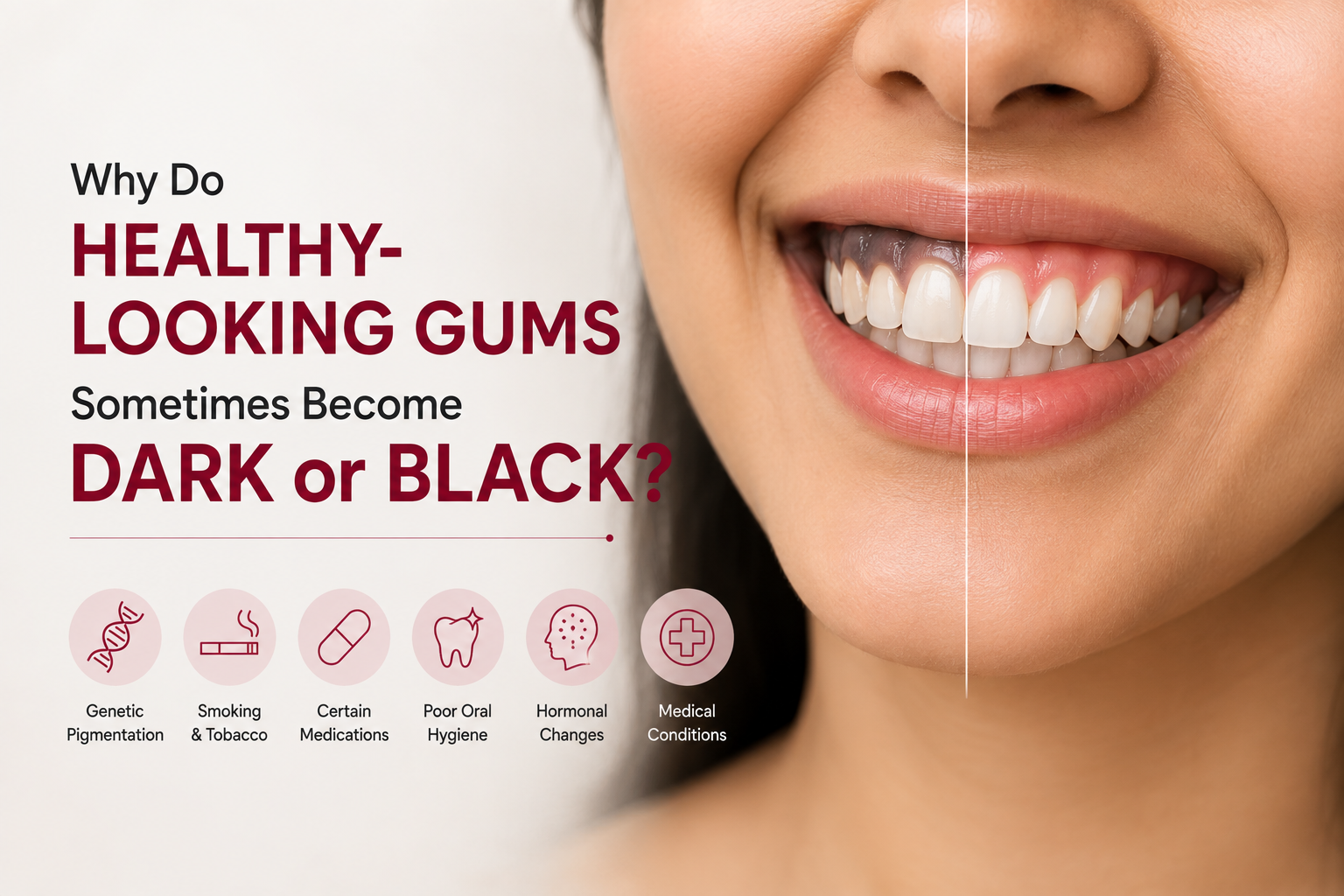
Why Do Healthy-Looking Gums Sometimes Become Dark or Black?
Have you ever noticed that your gums look darker than expected even though your teeth are clean and your oral hygiene is good? You may assume that black or dark gums automatically mean poor brushing, gum infection, or unhealthy teeth. That is not always true.
Gum colour naturally varies from person to person. In many individuals, darker gums are simply the result of melanin pigmentation, the same natural pigment responsible for skin, hair and eye colour. This type of pigmentation can appear as light brown, dark brown or almost black and may be completely harmless.
However, there is an important distinction: gums that have always been naturally dark are different from gums that suddenly develop a new black patch or noticeable colour change. A new, changing, irregular or symptomatic area deserves a dental examination to determine its cause.
What Is the Most Common Reason for Black Gums?
The most common explanation for naturally dark gums is gingival melanin pigmentation. It is usually harmless and may occur evenly or in patches. If the pigmentation has been present for a long time and there is no pain, bleeding, swelling or other abnormal symptom, it may simply be your natural gum colour.
If you want to improve the appearance of naturally pigmented gums, professional gum depigmentation may be considered after a dentist confirms that the dark colour is benign pigmentation.
Why Can Healthy-Looking Gums Become Dark or Black?
The surprising part is that gum colour is not determined by oral hygiene alone.
Your gums contain melanocytes, cells responsible for producing melanin. When melanin production or distribution is naturally higher, the gums can appear darker. Physiological gingival pigmentation can occur in people from many different ethnic backgrounds and is not, by itself, a sign of disease.
This means someone can have:
- Clean teeth
- Healthy-looking gums
- No cavities
- No bad breath
- Good brushing habits
…and still naturally have brown or black-looking gums.
1. Natural Melanin Pigmentation
This is one of the most common causes of dark gums.
The colour may be:
- Light brown
- Dark brown
- Purple-brown
- Brownish-black
- Nearly black
Natural pigmentation may be relatively symmetrical or distributed across larger areas of the gums. When it has been stable for years without symptoms, it is often a normal variation rather than a disease.
This is one of the most important things people don't know about black gums: dark gums do not automatically mean that something is wrong.
2. Smoking Can Make Gums Darker
Tobacco use can stimulate melanin production in the oral tissues. This can result in brown or black areas of pigmentation, commonly referred to as smoker's melanosis.
The pigmentation may become more noticeable over time. Stopping tobacco exposure can help prevent further tobacco-related pigmentation, and the colour may gradually reduce in some people.
If smoking is contributing to gum discoloration, cosmetic depigmentation alone does not address the underlying trigger.
3. Certain Medicines Can Affect Gum Colour
Some medications can cause pigmentation changes in the oral tissues. Certain antibiotics, antimalarial medications and other drugs have been associated with oral pigmentation.
Therefore, if your gums became darker after starting a new medication, mention this history during your dental consultation rather than assuming that the change is simply natural pigmentation.
4. Dental Materials Can Sometimes Create Dark Spots
A small blue-black or grey-black spot near a tooth with an older silver-coloured filling may sometimes be an amalgam tattoo.
This occurs when tiny particles from dental material become embedded in the surrounding tissue. These spots can be harmless, but a dentist may need to examine them to distinguish them from other pigmented lesions.
5. Gum Disease Can Also Change Gum Appearance
Not every dark gum is pigmentation.
Inflammation and severe gum disease can alter the normal appearance of gum tissue. If darkening occurs alongside bleeding, swelling, tenderness, persistent bad breath, pus, loose teeth or significant gum changes, it should not simply be treated as a cosmetic pigmentation problem.
In such cases, treating the underlying dental condition is more important than trying to lighten the colour.
When Should Black Gums Be Checked by a Dentist?
A professional examination is particularly important if the pigmentation is new, rapidly changing, uneven or associated with symptoms.
Seek dental evaluation if you notice:
- A new black or dark patch
- A patch that is becoming larger
- Uneven or irregular pigmentation
- Bleeding gums
- Swelling or pain
- An ulcer or sore that does not heal
- A lump or unusual tissue change
- Loose teeth
- A sudden change in gum colour
Most dark gums are not caused by a serious disease, but unusual pigmented lesions can occasionally require further investigation. A dentist may assess the colour, shape, location, duration and symptoms and decide whether additional testing is appropriate.
The key question is not simply “Are my gums black?” but “Why are they black?”
What Is the Best Black Gums Problem Solution in Surat?
There is no single treatment for every type of black gum because the correct solution depends on the cause.
For example:
| Cause | Possible approach |
|---|---|
| Natural melanin pigmentation | Cosmetic gum depigmentation may be considered |
| Smoking-related pigmentation | Tobacco cessation and professional evaluation |
| Tartar or deposits | Professional dental cleaning |
| Gum disease | Periodontal treatment |
| Medication-related pigmentation | Medical and dental review |
| Dental-material pigmentation | Clinical assessment |
| Suspicious lesion | Further examination and, when indicated, biopsy |
This is why attempting to remove dark gums with home remedies, bleaching products or abrasive substances is not recommended.
Can Naturally Black Gums Be Made Lighter?
Yes, some people with benign gingival pigmentation may consider cosmetic gum depigmentation.
Gum depigmentation is designed to reduce excess visible melanin pigmentation from the gingival tissue. Different techniques have been used, including laser-based approaches and other surgical or abrasive methods. Published dental literature describes laser techniques as one of the approaches used for gingival hyperpigmentation.
However, the goal is not necessarily to create an identical shade of pink for everyone. Natural gum colour varies, and the appropriate treatment depends on:
- The depth and pattern of pigmentation
- Gum health
- Amount of visible gum
- Smile characteristics
- Cause of pigmentation
- Individual aesthetic expectations
A proper dental assessment should come before deciding on cosmetic treatment.
Black Gums vs. Gum Depigmentation: What Is the Difference?
It is useful to understand that black gums are a symptom or appearance, while gum depigmentation is a cosmetic treatment option for selected cases.
If your gums are naturally dark because of melanin, depigmentation may be an option if you are unhappy with their appearance.
But if your gums are dark because of gum disease, infection, tobacco use or another underlying cause, the priority should be identifying and managing that cause.
This distinction makes a cause-first approach much safer and more effective than simply trying to lighten every dark gum.
Does Gingivoplasty Treat Black Gums?
Gingivoplasty and gum depigmentation are not exactly the same procedure.
Gingivoplasty primarily reshapes and contours gum tissue, while depigmentation focuses on reducing unwanted pigmentation. Depending on the patient's gum condition and cosmetic concerns, a dentist may determine whether contouring, depigmentation or another treatment is appropriate.
Elegance Clinic provides cosmetic dental and gum-related treatment options in Surat, and patients can discuss their specific gum colour and smile concerns with Dr. Ashutosh Shah during an evaluation.
Why Home Remedies Are Not the Best Black Gums Problem Solution
Searching online for ways to “turn black gums pink naturally” can lead to suggestions involving lemon, baking soda, salt, abrasive scrubbing or other substances.
These approaches can irritate delicate gum tissue and do not address the actual reason for pigmentation.
If your gums have always been naturally dark, there may be no medical problem to correct. If the colour has recently changed, the important step is identifying the cause.
Diagnosis should come before depigmentation.
How Is Black Gum Pigmentation Evaluated?
A dental professional may look at:
- When the pigmentation started
- Whether it has changed over time
- Whether the colour is uniform or patchy
- Whether both sides are similarly affected
- Whether there is bleeding or swelling
- Smoking or tobacco history
- Current medications
- Previous dental treatments
- Any associated oral symptoms
In unusual cases, further investigations may be required. This helps separate harmless physiological pigmentation from conditions that require treatment or monitoring.
Key Takeaways
- Black or dark gums do not automatically mean poor oral hygiene.
- Natural melanin pigmentation is a common reason for darker gums.
- Smoking, medications, dental materials, trauma and gum disease can also contribute to gum discoloration.
- A new, changing or symptomatic black patch should be examined by a dentist.
- Gum depigmentation may be an option for suitable patients with benign cosmetic pigmentation.
- The best Black Gums Problem Solution in Surat depends on the underlying cause.
- Home remedies should not be used to aggressively bleach or scrub gum tissue.
Conclusion: Finding the Right Black Gums Problem Solution in Surat
Healthy-looking teeth do not always mean that your gums will naturally be pink. Dark or black gums can simply be your natural pigmentation, particularly when the colour has been stable for a long time and there are no other symptoms.
But a sudden colour change, new dark patch, bleeding, swelling, pain or other unusual symptom should be professionally assessed rather than assumed to be cosmetic.
If the cause is benign gingival pigmentation and you are unhappy with the appearance of your smile, professional gum depigmentation may provide a cosmetic solution after an appropriate evaluation.
Looking for a Black Gums Problem Solution in Surat?
If you are concerned about dark gums or want to know whether gum pigmentation can be reduced, consult Elegance Clinic in Surat for a personalised dental assessment. A professional evaluation can help determine whether the pigmentation is natural, related to another dental factor, or suitable for cosmetic gum treatment.