
Back Acne, Marks and Tanning: What a Back Peel Does and Who It Suits
Written by Dr. Ashutosh A Shah, M.B.B.S., M.S., M.Ch., D.N.B., Consultant Plastic, Cosmetic and Reconstructive Surgeon, Elegance Clinic, Surat. Reg. no. [REG NO]. 22+ years in aesthetic and reconstructive practice.
Medically reviewed by Dr. Ashutosh A Shah · Published [DD Month 2026] · Last reviewed [DD Month 2026]
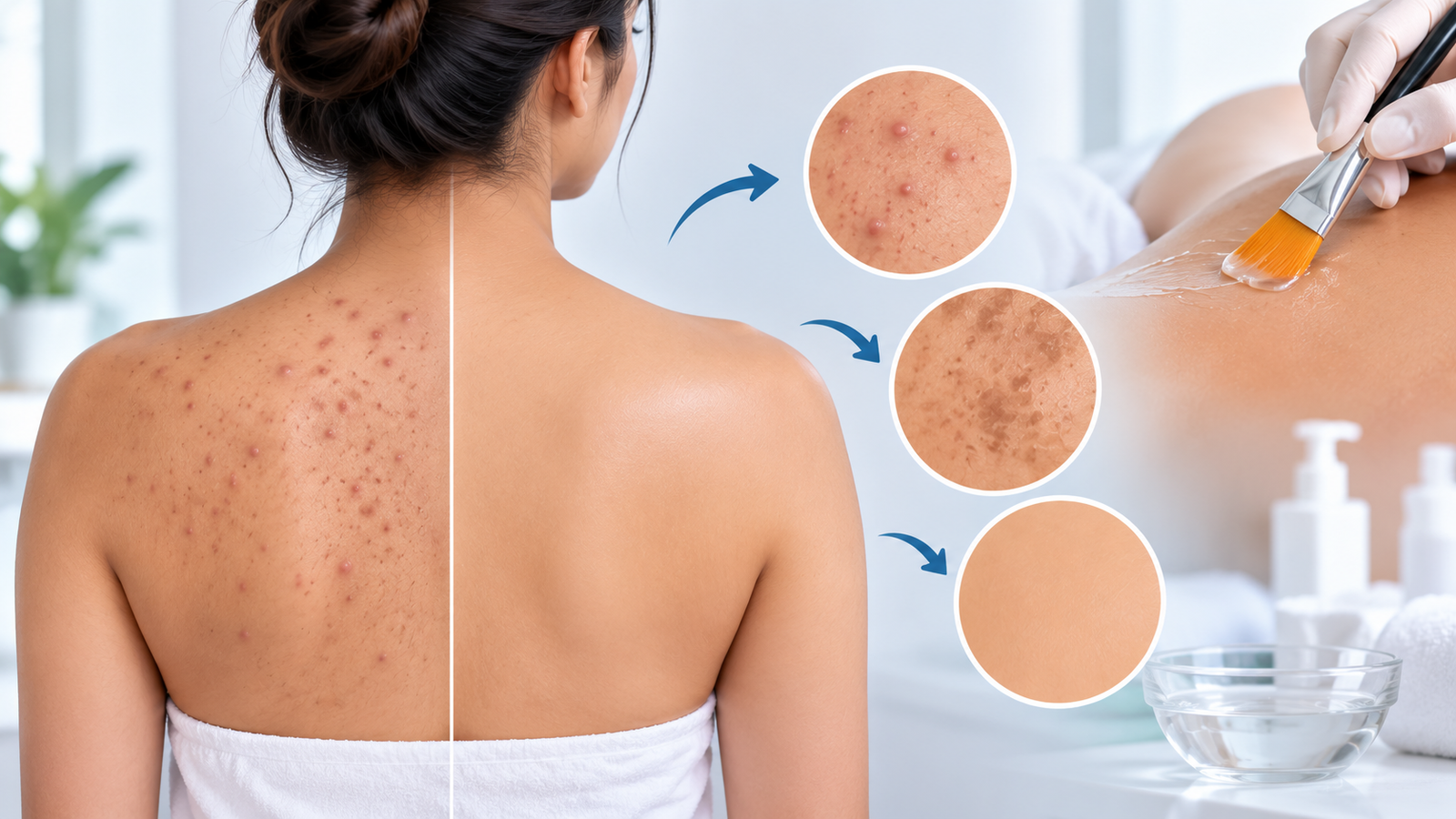
A back peel is a chemical peel applied to the back to treat acne, post-acne marks and uneven tanning. It works on the skin surface, so it helps active acne and pigmentation but cannot correct deep, pitted acne scars. Back skin is thicker than facial skin, so peels are stronger and heal more slowly.
Most people arrive at this treatment with a deadline. A wedding, a function, a holiday, a blouse or a shirt they have been avoiding. That is a perfectly good reason to come, and it makes one thing more important than everything else on this page: knowing what your problem actually is, because two of the things people call back acne do not respond to a peel at all.
This article explains what a back peel treats, what it genuinely cannot fix, and how to tell whether you are even in the right treatment.
What is a back peel, and how is it different from a face peel?
A back peel is a chemical peel applied to the upper back, and sometimes the shoulders and lower back, using the same families of acids used on the face. A solution is applied for a controlled time, removes the outer layers of skin, and the skin that replaces them is more even in colour and less congested.
Three things make it a different procedure from a facial peel rather than the same one done lower down.
- The area is several times larger. A face is a small, well-defined zone. A back is one of the largest continuous areas of skin on the body, which affects the time, the quantity of solution and the price.
- The skin is thicker and behaves differently. Covered in the next section but two.
- You cannot see it or reach it. Aftercare on a back depends on someone else, or on planning. This is not a small point and it is covered in the aftercare section.
The strength and the acid are chosen for your skin and your problem. That choice is the entire skill, and it is why a peel is a medical treatment rather than a product.
What are the three different problems being treated here?
People describe all of it as "back acne". It is usually three separate things, often together, and they respond differently.
| What you see | What it is | Does a peel help? |
|---|---|---|
| Active spots, whiteheads, blackheads, sore red bumps | Active acne. Blocked follicles with oil, dead cells and bacteria | Yes, as part of a plan. Peels help unblock and calm, but active acne usually needs medical treatment alongside |
| Flat brown or dark marks where spots used to be | Post-inflammatory pigmentation. Colour left behind after inflammation settled | Yes. This is what peels do best, and where you will see the clearest change |
| Uneven colour, darker patches where clothing exposed the skin | Tanning and uneven pigmentation from sun exposure | Yes, with sun protection afterwards. Without it, it returns |
| Small pits, craters or depressions with texture you can feel | Atrophic acne scars. Volume is missing from the deeper skin | No. See section 5. These need a different treatment entirely |
Run your hand over the area. If the surface feels smooth and the problem is only colour, a peel is a sensible option. If you can feel dips and craters, part of your problem is not something a surface treatment reaches, and you should know that before you pay for a course.
Are you sure it is acne? The condition that looks identical and does not respond
This section is the reason to read the article before booking anything.
A large share of what is called back acne is not acne. It is Malassezia folliculitis, an infection of the hair follicles caused by a yeast that lives normally on skin and overgrows in the right conditions. It typically affects exactly this area, the upper back and chest.
How to tell the difference. According to DermNet, Malassezia folliculitis appears as small, uniform, itchy papules and pustules, and critically, comedones are not seen, which is what distinguishes it from acne vulgaris.
In plain terms, three questions:
- Does it itch? Acne is usually sore rather than itchy. Persistent itch points away from acne.
- Do the bumps all look the same? Acne is untidy: different sizes, different stages, blackheads next to cysts. Malassezia folliculitis tends to be strikingly uniform, rows of similar small bumps.
- Are there any blackheads or whiteheads? If there are genuinely none, that is the single most useful clue, because comedones are an acne feature and this condition does not produce them.
Why this matters more in Surat than in a textbook. DermNet lists what makes it worse: a hot humid climate, high oil production, heavy sweating, occlusion from products applied to the skin, and antibiotic use. That is a description of a humid Gujarat summer, a gym schedule and the treatment many people have already been given for their "back acne".
Read that last one again. If you have taken antibiotics for back acne and it got worse rather than better, that is a meaningful clue rather than bad luck.
What it needs instead. Antifungal treatment, topical or oral, prescribed after the diagnosis is made. DermNet notes that it is suspected clinically and confirmed by examining a skin scraping under the microscope, which is a quick test. Recurrent cases sometimes need ongoing preventive treatment, because the yeast is a normal skin resident and the conditions that let it overgrow do not disappear.
The practical consequence. A course of peels for Malassezia folliculitis is money spent for nothing. Have the diagnosis made before you buy a course of anything. Any clinic that sells you a peel package for back bumps without examining the skin properly has skipped the step that matters most.
Why does back skin behave differently from facial skin?
Because it genuinely is different tissue, and the differences all work against you.
Published work on back acne describes differences between facial and truncal skin in pH, thickness and the distribution of oil glands, and concludes that truncal skin is more vulnerable to acne than facial skin because of sweat, oil, friction and pressure.
What that means for treatment:
- Thicker skin needs a stronger or longer application to reach the same depth. A peel strength that would be aggressive on a face may be appropriate on a back.
- Healing is slower. The back is not a high-turnover area like the face, so peeling and settling take longer.
- Friction never stops. Clothing, bag straps, gym benches, car seats and lying down all rub the area continuously. Facial skin has no equivalent.
- Sweat and occlusion are constant in this climate, under clothing, for most of the year.
Back acne is also far more common than most people assume. The same source puts the global lifetime prevalence of acne at 70 to 85 percent and notes that truncal acne affects roughly half of people who have facial acne. If you have felt like the only one avoiding backless clothes, you are not.
What does a back peel genuinely improve, and what can it not fix?
It improves colour and congestion. It cannot change shape.
What it does well:
- Flat post-acne marks, which is its strongest indication
- Uneven tanning and patchy pigmentation
- Congestion, blackheads and rough texture
- Active acne, as part of a plan that usually also includes medical treatment
- Overall evenness of tone, which is what most people actually mean when they say they want a smoother back
What it cannot do, stated plainly:
A chemical peel cannot correct pitted or depressed acne scars. Those are atrophic scars, meaning volume is missing from the deeper layer of skin, and a peel works above that layer. Removing surface cells does not refill a crater. No number of sessions changes this, and a clinic promising otherwise is describing a different procedure.
If texture is your main complaint rather than colour, the treatments that address it are different ones, covered on our acne scar management page. Many people need a combination: a peel for the marks and something else for the pits. Knowing which part of your problem is which is the reason to be examined before you commit.
Two more honest limits. A peel does not prevent new acne, so if your acne is still active you need it treated alongside or the marks will keep being replenished. And it does not change how your skin produces oil, which is why maintenance exists.
How many sessions are needed, and how far apart?
A course rather than a single treatment, spaced by weeks rather than days.
A single peel gives a modest, temporary improvement. Meaningful change in pigmentation comes from a series, because each session removes a layer and the effect accumulates. Spacing is dictated by how long the skin takes to recover, which on the back is longer than on the face.
Two practical points that matter more than the number:
- Plan backwards from your event. If there is a wedding or a function, the last session should not be in the week before it. The skin needs time to finish peeling and settle. Give yourself months rather than weeks, and tell the clinic the date at the first consultation so the course can be planned around it.
- The first session is usually the mildest. A sensible clinician starts conservatively on a new patient and increases strength once they have seen how your skin responds. If someone goes in at full strength on day one without a test, that is a warning sign rather than efficiency.
Your own number of sessions depends on which of the three problems dominates, how dark the marks are, how deep the pigment sits and how your skin responds to the first one. Anyone quoting an exact number before examining you is guessing.
What happens during a session, and what is the downtime?
The procedure itself is short. The recovery is the part to plan for.
- Preparation. The back is cleansed and degreased so the solution acts evenly. Uneven preparation is a common cause of uneven results.
- Application. The solution is applied and left for a controlled time while you are watched. You will feel warmth, tingling or stinging, which builds and then settles. Most people describe it as very manageable.
- Neutralising or removal, depending on the agent used.
- Immediate aftercare. Soothing application and instructions before you leave.
The days afterwards. Expect redness and a tight feeling for the first day or two, then flaking or peeling that begins a few days in and continues for several days. On the back this is usually slower and more prolonged than on the face.
The rule that decides your result: do not pick, peel, scrub or exfoliate the flaking skin. Let it come away on its own. Pulling skin that is not ready is the most common way people cause a mark that lasts longer than the one they came to treat. This is genuinely difficult when the skin is itching and you cannot see it, which is why the next section exists.
What aftercare actually decides the outcome?
Four things, and three of them are about the back specifically rather than about peels generally.
- Sun. Newly peeled skin pigments easily. If you are treating tanning and then expose the area, you undo the work and can end up darker than you started. Keep the back covered, and use sun protection on any part that will be exposed. This is not optional for the weeks after a session.
- Sweat and the gym. Heavy sweating on healing skin causes irritation and can cause breakouts. Most clinics advise avoiding sweaty exercise, steam, sauna and swimming pools for a period after each session. Ask for your specific timeframe and plan your training around it rather than the other way round.
- Friction. This is the one nobody warns about. Bag straps, tight sports bras, gym benches, car seats and lying on your back all rub healing skin. Wear loose cotton, avoid backpacks for a few days after a session, and change out of damp clothing immediately rather than sitting in it.
- Moisturiser and gentle washing only. No scrubs, no loofahs, no exfoliating body washes, no bleaching products, until you are told otherwise.
Two habits worth keeping permanently, whatever you decide about peels. Shower promptly after sweating rather than hours later, and wash long hair before the body so that conditioner rinsing down the back does not sit on the skin. Both reduce the conditions that cause the problem in the first place.
Who should not have a back peel, and what side effects should you expect?
Expected effects are redness, tightness, stinging during application, and flaking or peeling for several days. Temporary darkening before lightening can occur, particularly in darker skin.
Things that can go wrong, and they are mostly about the choice of peel rather than the peel itself:
- Post-inflammatory pigmentation. A peel that is too strong for the skin type inflames it, and inflammation in brown skin produces pigment. The result is darker marks than you came in with. This is the main risk in Indian skin and it is entirely a matter of depth selection and operator experience.
- Uneven result, usually from uneven preparation or application over a large area.
- Prolonged redness or irritation.
- Infection or scarring, uncommon with superficial peels but possible, particularly if the skin is picked during healing.
Tell the clinician before anything is applied if any of these apply:
- You take or recently took isotretinoin for acne. This one has real nuance. The long-standing advice was to stop it six months before any procedure because of a scarring and keloid concern. Published work indicates that concern attaches to medium and deep peels, and that superficial peels alongside oral isotretinoin appear safe, with no increase in side effects. That is not permission to go ahead. It means the information changes which peel is appropriate for you, so disclose it and let the clinician decide.
- You form keloid or thickened scars. The back and shoulders are among the commonest sites for keloids, so this matters more here than almost anywhere else on the body.
- You have active infection, eczema, psoriasis or broken skin in the area.
- You are pregnant or breastfeeding. Elective procedures generally wait.
- You tan easily or have recent sun exposure on the area. Peeling recently tanned skin raises the pigmentation risk.
- You are using any prescription skin treatment, including anything bought without a prescription.
What does a back peel cost in Surat?
These are researched market ranges and they come with an important caveat. They are not a quotation from this clinic.
| Item | Published market range, India |
|---|---|
| Superficial chemical peel, per session | Roughly Rs 1,000 to Rs 6,500 depending on the agent used |
| Chemical peels overall, per session | About Rs 1,200 to Rs 50,000 across the full range from superficial to deep |
| Gujarat reference point | Ahmedabad figures published at about Rs 2,500 to Rs 5,000 |
The caveat, and it matters. Every published figure above is quoted for a FACIAL peel. The back is several times the surface area of a face, uses considerably more solution and takes longer, so a back peel is normally priced above these ranges. Anyone quoting you a facial peel price for a full back is either quoting for a small area or has not understood the request. Ask specifically what area the price covers.
What moves your number: the area treated, whether the shoulders and lower back are included, the agent and strength, the number of sessions in a course, and whether review visits and any medical treatment for active acne are included. Ask what the quote excludes before comparing two clinics.
Back peel at Elegance Clinic, Surat
The approach here starts with establishing what the problem actually is, because as section 3 explains, a meaningful share of back bumps are not acne and will not respond to any peel.
What an assessment involves: examination of the area in good light, a judgement on whether the lesions are acne or follicular infection, an assessment of whether your concern is colour or texture, a check for keloid tendency and current medication, and a plan matched to the finding. Where the problem is texture rather than colour, you will be told that a peel is the wrong treatment for it.
Dr. Ashutosh A Shah is a Consultant Plastic, Cosmetic and Reconstructive Surgeon with M.Ch. and D.N.B. qualifications and over 22 years in practice.
Three things you will not be told here. That a peel removes pitted scars. That any result is permanent. Or a session count before your skin has been looked at.
Other non-surgical options are listed under non-surgical treatments, and current packages on our combo offers page.
Next step
Before booking a course of anything, get the diagnosis made. It is the step that decides whether the money is well spent.
- Note whether the bumps itch, and whether there are any blackheads or whiteheads at all
- Run your hand over the area and note whether you feel dips or only see colour
- Bring a list of everything you have already used, including any antibiotics taken for it
- If you have a wedding or function, bring the date, because the course is planned backwards from it
Book a back and body skin assessment at Elegance Clinic, Surat
Medical disclaimer. This article is general health information and is not a substitute for examination, diagnosis or treatment by a qualified doctor. Chemical peels are medical treatments and should be performed by a trained clinician after assessment of your skin type. Cost figures are researched market ranges for facial peels, given for orientation only, and are not a quotation. Do not use peeling products on your own skin at home on the basis of this page. Seek medical assessment if an area becomes increasingly painful, swollen, blistered or discharges after any treatment.
.png)